
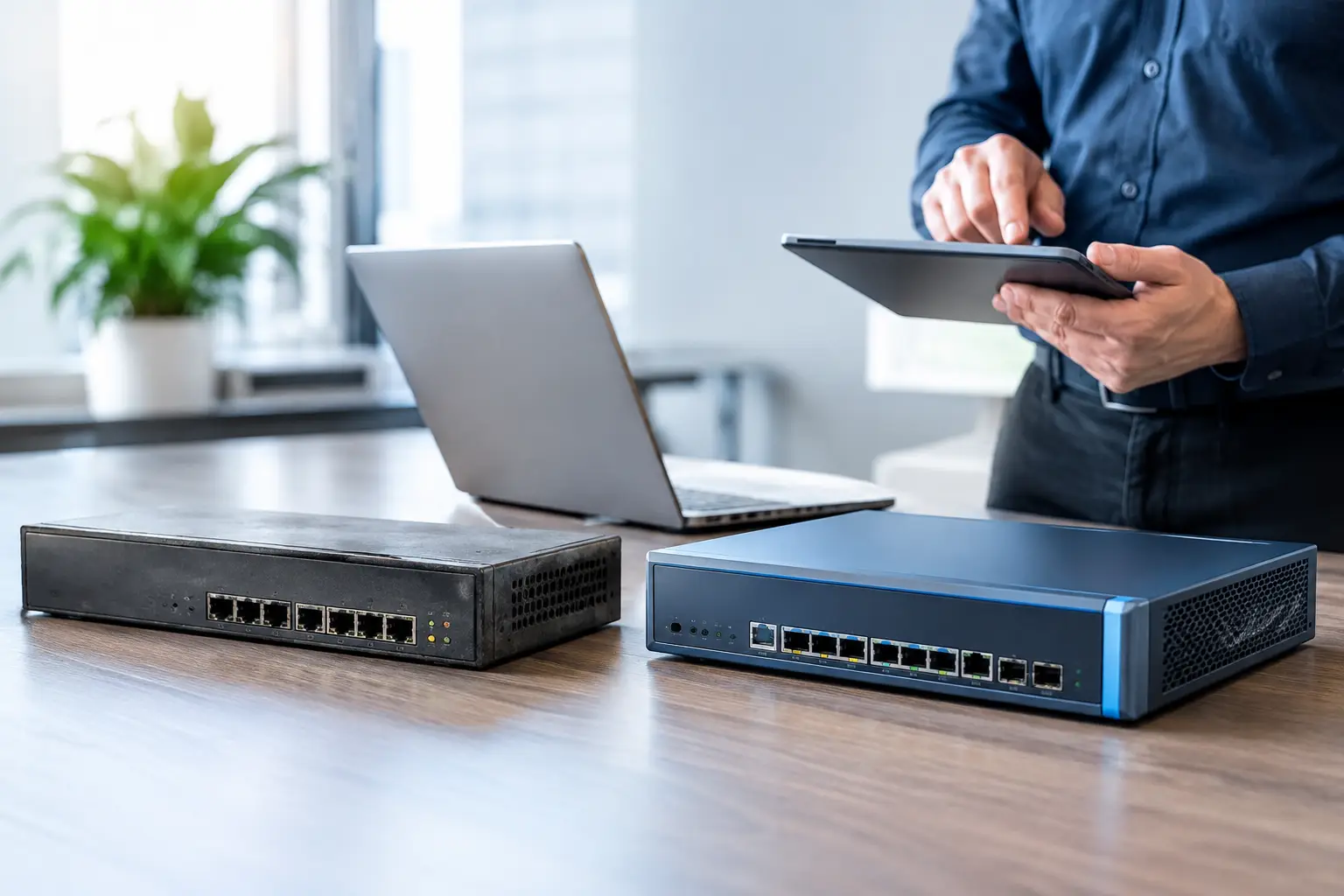
A firewall replacement is rarely just an IT refresh. It can interrupt tenant connectivity, remote access, cameras, access-control systems, building automation integrations, cloud applications, and the vendor pathways people forget exist until they fail. The device may sit in a telecom room, but the consequence of a poor change reaches every part of the operation.
The usual failure is not selecting the wrong appliance. It is treating replacement as a box swap rather than a controlled change to a live operating environment. When network diagrams are outdated, rules have no documented owner, and building systems were added outside normal IT processes, a cutover becomes a discovery exercise. That is the wrong time to discover what the firewall is actually protecting.
Firewall replacement starts with ownership
A firewall enforces decisions about who and what can communicate. Over time, those decisions accumulate: remote staff access, contractor connections, site-to-site tunnels, cloud services, guest networks, segmented building systems, application exceptions, and temporary rules that never got removed. The configuration becomes a record of operational dependencies, whether anyone intended it to or not.
Before a firewall replacement, assign one accountable owner for the change. That does not mean one person performs every task. Facilities may own the building systems, IT may own the network, security may own policy, and outside specialists may support individual platforms. But one party must have authority to reconcile requirements, approve exceptions, control the cutover, and confirm final acceptance.
Fragmented ownership produces familiar language: “That system was installed by another vendor,” “We did not know that port was required,” or “The application team never told us.” Those statements do not restore service. A replacement plan needs one standard for documentation, testing, change approval, and operational handoff.
Discover what the existing firewall really does
The current rule set is a starting point, not a complete design document. Some rules may be obsolete. Others may be too broad, poorly labeled, or attached to systems that no longer exist. Yet a rule that looks unnecessary can support a monthly financial process, a maintenance provider’s remote diagnostic session, or a controller that only calls home during an alarm condition.
Build a discovery record that connects firewall policy to business function. Identify internet circuits, public IP addresses, internal network segments, virtual private network tunnels, remote-access users, domain name services, certificates, routing dependencies, logging destinations, and alerting integrations. Record which business owner validates each dependency.
For commercial properties and connected facilities, inventory operational technology separately rather than assuming it behaves like standard office traffic. Cameras, access control, elevator monitoring, energy-management platforms, life-safety interfaces, and specialized controllers often have fixed addressing, vendor-managed connections, or older communication patterns. Some should be isolated more tightly during the replacement. Others may need carefully tested continuity because an unplanned block can create a safety, access, or tenant-service issue.
Do not copy every existing rule into the new platform without review. That is fast, but it preserves years of unmanaged risk. Do not aggressively remove every questionable rule immediately, either. That can turn a security improvement into a business interruption. The practical path is to classify rules: retain, tighten, retire after validation, or investigate. Each category needs an owner and a date.
Look beyond the firewall rule base
A firewall replacement can fail even when the rules transfer correctly. Network address translation, routing, dynamic name resolution, wireless controller paths, identity services, monitoring collectors, and cloud security controls may all depend on the existing configuration. If the firewall also provides remote access, web filtering, intrusion prevention, or network segmentation, each function needs its own validation plan.
Physical conditions matter too. Confirm power capacity, uninterruptible power supply runtime, rack space, cooling, cable labeling, diverse circuit handoffs, and out-of-band management access. A well-configured firewall cannot help if the cutover team cannot reach it after a circuit change or if the new equipment is connected to the wrong uplink.
Design the target state before the maintenance window
The replacement should produce a clearer operating model, not simply newer hardware. Define the required network zones, permitted traffic between them, remote-access conditions, administrative access controls, log retention, alert escalation, and configuration backup process. The design should show how corporate IT, tenant services, physical security, and building operations are separated while still supporting necessary workflows.
Least privilege is the goal, but it must be implemented with operational context. A facilities team may need a secure method to reach a building-management interface from a managed device. A contractor may need time-bound access to a specific system. Neither requirement justifies broad, permanent access from any network to any device.
Write these decisions in plain language alongside the technical configuration. A rule labeled only with an address and port is difficult to govern six months later. A rule tied to a named service, system owner, approval date, and review interval can be audited and maintained.
Test the firewall replacement like a continuity event
A successful configuration import is not proof of a successful cutover. Testing must reflect how people and systems use the environment. That means confirming internet access, critical applications, remote connections, site-to-site tunnels, wireless services, voice traffic where applicable, security systems, and building-system communications.
Create test cases before the maintenance window and assign a person to validate each one. Ask each validator to confirm the expected outcome from the user or system perspective, not just that a network engineer can see traffic in a log. For example, a camera platform may appear reachable while live video fails. An access-control server may respond to a ping while field panels cannot receive updates.
Testing should include failure conditions. Confirm that secondary connectivity operates as designed, that alerting reaches the right people, and that administrators can access the management interface through the approved path. If there is a secondary site, cloud environment, or managed service connection, validate the recovery behavior rather than assuming it will work because the tunnel shows as established.
Run the cutover with a real rollback decision
A maintenance window needs more than a start time and a bridge call. It needs entry criteria, a sequenced implementation plan, communication responsibilities, test checkpoints, and a defined rollback trigger. The rollback plan must be technically possible, not a sentence in a change ticket.
Keep the existing firewall configuration intact and ensure the prior device can be restored without improvisation. Confirm cable maps, interface assignments, circuit handoff details, and configuration backups before any production change begins. If the old device must remain available for rollback, plan the physical layout and power connections accordingly.
Set a clear decision point. If named critical services are not validated by an agreed time, who can authorize continued troubleshooting, and who can order restoration? Waiting for consensus while outages expand is an ownership failure. A short service interruption may be acceptable; an undefined and escalating one is not.
Communications should be equally disciplined. Stakeholders do not need a stream of technical minutiae. They need to know when the work begins, what services may be affected, when validation is complete, and who owns escalation. Building operations and security teams should have a direct contact path during the change because their systems may reveal issues that standard IT monitoring does not catch.
Final acceptance is not the end of the work
After the cutover, compare the live configuration to the approved design. Confirm that administrator access is limited, logging is arriving where it should, alerts have been tested, backups are running, and retired rules are scheduled for removal. Update network diagrams, circuit records, rack documentation, vendor access records, and the incident runbook.
Then establish a review cadence. Firewall policy changes with tenant turnover, application changes, construction projects, acquisitions, and new building systems. A replacement creates a clean governance point, but only if someone keeps it clean. Review privileged access, inactive remote accounts, temporary rules, tunnel status, software support dates, and configuration backups on a defined schedule.
The most valuable outcome of a firewall replacement is not the new device. It is a more accountable operating environment: known dependencies, tested recovery, controlled access, current documentation, and one clear standard for the systems that keep the property and business running.