
Show Notes
Move-In Day Is Only the Beginning
A successful move-in is not the same as a stable building. In this episode of Built, Wired & Secured, the conversation focuses on the operational problems that often appear after tenants arrive: flickering conference-room lights, cycling HVAC, nuisance fire-panel inputs, blank monitoring feeds, and tickets that reopen week after week.
The central point is simple: temporary decisions made during construction and commissioning can become long-term operational liabilities when teams do not require evidence that those decisions were reversed, documented, and handed over. A small issue can quickly become a tenant experience problem, a vendor-management problem, and eventually a capital-planning problem.
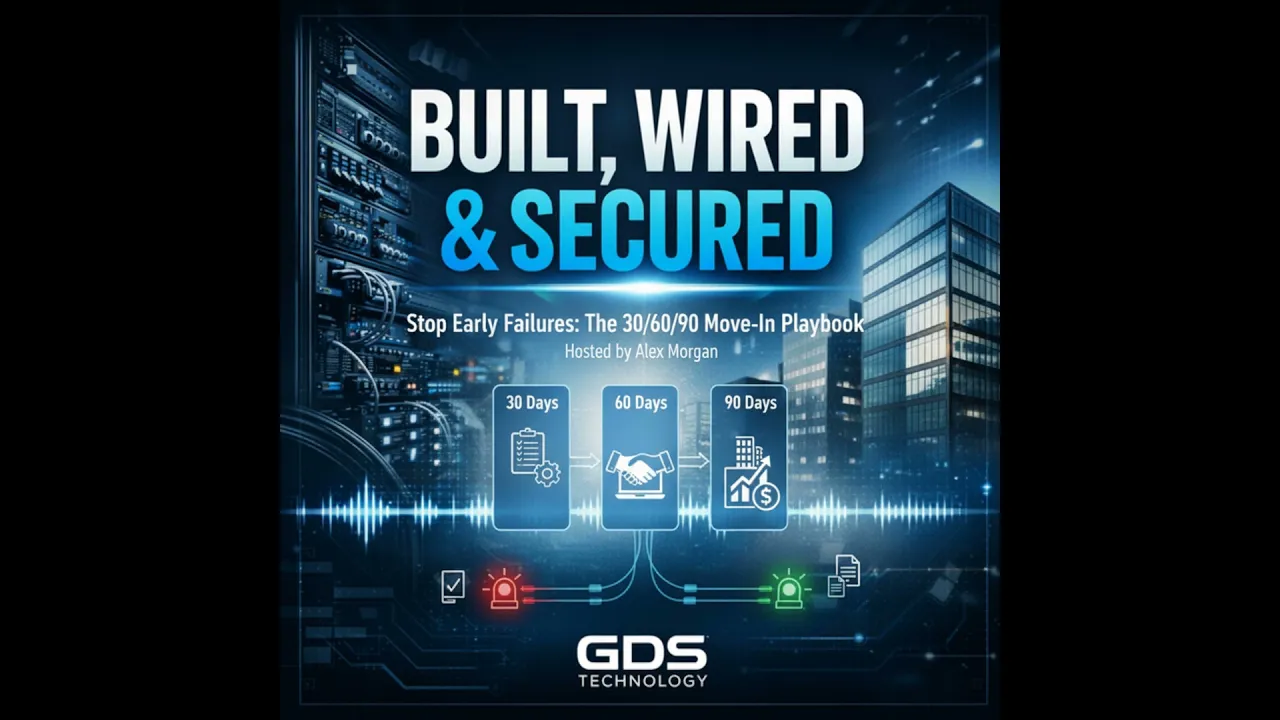
The episode presents a practical 30/60/90 stabilization playbook designed to help property and facilities teams establish ownership, document evidence, prioritize remediation, and hand systems into operations with known exceptions clearly identified.
The Early Failure Patterns to Watch
Several recurring post-handover issues can create operational blind spots and tenant frustration:
- Credential sprawl: Multiple logins, orphaned accounts, and equipment left in commissioning mode can make systems difficult to operate or support.
- Orphaned PoE devices: Access panels, PoE lighting, or other powered devices may be moved or repurposed, leaving monitoring feeds blank or creating unexpected dependencies.
- Monitoring gaps: A system may not be placed on the correct alerting channel, meaning the failure is discovered only after a tenant reports it.
- Temporary configuration left behind: Test modes, temporary VLANs, and installation shortcuts can remain in place long after handover.
The episode’s example involves PoE lighting initially routed through a vendor switch. Some ports remained in a default testing VLAN. When HVAC controls were connected later, a mistagged port created cross talk and false fire inputs. The resulting nuisance alarms took weeks to trace because the handover record did not identify devices still in test modes or document where temporary VLANs had been used.
That is why the playbook emphasizes visibility and ownership. Tenants do not care whether a problem belongs to a construction budget, an operations budget, or a vendor warranty. They expect the building to work reliably.
Day 30: Establish a Stability Baseline
The Day 30 objective is to confirm that nothing critical is failing under normal use. The evidence standard is intentionally straightforward. Teams should be able to produce three items:
- A one-page stability log
- A short vendor attestation confirming temporary configurations were removed
- A tenant walkthrough sign-off for primary spaces
If those three items are not available, the team does not have a reliable basis for confidence.
The one-page stability log should be evidence, not narrative. For each critical system, include:
- The system being reviewed
- The monitored metric
- An observation window, such as seven to 14 days
- A pass/fail result or anomaly count
- A timestamped screenshot or exported log snippet
Examples from the episode include monitoring PoE lighting power-draw variance over 14 days and tracking unexpected resets, or observing HVAC supply-temperature variance over the same window and recording zero incidents. The goal is an auditable record that can be reviewed quickly.
Day 60: Prioritize Remediation and Temporary Fixes
At Day 60, use the stability baseline to determine what needs immediate remediation, what can be temporarily mitigated, and what should become a capital project. The key deliverable is a prioritized remediation register.
Each register entry should include a short description of the issue, its impact on tenant operations, the estimated level of effort, and an assigned owner. It should also document temporary operational mitigations that allow tenants to keep working while a permanent correction is planned.
A temporary mitigation is not the same as a permanent fix. The episode offers a familiar example: if flaky sensor wiring requires a ceiling demolition to replace, the team could add a redundant sensor circuit or adjust alert thresholds to prevent false alarms while intrusive work is scheduled. The mitigation, its owner, and the acceptable period of reliance all need to be documented.
Day 90: Operational Acceptance With Evidence
By Day 90, the goal is to be able to state—using evidence—that systems are stable for business operations. The handoff package should include:
- The final stability log
- A remediation register showing completed actions and funded items that are queued
- An updated O&M manual with known exceptions clearly called out
- A short acceptance memo from the operations lead
O&M means operations and maintenance. The acceptance memo acts as the baton handoff: operations accepts responsibility for daily upkeep while longer-term fixes remain captured in capital plans.
A Relationship-Aware Remediation Ladder
The episode defines a remediation ladder as a stepwise escalation path for defects. It begins with vendor fixes and can move toward funded capital work when necessary. The purpose is not to create conflict; it is to make a factual, evidence-based request that gives vendors a clear opportunity to respond.
A concise remediation request can state the issue, cite the supporting evidence, set a timeline, and ask for a temporary plan if a permanent repair cannot be completed promptly. For example, the request can reference the Day 30 stability log, identify repeated PoE-lighting resets in a defined area, attach timestamped logs and the vendor attestation, request warranty remediation within 14 calendar days, and ask for a temporary mitigation plan and estimated owner cost if that timeline cannot be met.
The Cost of Waiting
The PoE-lighting and HVAC example illustrates why governance early in the move-in period matters. Without clear handover ownership, a remediation register, or supporting evidence, quick fixes were applied but the nuisance fire inputs recurred. Six months later, the owner had to authorize a capital rewiring project. Ticket volume remained high, and the operational cost to stabilize was roughly three times what an earlier funded correction would have cost.
Three Actions to Take This Week
- Create a one-page stability-log template and populate it with seven days of current alerts for critical systems.
- Open remediation-register entries for the two most recurring tickets, assigning owners and temporary mitigations.
- Send a remediation request for any issue that meets the evidence standard, including timestamped logs and a 14-day remediation window.
Use one question to guide priorities: What breaks if this goes down? That answer should help determine what belongs on the stability log and what needs escalation.
This episode provides governance and operational practice, not legal or contractual advice. For warranty interpretation, contract language, or legal decisions, involve procurement or counsel. Visit the Built, Wired & Secured hub for the 30/60/90 checklist, remediation-request template, and sample acceptance evidence referenced in the episode.
Why Move-In Success Can Hide Operational Risk
Move-in day often creates a false sense of completion. The tenant has arrived, the space is occupied, and the project appears finished. But the weeks after handover are when many building-technology issues reveal themselves under normal use.
Consider a familiar operational scenario: a tenant reports flickering conference-room lights, HVAC cycling repeatedly, and a nuisance input appearing on the fire alarm panel. A ticket is opened, vendors are engaged, and the tenant loses productive time. Then the ticket reopens the following week. And the week after that.
What initially looks like a small move-in snag can become a persistent drain on facilities operations. The building team is left juggling vendors, trying to calm an upset tenant, and searching for a path to fund a permanent correction. The issue is no longer just technical. It affects reliability, accountability, tenant confidence, and operating cost.
A 30/60/90 stabilization cadence helps property teams prevent those early problems from becoming long-term operational debt. It provides a practical structure for verifying stability, gathering usable evidence, prioritizing remediation, and handing systems into operations with the right context.
The Root Problem: Temporary Decisions That Outlive the Project
During construction and commissioning, temporary configurations are common. Teams need test networks, temporary vendor access, commissioning modes, and quick adjustments to keep work moving. The problem begins when those temporary choices are not removed, documented, or clearly assigned during handover.
Several patterns commonly create early post-move-in failures:
- Credential sprawl: Multiple logins and orphaned accounts leave systems difficult to manage and support.
- Commissioning settings left active: Equipment may still be operating in a test state rather than a documented production state.
- PoE devices without clear ownership: Access panels, PoE lighting, and other powered devices can be moved or repurposed, leaving monitoring gaps behind.
- Monitoring blind spots: Systems may not be connected to the right alerting channel, so a failure is not discovered until a tenant complains.
- Undocumented network changes: Temporary VLANs and port settings can create failures long after the original installation team has left.
In the episode’s example, PoE lighting was routed through a vendor switch during installation. Some ports were left in a default VLAN for testing. Later, HVAC controls were connected and a mistagged port created cross talk and false fire inputs. The nuisance alarms persisted because the initial handover did not identify which devices remained in test modes or where temporary VLANs had been used.
The lesson is not that every temporary configuration is wrong. The lesson is that temporary configurations need visible ownership and evidence that they were either reversed, retained intentionally, or recorded as a known exception.
Day 30: Build an Evidence-Based Stability Baseline
The first 30 days should focus on a single question: are critical systems stable under normal use?
The answer should not rely on verbal assurance or a general statement that everything looks fine. It should be supported by a lightweight evidence package that operations can review quickly. The minimum package includes a one-page stability log, a vendor attestation that temporary configurations were removed, and a tenant walkthrough sign-off for primary spaces.
The stability log does not need to become a lengthy report. It should contain only the information needed to assess what is happening:
- The system being observed
- The monitored metric
- The observation period, typically seven to 14 days
- A pass/fail result or anomaly count
- A timestamped screenshot or exported log snippet
For instance, a team could record PoE-lighting power-draw variance over 14 days and note two unexpected resets. It could record HVAC supply-temperature variance over 14 days and note zero incidents. These entries are concise, measurable, and auditable.
A stability log is evidence, not a narrative. That distinction matters. When an issue reappears, an evidence record allows teams to see whether it is isolated, recurring, improving, or getting worse. It also gives vendors and owners a common factual basis for deciding what happens next.
Day 60: Turn Findings Into a Prioritized Remediation Register
By Day 60, the stability baseline should be producing a clearer picture of what needs attention. Some items may require immediate vendor remediation. Others may be manageable with a temporary operational mitigation. Still others may need to enter a capital-planning process.
The tool for organizing those decisions is a prioritized remediation register. Each entry should include a brief issue description, the impact on tenant operations, an estimated level of effort, and an assigned owner. Critically, the register should include temporary mitigations so the business can continue operating while permanent work is planned.
Temporary mitigation is a controlled bridge, not an excuse to stop. If a sensor has flaky wiring and replacement requires ceiling demolition, a team might add a redundant sensor circuit or adjust alert thresholds to reduce false alarms while it schedules the intrusive work. That can protect tenant operations in the near term.
But the mitigation needs documentation: who owns it, what risk it addresses, and how long it is acceptable to rely on it. Without those details, a temporary measure can quietly become the building’s permanent operating model.
Use a Remediation Ladder That Is Factual and Relationship-Aware
Vendor escalation does not need to be adversarial. A remediation ladder creates a stepwise path for handling defects: begin with vendor correction, document the response, apply a defined temporary mitigation when needed, and move toward funded capital work if the issue cannot be resolved within the appropriate scope.
The most effective remediation requests are factual and time-boxed. They identify the observed issue, point to the supporting evidence, state the requested action, and establish a decision point if the repair cannot be completed in the requested window.
The episode gives a practical template: reference the Day 30 stability log, identify repeated resets on PoE lighting in a specific location, attach timestamped logs and the vendor attestation, request warranty remediation within 14 calendar days, and ask for a temporary mitigation plan plus estimated cost for owner approval if the vendor cannot complete the correction within that window.
This approach protects relationships because it is clear rather than accusatory. It gives the vendor a defined opportunity to remediate while ensuring the property team has a documented basis for the next decision.
Day 90: Hand Operations a Clear, Defensible Package
At Day 90, the building team should be able to state with evidence that systems are stable for business operations. That does not mean every possible improvement has been completed. It means operational responsibility is being accepted with the right documentation, known exceptions, and future work visible.
The handoff package should include:
- The final stability log
- A remediation register showing completed work and funded items that are queued
- An updated O&M manual with known exceptions identified
- A short acceptance memo from the operations lead
O&M means operations and maintenance. The acceptance memo is the handoff point between project activity and ongoing operations. It confirms that operations is taking responsibility for day-to-day upkeep while longer-term capital work remains visible and planned.
The Cost of Deferring Evidence and Ownership
The recurring PoE-lighting and HVAC issue demonstrates why this process matters. There was no clear ownership at handover. Temporary VLANs and test settings remained in place. Quick fixes were applied, but there was no remediation register or evidence trail to drive a permanent correction.
The issue continued. Six months later, the owner had to authorize a capital rewiring project. Ticket volume remained high, and the cost to stabilize operations was roughly three times what an earlier funded fix would have been.
That is the business value of a stabilization cadence. A small early investment in evidence and governance can reduce tenant disruption, shorten the path from ticket to action, and prevent minor post-handover defects from becoming expensive operational problems.
Start With These Three Actions
- Create a one-page stability-log template and populate it with seven days of current alerts for critical systems.
- Open remediation-register entries for the two most recurring tickets, assigning owners and temporary mitigations.
- Send a remediation request for any item that meets the evidence standard, including timestamped logs and a 14-day vendor-remediation window.
To prioritize, ask one question: What breaks if this goes down? Use the answer to determine what belongs on the stability log and what needs escalation.
For the one-page 30/60/90 checklist, remediation-request template, and sample acceptance evidence discussed in this episode, listen to Built, Wired & Secured and visit the show’s hub to download the bundle. This is operational governance guidance, not contractual or legal advice; involve procurement or counsel when warranty interpretation, contract language, or legal decisions are required.