
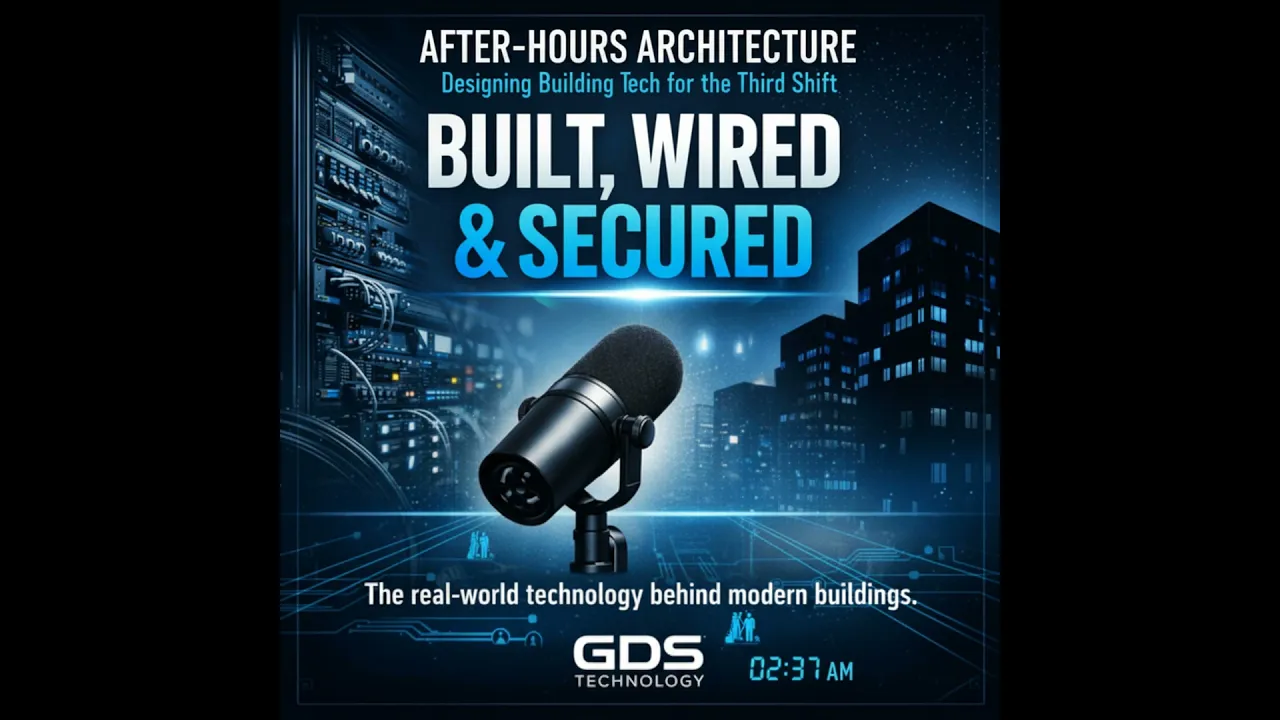
Show Notes
Why the Third Shift Exposes Weak Design Choices
This episode of Built, Wired & Secured looks at a part of building operations that is easy to underestimate: the third shift. The conversation opens with a realistic overnight failure scenario. A cleaning crew is finishing work, lights go out on two elevators, the access control system reboots, badges stop working, and a vendor does not answer until morning. What should have been a routine maintenance transfer becomes an expensive and reputation-damaging event.
The central point is simple: many environments are designed for weekday visibility, not off-hours resilience. During the day, more people are present, more dashboards are being watched, and issues are noticed faster. At night, weekends, and holidays, smaller teams, reduced monitoring, scheduled automation, and slower vendor response all converge. That is when hidden dependencies show up.
- Fewer people are available to spot early warning signs
- Automation often runs when staffing is lowest
- Night and weekend support paths are usually weaker than daytime support
- Single points of failure are more likely to trigger cascading operational problems
The Five Failure Modes That Appear After Hours
The episode identifies five recurring causes of off-hours disruption, each with direct implications for facilities, property operations, and tenant experience.
- Transfer timing and power sequencing: Generator transfers, UPS behavior, and transfer switches can fail to hand off cleanly. When that happens, controllers may reboot in the wrong order and leave doors, elevators, or other systems in unstable states.
- Scheduled jobs: Backups, firmware updates, and nightly reboots are often scheduled during low-occupancy windows. That makes sense until one of those jobs fails or collides with another system event.
- Reduced monitoring and alert fatigue: Teams frequently mute lower-priority alarms overnight. That can prevent nuisance alerts, but it also increases the chance that important warning signals are missed.
- Vendor responsiveness: Support at night is rarely the same as support during business hours. Escalation paths are less clear and response times are often slower.
- Human factors: Cleaning crews, late-night contractors, and temporary workers may not be fully reflected on access rosters. When a door fails or a process breaks, improvisation creates safety and liability risk.
The key insight is that these issues do not stay isolated. A modest technical fault can quickly become a building-wide operational problem when staffing is thin and response paths are unclear.
How Small Failures Turn Into Large Operational Events
One example in the episode shows how a routine generator test can create a chain reaction. A building control system reboots after midnight. The access control server tries to reconnect to a cloud service. A network firewall blocks the re-registration because a scheduled firmware check caused a temporary route change. Doors default to fail secure and lock down. A cleaning crew gets trapped behind a badge-protected path, security gets involved, on-call facilities staff are pulled in, and the vendor cannot respond until the next morning.
That is the real cost of poor off-hours design. The impact is not limited to one reboot or one blocked device. It becomes lost access, emergency escalations, tenant disruption, staff frustration, and reputational damage.
Automation Helps, but Only When Fallbacks Are Real
The discussion does not argue against automation. Instead, it makes the case that automation must be treated like a contract, not a convenience. In other words, every automated action should be matched with a clear understanding of what happens if it fails.
Several practical principles stand out:
- Define which failure modes are acceptable and which are not
- Do not accept overnight savings if they put critical tenant operations at risk
- Create manual overrides that are simple, documented, and tested by real people
- Match monitoring depth to actual business risk
- Write night and weekend response expectations into vendor SLAs
- Practice maintenance windows with realistic staffing conditions
A strong example is overnight HVAC reduction. Saving money is fine, but not if the same schedule undermines humidity control for sensitive tenant equipment. The right decision is not always the cheapest or fastest one. Sometimes the slower, slightly more expensive path avoids repeated emergency callouts and preserves tenant confidence.
Two Low-Cost Fixes With High Value
The episode also shares two concrete examples where modest changes improved resilience without major capital spending.
In the first case, elevator controls and access systems in a multi-tenant office building were placed on the same UPS cluster. During an after-hours load test, the UPS dropped out of rotation and the access controller rebooted into maintenance mode. Tenants could not badge back in from the stairwells. The fix was to separate critical controllers onto a smaller dedicated UPS and change default door behavior so people could exit while ingress remained restricted during power anomalies. The result was a far safer and more resilient outcome with limited cost.
In the second case, nightly firmware pushes from a central management platform collided with HVAC night-mode transitions across a portfolio. The result was nuisance alarms and false escalations. The solution was governance rather than replacement: a scheduling matrix deferred firmware pushes for systems with active night modes, and a simple one-page escalation flow was published for on-call staff. That policy change reduced overnight vendor callouts by more than 60 percent in six months.
A Practical Third-Shift Checklist
For listeners who want immediate progress, the episode closes with a concise five-step checklist that can be tackled this quarter.
- Map the third-shift critical path and document overnight system dependencies
- Validate power sequencing with a supervised transfer test
- Audit scheduled jobs, backups, and firmware pushes, then move high-impact tasks to safer windows
- Set clear off-hours vendor escalation tiers with response targets and named contacts
- Run a realistic night drill using the people who are actually on call remotely
An additional recommendation is to publish a one-page emergency cheat sheet for night staff covering egress, temporary bypass procedures, and who to call. That kind of simple documentation can sharply reduce confusion during a live event.
Final Takeaway
The strongest line in the episode may be the simplest: do not confuse efficiency with resilience. A lean overnight schedule may save a small percentage on utilities or staffing, but if it fails at 2:00 a.m., the cost is measured in recovery time, tenant trust, and operational disruption.
The broader lesson for facilities and IT leaders is to ask one question earlier in the process: what breaks if this goes down? That mindset changes specifications, handoff decisions, support contracts, and day-to-day operations. It also helps teams build environments that perform not just when the building is busy, but when it is quiet and least supported.
Why Buildings Need to Be Designed for the Third Shift
Most building technology decisions are made with daytime operations in mind. Teams think about weekday occupancy, front-desk activity, visible comfort issues, and the systems people interact with when a full operational staff is present. But this episode of Built, Wired & Secured argues that the real test of a building is not noon on a Tuesday. It is 1:00 a.m., a holiday weekend, or a maintenance window when automation is running, staffing is lean, and nobody is standing nearby to catch a small problem before it grows.
The episode centers on what the conversation calls the third shift: the nights, weekends, and off-hours when cleaning crews, scheduled jobs, reduced monitoring, and slower vendor response expose the decisions made long before a building is handed off. A building may look efficient on paper and perform well during normal business hours, yet still be far too brittle when operations are quiet. That gap is where expensive outages, tenant frustration, and unnecessary emergency escalations begin.
Off-Hours Problems Are Usually Design Problems in Disguise
The cold open frames the issue clearly. A cleaning crew is finishing work when lights go out on two elevators and the access control system reboots. Badges stop working. A vendor does not answer until morning. The root cause is not dramatic sabotage or a catastrophic event. It is a maintenance transfer that switched incorrectly, combined with a scheduled network job and a single control point that went quiet.
That is the episode's broader point: off-hours incidents are often the result of ordinary systems interacting in the wrong sequence. Daytime conditions can hide those weaknesses because more people are available to notice trouble and intervene quickly. Overnight, the same environment is much less forgiving. There are fewer eyes on dashboards, fewer people available to troubleshoot locally, and fewer support options when something breaks.
For commercial real estate teams, that distinction matters. A building is not resilient just because each individual component is functional. It is resilient when those components continue to behave predictably during low-staff, low-visibility periods when operational tolerance is smallest.
The Five Failure Modes That Deserve Attention
The conversation lays out five recurring failure modes that show up after hours.
The first is transfer timing and power sequencing. Generators, UPS systems, and transfer switches can all work properly in isolation and still create operational issues when they hand off in the wrong order. If building controllers drop or restart in the wrong sequence, doors, elevators, and access systems may land in unstable states.
The second is scheduled jobs. Backups, firmware updates, and nightly reboots are commonly pushed into overnight windows because disruption appears lower there. But those windows also have the fewest people available to detect or manage failure. What looks convenient from a scheduling standpoint can be risky from an operational one.
The third is reduced monitoring and alert fatigue. Overnight teams often suppress lower-priority notifications to avoid constant noise. That is understandable, but it increases the odds that meaningful warning signs get ignored or delayed.
The fourth is vendor responsiveness. One of the most practical insights in the episode is that support contracts do not behave the same way at night as they do during the day. Escalation routes are often less direct, response commitments are weaker, and the person who answers may not be empowered to solve the issue.
The fifth is human factors. Cleaning crews, late-night contractors, and temporary workers are part of the real operating environment. If they are not accurately reflected in access plans or emergency workflows, a routine technical issue can quickly turn into a safety or liability problem.
Why Cascading Failures Get Expensive Fast
The episode offers a realistic example of cascading failure. A generator test causes a building control system to reboot. The access control server then attempts to reconnect to a cloud service. A network firewall blocks that re-registration because of a scheduled firmware check that causes a temporary route change. Doors default to fail secure, which is correct from one perspective but problematic in context. A cleaning crew cannot move freely, security is pulled in, facilities staff are escalated, and the vendor cannot respond until the next morning.
This sequence matters because it shows how technical design and human response are inseparable. The financial cost does not come from the initial reboot alone. It comes from the chain reaction: blocked movement, alarm activity, emergency calls, service delays, tenant notifications, and the reputational damage that follows a visibly preventable event.
In a multi-tenant environment, those downstream effects can be even more significant. Tenants do not judge a building by whether an outage was caused by a firewall rule, UPS event, or transfer switch timing issue. They judge it by whether they could access their space, whether operations were interrupted, and whether building management seemed prepared.
Automation Should Be Treated Like a Contract
One of the strongest ideas in the episode is that automation should be treated like a contract, not a convenience. That means teams should not simply ask whether an automated sequence saves time or reduces cost. They should ask what failure modes that sequence creates, what dependencies it introduces, and whether the fallback path is simple enough for real people to use under pressure.
The episode gives a useful example with overnight HVAC setbacks. Lowering energy use during off-hours may be a sensible cost-control move. But if that same schedule interferes with humidity control for sensitive tenant equipment, the building has made a poor trade. Efficiency cannot be the only design goal. Business continuity and operational recovery have to be considered alongside utility savings and labor reduction.
The same principle applies to access control, monitoring, firmware scheduling, and centralized management platforms. Automation is valuable, but only when visibility and manual recovery paths are designed with equal seriousness.
Two Practical Examples of Low-Cost Improvement
The discussion includes two examples that are especially useful because neither required a major capital project.
In one multi-tenant office building, elevator controls and access systems were on the same UPS cluster. During an after-hours load test, the UPS dropped out of rotation and the access controller rebooted in maintenance mode. Tenants could not badge back in from stairwells. The solution was to separate critical controllers onto a smaller dedicated UPS and adjust default door behavior to support egress while keeping ingress restricted during power anomalies. The change was targeted, affordable, and highly effective.
In another case, nightly firmware pushes from a central management platform were colliding with HVAC night-mode transitions across a portfolio. That created nuisance alarms and false escalations. Rather than replacing systems, the team implemented governance: a scheduling matrix to defer firmware pushes during active night modes, plus a one-page escalation flow for on-call staff. The result was a reduction of more than 60 percent in overnight vendor callouts within six months.
Both examples reinforce the same lesson. Resilience is not always about buying more technology. Often it comes from separating dependencies, sequencing actions correctly, and making escalation rules clear before an issue occurs.
A Smart Checklist for This Quarter
For facilities leaders, property managers, and IT stakeholders, the most useful part of the episode may be the practical checklist at the end.
Start by mapping the third-shift critical path. Identify which systems truly must remain functional overnight and document their dependencies. Then validate power sequencing with a supervised transfer test so you can see restart order in the real world, not just in theory.
Next, audit scheduled jobs, backups, and firmware pushes. If high-impact tasks are running when support coverage is weakest, move them. After that, define off-hours vendor escalation tiers with explicit response targets and named contacts rather than assuming daytime support expectations will carry over.
Finally, run a realistic night drill with the people who are actually on call remotely. Do not limit the exercise to engineering staff under ideal conditions. Use the real escalation path and observe what happens.
A one-page emergency actions cheat sheet for night staff is a valuable add-on. Clear instructions for egress, temporary bypass procedures, and emergency contacts can reduce confusion dramatically during a live event.
Resilience Protects Tenant Trust
The closing message of the episode is worth carrying into every future spec, handoff, and support agreement: do not confuse efficiency with resilience. A lean schedule, an aggressive night mode, or a consolidated control point may save money in the short term, but if those decisions fail at 2:00 a.m., the cost shows up in recovery time, emergency callouts, and tenant confidence.
For commercial real estate and building technology leaders, the better question is not just whether a system works. It is what breaks if it goes down after hours, who can recover it, and how quickly normal operations can be restored.
If you want a sharper framework for reviewing off-hours risk in building systems, this episode is a practical listen. It connects technical design choices to operational outcomes and offers realistic steps teams can take now without overengineering the environment.