
Show Notes
When Power Is Present but Operations Are Down
A building can have lights on after an outage and still be functionally offline. This episode examines the operational gap between restoring electrical power and restoring the systems tenants depend on: access control, elevator controls, HVAC controllers, point-of-sale systems, and network edge equipment.
The central risk is not always a total power loss. A generator may start and an automatic transfer switch may move the building to backup power, yet sensitive controllers can reboot into fault states, lose communication, or require manual intervention. The result is stalled tenant operations even though the building appears energized.
Why Power Quality Matters
Power quality problems often develop quietly. Modern buildings contain many nonlinear loads, including LED lighting drivers, variable frequency drives, and server power supplies. These loads can distort the electrical waveform and create harmonics that place stress on neutral conductors and UPS components even when voltage readings appear normal.
- Harmonics can overload neutrals and heat components.
- Unbalanced nonlinear loads can create neutral distortion.
- Facilities teams may see hot breakers, unusual phase-to-phase voltage behavior, or intermittent protective-device trips.
- Sensitive power supplies may reset during transients or experience firmware corruption.
These failures are especially difficult to diagnose because they are not always dramatic. Instead of a clear blackout, teams encounter intermittent controller faults, unreliable communications, and devices that work normally until the next transfer event.
UPS Sizing Is More Than Runtime
A UPS may be sized for expected steady-state load and still fail under real operating conditions. Inrush currents and harmonic heating can cause a UPS to trip when the connected equipment starts, transfers, or responds to a disturbance. That makes load behavior—not simply nameplate runtime—a critical part of resiliency planning.
For sensitive equipment, point-of-load UPS units can be a practical protection layer. A small UPS located at a rack or directly supporting a critical controller localizes risk and can better accommodate the conditions experienced by that equipment. The trade-off is higher capital expense and a larger maintenance footprint.
Transfer Timing Can Create the Failure
Automatic transfer switches are essential during an outage, but their timing and settings can determine whether downstream systems ride through an event cleanly. The episode contrasts soft and hard transfer approaches:
- Soft transfer: The generator and utility are synchronized before switching, reducing voltage and frequency changes.
- Hard transfer: The utility connection is broken before the generator is connected. This simpler approach can introduce voltage sags or phase-angle jumps that sensitive equipment interprets as faults.
Soft transfer and synchronous controls can reduce transients, but they add cost and controls complexity. Hard transfers can be less expensive and simpler, but may raise the likelihood of nuisance trips for sensitive systems. The practical recommendation is a mixed strategy: use softer transfer approaches where life-safety and tenant-critical systems require them, provide tested local UPS protection for edge devices, and define exactly who owns transfer sequences in maintenance plans.
Centralized vs. Distributed Resiliency
Central UPS plants can improve efficiency and simplify maintenance by consolidating equipment. However, they can also create single points of failure and more complicated transfer behavior when generators are involved. Distributed point-of-load UPS units require more dispersed maintenance, but they isolate failures and can protect equipment with particularly sensitive power supplies.
The right approach begins with prioritization. Identify the systems that must remain operational during a transfer, then protect those systems with dedicated, tested solutions. Not every load has the same business impact, and resiliency investments should reflect that reality.
Operational Practices That Reduce Surprise Downtime
- Monitor waveform quality, harmonic content, and UPS input/output anomalies—not just whether power is present.
- Schedule transfer rehearsals and observe every tenant-critical system during the event.
- Capture UPS and ATS controller logs before and after transfer testing.
- Require transfer-sequence documentation at handover, including vendor and facilities responsibilities.
- Maintain a prioritized list of point-of-failure systems and protect the most tenant-impacting equipment with local UPS units or isolation transformers.
Simple Handover Tests
Teams do not need specialized lab equipment to begin validating transfer behavior. Start with a staged transfer test during a low-risk window. Observe access control, elevators, critical HVAC, and IT edge devices while the ATS changes source. Confirm that controllers reboot cleanly, return to central management, and do not remain in fault states.
Use inexpensive power-quality loggers for a week during normal building operation to identify harmonics and voltage sags. At least annually, conduct a cold transfer test to understand how systems respond to a non-synchronized event. A successful test is not just a completed transfer; it includes post-transfer validation of the systems that keep the building operational.
A 30- to 90-Day Road Map
- First 30 days: Obtain ATS and UPS transfer logs, review them, and clarify transfer-sequencing ownership in the maintenance agreement.
- Days 30-60: Schedule a staged transfer rehearsal with observers for tenant-critical systems and collect post-transfer logs.
- Days 60-90: Deploy temporary power-quality monitoring in known trouble areas, then prioritize point-of-load protection for the three systems with the greatest tenant impact.
Document every finding and incorporate it into capital planning. For changes to electrical systems, involve licensed electrical professionals and treat transfer rehearsals as recurring operational exercises—not one-time commissioning tasks.
Clean Power Is an Operational Requirement, Not Just an Electrical One
When a utility outage occurs, the immediate question is usually whether the generator started. That is important, but it is not the whole operational story. A building can regain electrical power quickly and still lose the systems that make it usable: access control, elevator controls, critical HVAC controllers, point-of-sale platforms, and network edge equipment.
That distinction matters to owners, facilities teams, and IT teams because tenants experience business interruption, not electrical theory. If badges no longer open doors, elevators move to restricted mode, HVAC controllers stop responding, or network gear fails to return to service, the building is operationally impaired even if lights are on.
Power resilience must therefore be measured by what happens to critical systems before, during, and after a transfer—not solely by whether backup power becomes available.
The Hidden Problem: Power Quality
Many of the most disruptive power events are not complete blackouts. They are power-quality events: voltage sags, waveform distortion, phase-angle changes, harmonic effects, and brief transfer-related disturbances that sensitive equipment may interpret as a fault.
Modern buildings contain a growing number of nonlinear loads. LED lighting drivers, variable frequency drives, and server power supplies are common examples. These loads can distort the electrical waveform, creating harmonics that affect neutral conductors, UPS equipment, and other electrical components even when standard voltage readings look acceptable.
That is why “power is present” is not an adequate operating metric. A system can be energized while still receiving power conditions that cause resets, intermittent faults, protective-device trips, or unstable controller behavior.
In day-to-day operations, the symptoms can be subtle:
- Breakers that run unusually hot.
- Unexpected or intermittent trips of protective devices.
- Odd voltage behavior between phases.
- Controllers that reset after a transfer but do not reconnect to central management.
- Sensitive electronics that enter fault states or experience firmware corruption during transients.
These are difficult events to troubleshoot because they may occur only during specific loading conditions or during an outage transfer. A team may spend days chasing what appears to be a controller, network, or software issue when the initiating condition was a brief electrical disturbance.
Why UPS Runtime Alone Does Not Equal Protection
UPS planning is often framed around runtime: how long will a device remain powered if utility service is unavailable? Runtime matters, but it is only one part of the equation.
A UPS sized for steady-state load may not respond well to inrush currents or harmonic heating under real-world conditions. During a transfer, connected equipment may behave differently than it does during normal utility operation. If the UPS trips at the moment a critical controller, rack, or edge device needs it most, the intended resiliency design has not achieved its business purpose.
This is one reason point-of-load UPS units can be useful for sensitive electronics. Rather than placing all protection in a centralized plant, a small UPS at a critical rack or device can localize the risk and provide a dedicated protection layer. Point-of-load approaches can also handle the characteristics of sensitive electronics more effectively in some cases.
There are trade-offs. Central UPS plants can be efficient and easier to maintain from one location, but they may become single points of failure and can introduce complex interactions with generator transfers. Distributed UPS units can increase capital cost and create dispersed maintenance responsibilities. The practical decision is not to choose one model by default. It is to identify the systems that must remain available and match their protection to their operational importance.
Transfer Dynamics Are a Design and Operations Issue
The automatic transfer switch is the component that moves a building from utility to generator power. Its settings, sequence, and timing can have a direct impact on sensitive equipment.
A soft transfer attempts to synchronize the generator and utility before switching. This can reduce transient voltage and frequency changes. A hard transfer breaks the utility connection first and then connects the generator. Hard transfers are simpler and may cost less, but they can create voltage sags or phase-angle jumps that sensitive controllers interpret as faults.
Neither approach should be selected in isolation. The right approach depends on the systems served, their tolerance for disturbances, and the building’s operating priorities. Life-safety and tenant-critical systems may justify the added cost and controls complexity associated with softer transfer approaches. Sensitive network edge gear and controllers may benefit from point-of-load UPS protection. Other loads may be able to tolerate a simpler transfer arrangement.
The important requirement is ownership. Teams need a documented transfer sequence, a clear understanding of ATS settings, and an accountable party responsible for maintaining that sequence over time. Without that documentation, an operationally significant setting can become an invisible dependency that no one actively manages.
Make Transfer Testing a Rehearsal, Not a Checkbox
Generator and transfer testing is often treated as a compliance or maintenance event. A more useful approach is to treat it as an operational rehearsal.
During a staged transfer test, schedule a low-risk window and identify observers for access control, elevators, critical HVAC, and IT edge systems. Switch the ATS and watch the systems that matter to tenants. Then validate them after the transfer.
Questions to answer include:
- Did access controllers return to normal operation?
- Did elevator controllers leave restricted mode correctly?
- Did critical HVAC controllers reboot and resume communication?
- Did network edge devices return to central management?
- Did UPS and ATS controllers report anomalies in their logs?
A transfer that completes electrically is not necessarily a successful operational transfer. The real test is whether critical systems reboot cleanly, report in correctly, and remain usable without manual recovery.
Facilities and IT teams should also use inexpensive power-quality loggers for a week during normal operating conditions. This provides a practical way to identify harmonics and voltage sags that may not be evident during a single scheduled test. At least annually, conduct a cold transfer test to see how the building behaves under a non-synchronized event.
A Practical 90-Day Power Resilience Plan
Building teams can improve their position without beginning with a major capital project.
In the first 30 days, request ATS and UPS transfer logs from the contractor and review who owns transfer sequencing under the maintenance agreement. This establishes visibility and accountability.
From days 30 to 60, schedule a staged transfer rehearsal with observers assigned to tenant-critical systems. Capture post-transfer logs and document every device that fails to return cleanly.
From days 60 to 90, deploy temporary power-quality monitoring in known trouble areas. Use the findings to prioritize point-of-load protection for the three systems with the greatest tenant impact. Document the results and make them part of capital planning.
This approach turns power strategy into measurable uptime. It focuses investment and attention where operational consequences are greatest rather than relying on assumptions created during initial installation.
Build for Measurable Uptime
Power resilience is not simply about adding generators, UPS capacity, or redundant equipment. It is about understanding how systems behave together under real transfer conditions. Harmonics, UPS sizing, neutral distortion, ATS timing, and controller behavior all affect whether a building remains functional when the utility feed is interrupted.
The most effective teams monitor meaningful signals, rehearse transfers, document ownership, and protect critical edge systems with tested solutions. They also involve licensed electrical professionals when changes are required and treat testing as an ongoing operational discipline.
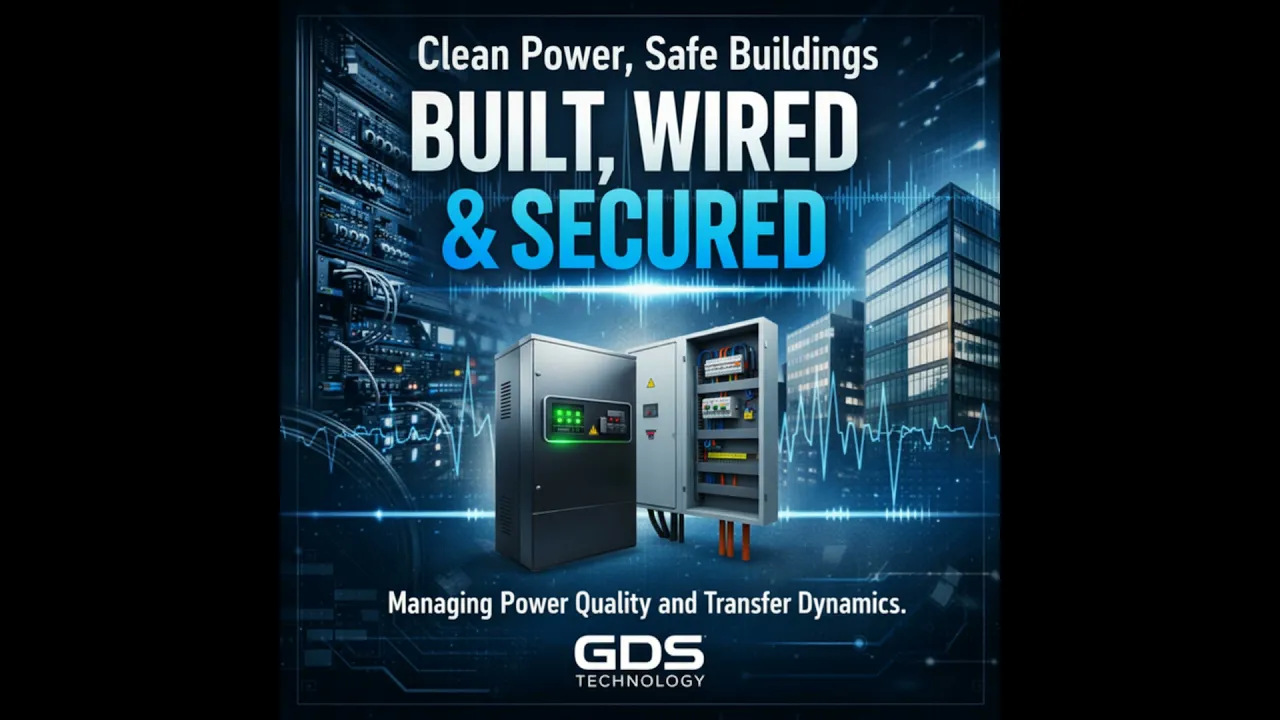
For a practical discussion of transfer testing, monitoring, and protection priorities, listen to this episode of Built, Wired & Secured. It offers a clear framework for moving from backup-power assumptions to a power strategy that supports real tenant operations.