
Show Notes
Why the Last Meter Causes Big Problems
This episode of Built, Wired & Secured focuses on one of the most overlooked failure points in commercial real estate technology: the handoff between a carrier and the building. The conversation opens with a familiar operational nightmare. A building loses connectivity at lunchtime. Point of sale terminals stop working, badge readers fail, and front desk operations slow down while tenants feel the impact immediately. The carrier says the circuit is good to its demark. The building team thinks the carrier still owns the issue. In the middle sits a preventable outage made worse by confusion.
The core message is simple: speed during an outage matters, but clarity matters first. If ownership, labeling, and test procedures are fuzzy, teams can move quickly in the wrong direction. That turns a technical issue into a coordination issue. The last meter becomes the place where downtime stretches out, costs climb, and accountability disappears.
Common Failure Modes at the Demark
The discussion breaks down the routine ways handoffs fail in the real world. These are not exotic edge cases. They are the operational basics that get missed during procurement, turnover, and ongoing maintenance.
- Ambiguous ownership that leaves technicians unclear on who is allowed to touch what
- Poor labeling across panels, ports, and patch cords
- Missing spare patch cords that turn a small fix into a long service interruption
- Single points of failure created to save money upfront
- No alternate power for the demark or related edge equipment
One of the most practical observations in the episode is that even perfect fiber does not help much if the right panel cannot be found or nobody has the spare cord needed to restore service. In those moments, recovery stalls not because the infrastructure is impossible to fix, but because the handoff was never made operationally usable.
Where Ownership Should Begin and End
The panelists spend time defining what a clean boundary should look like. The baseline position is straightforward: the carrier should own the service up to a clearly marked physical demark point such as a splice, handoff box, or patchfield. From that point inward, the building should own the infrastructure.
That sounds simple, but the episode also surfaces an important nuance. Building owners may need control over a small set of local elements, such as the first patch into the building panel or the UPS feeding edge devices. The reason is practical, not philosophical. During an incident, local control can allow the building team to perform a workaround or fast recovery step without waiting for a carrier process that may be slower or more restrictive.
The takeaway is not that every owner should push responsibility back on the carrier. It is that the exact boundary must be written down with enough specificity to remove interpretation later. If the physical handoff, associated wiring, and power responsibilities are not defined in writing, service-level commitments become fuzzy right when teams need them most.
What a Joint Acceptance Test Should Include
A major theme in the episode is that documented agreements are necessary but not sufficient. Teams also need shared testing at turnover so nobody can later say, “it worked on our end.” The conversation outlines a joint acceptance process built around measurable proof.
- Run an OTDR trace to establish a continuity and loss baseline up to the demark
- Perform an end-to-end functional test such as a loopback or authenticated ping
- Physically verify labels and sign off on the demark diagram
- Record who fixed what if a test fails and update the handoff document immediately
- Confirm whether the demark or feeding equipment is on backed-up power
- Require two matching spare patch cords on site
- Provide a labeled test port at the demark
- Include named contacts, roles, and escalation steps
- Tie pass/fail thresholds to documented measurements and technician signoff
This is one of the most useful parts of the episode because it translates a broad reliability discussion into a practical acceptance packet. Instead of relying on assumptions, owners and operators can insist on trace results, functional testing, labeling standards, spare inventory, and an escalation path that is already agreed before a problem happens.
Real Examples of Faster Recovery
The episode backs up its advice with examples that show how small disciplines produce large operational gains. In one campus environment, the team had lived with a single fiber entry and mostly verbal handoffs. After a project, they created a one-page demark diagram, stocked two labeled spare patch cords, and ran joint OTDR and ping tests. Later, when an outside contractor cut the wrong sheath, the carrier could prove service to its splice point and the building team could immediately use a spare patch. The result was service restoration in under an hour.
Another example came from a medical office where badge readers and nurse phones went dark. The carrier said the circuit was fine. The building team discovered an unlabeled patch had been rolled back during a vendor visit. Because they had a recent acceptance form and spares on hand, they were able to repatch quickly. The outage was measured in minutes instead of hours.
These examples reinforce a central point from the episode: the best outage response often starts before the outage, during design, documentation, acceptance, and maintenance.
The Checklist to Put in Contracts and Closeout Packages
For listeners who want an actionable framework, the episode offers a concise checklist that belongs in both contract language and project closeout materials.
- One-page demark diagram and ownership table
- Physical labeling standard with photos
- Two on-site spare patch cords
- A labeled test port
- Recorded OTDR trace and functional test results
- Documented contact list and 24/7 escalation steps
- Pass/fail thresholds for acceptance
- Technician signoff and recorded test times
- Confirmation of power for demark equipment
- Contract language assigning maintenance responsibility for labeling and spares after turnover
The panelists also emphasize two actions building teams can take right away: create or find the one-page demark diagram, and schedule a joint acceptance test within 30 days if there has been a major change since the last one. Those are low-cost moves that reduce confusion before the next incident.
Why This Matters to Operations and Tenants
The episode consistently ties technical decisions back to operational outcomes. Tenants feel outages first. Payments stop. Phones fail. Access systems become unreliable. Front desk teams take the pressure while vendors debate ownership. That is why the last meter is not just a cabling issue or carrier issue. It is an operations issue.
The closing message is practical and memorable: do the tests, keep the spares, and make ownership visible. When the last meter is clear, documented, and testable, outages get shorter and coordination gets easier. In the best-run buildings, the handoff becomes invisible in the right way because it works exactly as everyone expects when it matters most.
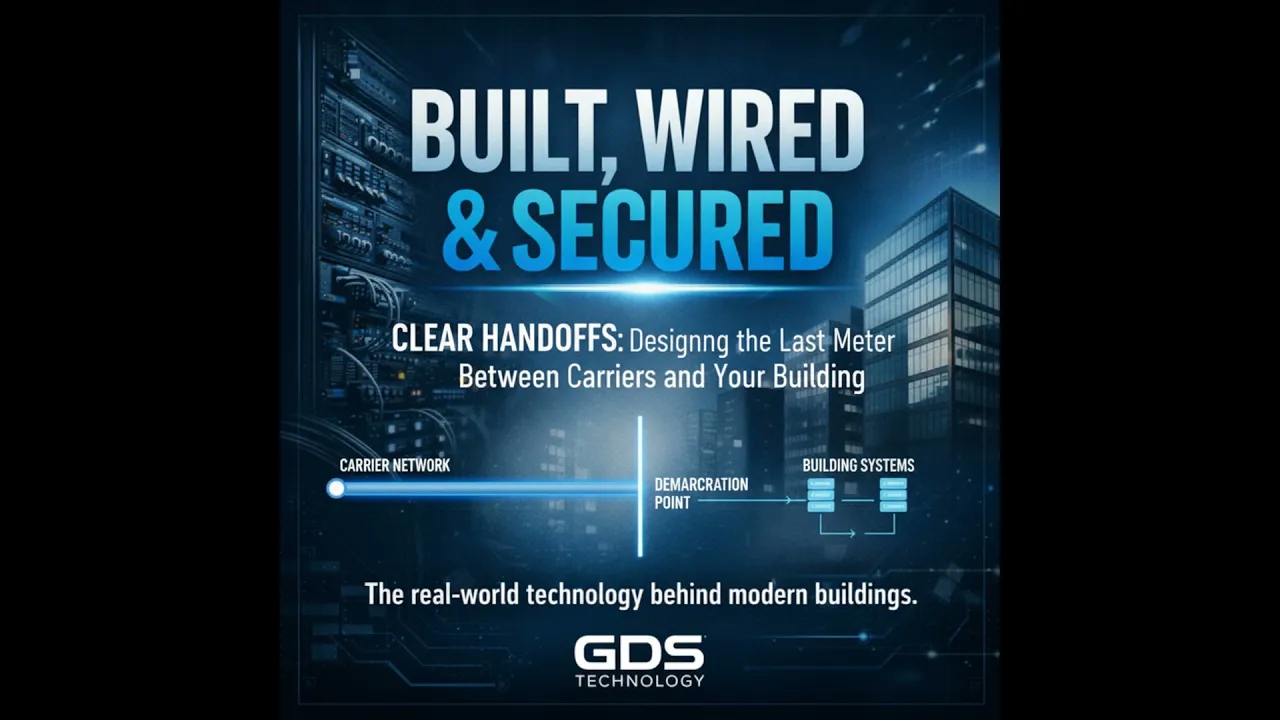
Clear Handoffs: How to Design the Last Meter Between Carriers and Your Building
In commercial real estate, some of the most painful outages come from a boundary that should be simple but often is not: the last meter between the carrier handoff and the building’s internal responsibility. When that boundary is poorly defined, even a straightforward service issue can drag into a long, expensive incident filled with finger-pointing, delays, and tenant frustration.
This episode of Built, Wired & Secured examines that handoff in practical terms. The discussion is not about abstract standards or idealized network diagrams. It is about what happens when a building loses connectivity in the middle of the day and nobody can immediately answer the most important question: who owns what, right now, at the point where carrier service becomes building responsibility?
The opening scenario captures the operational reality well. The network drops during lunch in a downtown office. Point of sale terminals fail. Badge readers stop authenticating. Nobody can check people in. The carrier says the circuit is fine up to its demark. The building team thinks the demark is still on the carrier. Tenants call the front desk. Time passes. By the time ownership is sorted out, the business day is effectively gone.
That is the real cost of a fuzzy handoff. The infrastructure problem may be solvable, but the coordination problem turns it into a business disruption.
The Operational Problem Behind the Technical Problem
One of the clearest points in the episode is that outages are felt first through operations, not diagrams. Tenants do not care whether the issue is on the carrier side or the building side. They care that payments are failing, phones are down, and access systems are acting unpredictably. Facilities teams and front desk staff feel pressure immediately because the impact is visible and public.
That visibility creates urgency, which is understandable. But urgency without clarity often produces the wrong response. Teams start moving quickly before they know the ownership boundary, the available spares, the power dependencies, or even the exact patch path they need to inspect. In that environment, speed can actually extend downtime.
The episode frames reliability as a maintenance discipline, not just a technology investment. That includes the way handoffs are documented, tested, labeled, and maintained after project turnover.
Why the Demark Becomes a Failure Point
The panelists identify a set of routine failure modes that repeatedly appear at the demark. None of them are surprising, which is exactly why they deserve more attention.
The first is ambiguous ownership. When technicians arrive and there is no shared understanding of who is responsible for the splice, handoff box, patchfield, first patch, or local power, troubleshooting slows down before it even begins. The problem is not only technical access. It is authority. If no one knows who is supposed to touch which component, people hesitate, defer, or escalate while the outage continues.
The second problem is poor labeling. Unlabeled panels, unlabeled ports, loosely managed patch cords, and inconsistent standards turn the demark into a guessing game. Even where the physical plant is sound, recovery can take far too long because the correct path is not obvious.
The third issue is the absence of spares. The episode makes a practical case for keeping two matching spare patch cords on site. That sounds minor until a missing spare becomes the reason an outage lasts hours instead of minutes.
The fourth issue is architectural: single points of failure. Owners sometimes accept one entry path, no diversity, or no alternate power at the demark because the upfront cost is lower. The panelists are clear about the tradeoff. Those are short-term savings with long-term operational consequences.
What a Clear Ownership Boundary Looks Like
The episode offers a baseline model that building owners and operators can use in procurement and operations. The carrier should own the service up to a clearly marked physical demark point, such as a splice, handoff box, or patchfield. The building should own everything inside that point.
That baseline matters because it simplifies accountability. If the handoff is explicitly defined and signed off, each party knows where its responsibilities stop and start. That improves response during outages and reduces ambiguity in contracts, maintenance, and escalation.
At the same time, the discussion introduces an important operational nuance. Owners may still need control over specific local elements near the handoff, including the first patch into the building panel or the UPS feeding edge devices. The logic is straightforward: local control can enable temporary workarounds or faster restoration steps during an incident.
This is where the episode’s practical tone is strongest. It does not argue for a rigid rule in every building. It argues for written specificity. If local power, local patching, and carrier handoff ports are not clearly assigned, then service levels become fuzzy at exactly the wrong moment.
Why Shared Testing Matters
Documentation is necessary, but the panelists make it clear that documentation alone is not enough. A handoff that exists only on paper can still fail operationally if the two sides never test it together.
That is why the episode strongly recommends a joint acceptance test. The point of the test is not simply to prove that light exists on a strand or that a device came online once. The goal is to establish a measurable baseline and a shared record of what was verified, when, by whom, and against what criteria.
The recommended process includes an OTDR trace to document continuity and loss to the demark, plus an end-to-end functional test such as a loopback or authenticated ping from the carrier endpoint to a building endpoint. The team should also physically verify labels and sign the demark diagram.
Just as important, the acceptance packet should include pass/fail thresholds, recorded test times, technician names, confirmation of whether the demark or feeding equipment is on backed-up power, and a defined contact and escalation list. If a test fails during turnover, the fix should be documented immediately and the handoff document updated on the spot.
That process turns a vague “it should work” assumption into operational evidence.
What Actually Shortens Downtime
The real-world examples in the episode make the value of this discipline easy to understand. In one campus case, a team that had relied on verbal handoffs created a one-page demark diagram, stocked labeled spare patch cords, and completed joint OTDR and ping tests after a project. When an outside contractor later cut the wrong sheath, the carrier could prove the circuit up to its splice point, and the building team could immediately use a spare patch. Service came back in under an hour.
In another case, a medical office lost badge readers and nurse phones. The carrier said the circuit was fine. The building team found an unlabeled patch that had been rolled back during a vendor visit. Because they had a recent joint acceptance form and spares, they repatched immediately and restored service quickly.
In both examples, the recovery win did not come from a heroic technical breakthrough. It came from preparation: clear ownership, current documentation, working labels, tested paths, and available spares.
The Checklist Building Teams Should Standardize
The episode closes with a practical checklist that listeners can use in procurement, acceptance, and incident response. It includes a one-page demark diagram and ownership table, a physical labeling standard with photos, recorded OTDR and functional test results, two on-site spare patch cords, a labeled test port, named contacts and 24/7 escalation steps, and contract language that keeps these responsibilities in force after turnover.
That last point is especially important. Good handoffs decay when nobody owns the upkeep. Labels drift. Spares disappear. Drawings go stale. New vendors make changes that are never recorded. A contract should not just define the initial acceptance package. It should assign ongoing maintenance responsibility so the handoff remains usable months and years later.
Two Actions to Take Now
If there is one practical lesson to carry forward from this episode, it is that small operational steps create outsized resilience. First, find or create a one-page demark diagram and put it where both facilities and IT can access it. Second, schedule a joint acceptance test within 30 days if there has been a major change and no recent shared test.
Those two actions alone can reduce confusion dramatically in the next incident.
The larger business lesson is just as important. Connectivity handoffs are not only technical boundaries. They are accountability boundaries. When they are clear, outages get shorter, escalations get cleaner, and tenants stay operational. When they are vague, even a small fault can become a long day.
If this episode’s topic sounds familiar, it is probably because many buildings already have the ingredients for better outcomes. They just need to formalize them. A clear demark, tested jointly and maintained intentionally, gives owners and operators a faster path to recovery when the next problem appears. For building teams that want fewer surprises and cleaner incident response, this is a practical place to start. Listen to the full episode for the complete checklist and the examples that show how these low-effort steps can prevent high-cost downtime.