
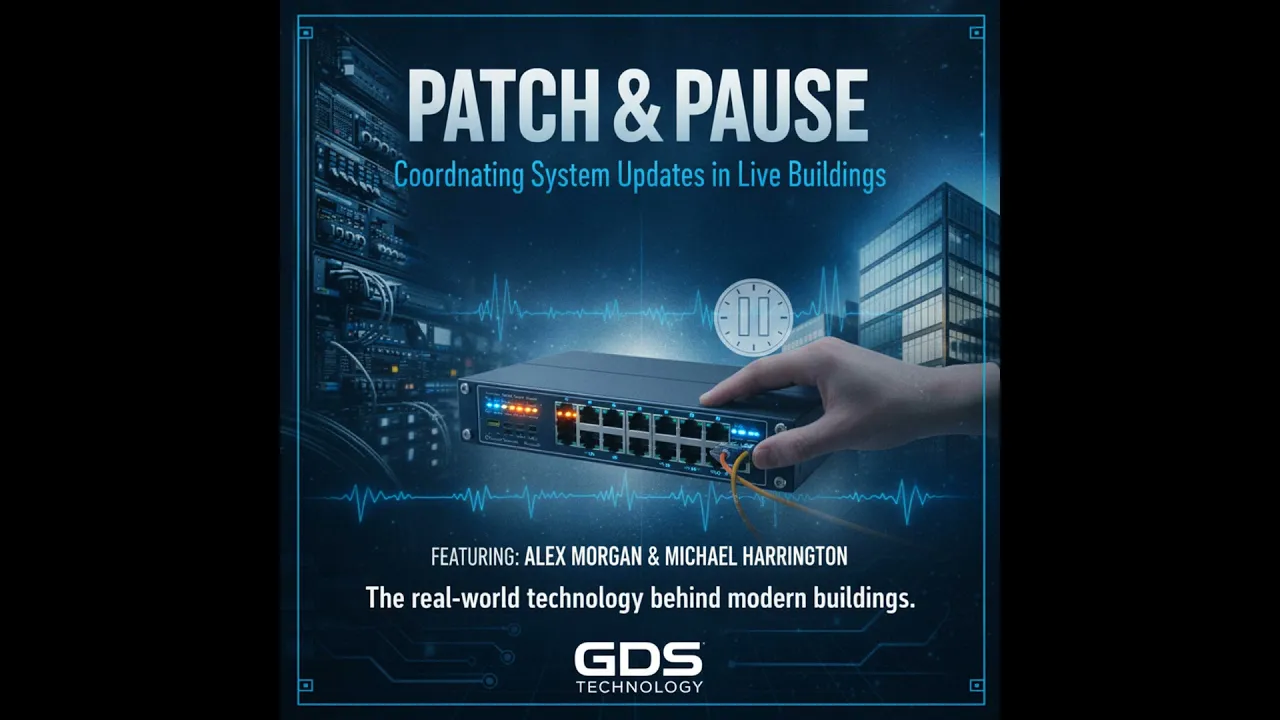
Show Notes
Patch & Pause: Why Building Updates Need Coordination
System updates are unavoidable in commercial buildings. Access control firmware, HVAC controllers, fire panel patches, and network appliance upgrades all need attention to address reliability, security, and supportability. But a change that looks routine on paper can become a tenant-facing operational problem when it is poorly scoped, poorly communicated, or impossible to reverse.
This episode examines practical change management for live buildings: how to schedule maintenance, identify dependencies, set ownership, require vendor accountability, and verify that systems return to normal after a change. The central message is straightforward: updates should reduce risk, not introduce surprise downtime.
The Cost of a “Low-Risk” Update
The episode opens with a familiar scenario. A late-night firmware update completes successfully, yet tenants arrive the next morning unable to badge into the building. Deliveries back up, a meeting is delayed, and the operations team spends valuable time coordinating a rollback with the vendor.
The operational cost goes beyond the immediate outage. When building systems fail during normal use, tenants lose confidence in the team responsible for the environment. A routine update can affect access, comfort, scheduling, safety-related systems, and the daily flow of the property. That is why building technology changes need an operational process, not just a technical implementation.
What Change Management Means in a Live Building
Change management is the orchestration of updates across mechanical, electrical, security, and network systems so those updates happen safely and with minimal tenant impact. The systems may be managed by different teams and vendors, but their dependencies often overlap.
Common failure modes include:
- Missing dependencies between systems, controllers, gateways, and networks
- Unclear ownership of the change window and approval process
- Silent vendor updates that occur without coordinated planning
- Single points of failure that were never documented
- Backups or rollback paths that have not actually been tested
- Undocumented handoffs between facilities, security, and IT
A useful question for every proposed change is: what breaks if this goes down? If the team cannot answer quickly, the risk has not been fully scoped.
Technical Debt and Process Risk Work Together
Older controllers, unsupported firmware, and bespoke integrations make systems more fragile. A card reader may depend on a controller that has not been updated in years. A gateway may have a backup, but the backup may never have been validated. An update can expose weaknesses that were already present but invisible during normal operations.
Process problems amplify that technical risk. Even good hardware can fail operationally when a vendor assumes a network dependency is unused, or when one team makes a change without informing another team that owns a connected system. The result is a hidden single point of failure that turns routine maintenance into a tenant-facing outage.
Balance Fast Patching With Controlled Change
Organizations need security and reliability updates, but rapid patching must be balanced with control. Frequent unscheduled changes may reduce exposure to known vulnerabilities while increasing the likelihood of disruption. The episode recommends categorizing changes by impact rather than treating every update the same.
- Low-impact, reversible changes can be bundled into regular weekly maintenance windows.
- High-impact or non-reversible changes need staging, explicit signoff, and a defined rollback plan.
- Every change should be planned with failure in mind, not just with success as the expected outcome.
- Tenants should be informed of scheduled windows when the change could affect their environment.
Rollback planning is especially important. A fallback is not meaningful simply because it exists on paper. Teams should test whether the system can actually return to a known-good state.
Assign One Owner to the Change Calendar
Commercial properties benefit from a single designated change owner. That role often sits in building operations or facilities, with clear escalation to IT for networked systems. The owner coordinates maintenance windows, gathers stakeholder approvals, enforces vendor requirements, and makes sure the calendar is visible to the people affected by the work.
The calendar should be published and shared with tenants and vendors. This is lightweight governance, not unnecessary bureaucracy. It establishes a predictable place for maintenance planning and helps prevent overlapping vendor activity, unannounced changes, and confusion about who can authorize work.
Pre-Deployment Checks That Catch Problems
Testing does not need to mean an expensive replica of every building system. A pragmatic pre-deployment checklist catches many avoidable problems before a live change begins.
- Confirm current backups are available.
- Validate configuration snapshots.
- Verify communication paths to controllers.
- Test a rollback during a controlled window.
- Confirm the system can return to a known-good state.
- Require vendors to explain expected failure modes and provide a recovery checklist.
For higher-risk devices, a parallel controller or off-hour staging zone that mirrors the live setup can provide a practical test environment. The goal is not complexity. The goal is disciplined validation before a change affects occupants.
Two Examples of Process Fixes
In one example, a vendor performed an overnight access-control firmware update without checking the controller time-zone settings. Badge authentication failed across several zones the next morning. The recovery required a rollback and manual time correction on hundreds of readers. The operational change afterward was simple: timestamp checks became part of every pre-deployment checklist, and firmware changes required a mandatory staging window.
In another example, an HVAC controller update changed Modbus polling intervals and overloaded a gateway. Heat scheduling failed for a floor. The response was not to buy new technology. The team added explicit dependency mapping and limited concurrent vendor changes during occupancy hours.
Rules of Thumb and the Post-Change Checklist
Three rules guide the episode: own the calendar, categorize risk, and require rollback. After any change, complete a short verification process:
- Verify the primary function.
- Confirm dependent systems are working.
- Validate tenant access or occupant safety systems.
- Record exact versions and results.
- Send stakeholders a quick update.
Clear ownership, focused testing, verified rollback capability, and timely communication can help property teams reduce disruption while keeping essential building systems current.
Coordinating System Updates in Live Commercial Buildings
Commercial buildings depend on technology that cannot simply be taken offline without consequences. Access control systems manage entry. HVAC controllers influence occupant comfort. Fire panels support life-safety operations. Network appliances connect controllers, vendors, management platforms, and building services.
Each of these environments requires updates. Firmware becomes outdated, vulnerabilities need remediation, controllers need fixes, and network equipment requires maintenance. The challenge is not deciding whether updates are necessary. The challenge is completing them without creating an avoidable tenant-facing disruption.
A late-night update may appear low risk because occupancy is lower. Yet if the update causes badge access to fail the next morning, the impact arrives precisely when tenants, visitors, deliveries, and building teams need the system most. The resulting problem includes more than lost time. It erodes trust in the people responsible for operating the property.
Change Management Is an Operational Discipline
In a live building, change management is the coordinated planning of updates across mechanical, electrical, security, and network systems. It is not solely an IT function, a facilities function, or a vendor task. It is a shared operating discipline that makes responsibilities, dependencies, risks, and recovery steps clear before the work starts.
The most common breakdowns are often predictable:
- A dependency between systems was not identified.
- No one had clear ownership of the maintenance window.
- A vendor made a silent or uncoordinated change.
- A single point of failure had not been documented.
- A rollback plan existed but had not been tested.
- Security, facilities, and IT had an undocumented handoff.
Before approving an update, building teams should ask a direct question: what breaks if this system goes down? That question forces the team to look beyond the device being updated and consider connected readers, gateways, communications paths, scheduled operations, and tenant workflows.
Why Routine Updates Become Tenant Problems
Technical debt is one contributor. Older controllers, unsupported firmware, and bespoke integrations can make building systems fragile. A card reader may depend on a controller that has not been updated for years. A gateway may have a backup that no one has verified. These weaknesses may not create visible trouble during normal operations, but a routine update can expose them quickly.
Process gaps make the technical problem worse. A vendor might assume a network dependency is not in use. Facilities may schedule work without knowing that a security system relies on a related gateway. IT may make a network change without realizing a controller depends on that communication path.
In other words, good hardware alone is not enough. An organization can have capable equipment and still create an outage through unclear ownership, weak coordination, or incomplete documentation. The issue is not whether an update should happen. The issue is whether the team has controlled the conditions around it.
Use Risk Categories Instead of One Update Process
Security and reliability updates are necessary, but urgency should not eliminate change control. Rapid patching can reduce exposure to known vulnerabilities. At the same time, frequent unscheduled changes can increase the chance of service interruption. The answer is to categorize updates by impact.
Low-impact and reversible changes can be grouped into routine weekly maintenance windows. These are changes where the operational effect is limited and where restoration is straightforward if something does not behave as expected.
High-impact or non-reversible changes deserve a more deliberate process. They need staging, explicit stakeholder signoff, a defined recovery path, and a maintenance window that accounts for tenant and building operations. A change that may affect access, occupant comfort, safety-related functions, or a widely shared gateway should not be treated like a small administrative adjustment.
Every category should include a core principle: plan for failure. A successful deployment is the goal, but a responsible plan assumes something can go wrong. The team should know who makes the decision to pause, who calls the vendor, what gets restored first, and how occupants will be informed if the change affects them.
Make One Person Accountable for the Calendar
Every commercial property should designate a single change owner. In many buildings, this role belongs in building operations or facilities, with a clear path to escalate issues involving IT-connected systems. The change owner does not need to perform every technical task. Their responsibility is to coordinate the calendar, collect approvals, enforce requirements, and confirm that vendors and stakeholders are working from the same plan.
A published calendar is a practical control. It gives tenants notice when appropriate, gives vendors a defined maintenance window, and helps prevent multiple changes from colliding. It also prevents the common failure mode in which a vendor makes an update that no one else expected.
This is lightweight governance. It does not require a large committee or excessive paperwork. It requires a visible owner, a shared calendar, and a small set of non-negotiable requirements for changes that affect live systems.
Require Practical Pre-Deployment Validation
Testing is often viewed as expensive because teams imagine a complete duplicate of the building environment. That is not always necessary. A basic pre-deployment checklist can catch a meaningful number of issues before a change reaches production.
Before work begins, confirm that backups are current and usable. Validate configuration snapshots. Verify communication paths to controllers. Test the rollback procedure during a controlled window. Confirm that the system returns to a known-good state.
For higher-risk devices, consider using a parallel controller or an off-hour staging zone that mirrors the live environment. The point is to create enough validation to identify likely problems without delaying every needed update indefinitely.
Vendors also need clear responsibilities. Require them to explain anticipated failure modes and to provide a recovery checklist. A vendor should not arrive with only a deployment procedure. They should also be prepared to explain what happens if the update fails, what dependencies are involved, and how restoration will be handled.
Lessons From Access Control and HVAC Updates
One access control incident began with an overnight firmware update. The vendor had not verified the controller time-zone settings. The next morning, badge authentication failed across several zones. Recovery required a rollback and manual time correction on hundreds of readers.
The important lesson was not that firmware updates should stop. The fix was procedural: timestamp checks were added to every pre-deployment checklist, and firmware updates received a mandatory staging window.
A second example involved an HVAC controller update. The update changed Modbus polling intervals and overloaded a gateway, which caused heat scheduling to fail for a floor. Again, the response was not a new technology purchase. The team added explicit dependency mapping and limited concurrent vendor changes during occupancy hours.
Both examples show that disciplined process improvements can address common operational risks. Teams do not always need a larger platform or a more complex architecture. They need to identify dependencies, control the maintenance window, and make recovery actionable.
Close Every Change With Verification
Work is not complete when a vendor says the update succeeded. It is complete when the property verifies that normal operations have returned. A concise post-change checklist should include five actions:
- Verify the primary function of the updated system.
- Confirm connected or dependent systems are operating normally.
- Validate tenant access and occupant safety systems.
- Record the exact versions deployed and the results observed.
- Send a quick update to stakeholders.
That final communication matters. It gives stakeholders confirmation that the work is complete, documents the result, and creates a clear record if follow-up is needed.
Build a More Predictable Maintenance Process
Effective change management does not mean avoiding updates. It means making updates predictable. Own the calendar. Categorize the risk. Require a tested rollback path. Confirm backups and communication paths. Map dependencies. Limit overlapping vendor work during occupancy hours. Verify results after the change and communicate them quickly.
For property teams responsible for planning, operating, and protecting technology environments, these practices provide a practical way to reduce surprises without adding unnecessary bureaucracy. Listen to this episode of Built, Wired & Secured for the full conversation on coordinating updates in live buildings and applying a lightweight post-change process.