
Show Notes
Episode Overview
What turns a manageable building outage into a drawn-out tenant disruption? In this episode of Built, Wired & Secured, Alex Morgan sits down with senior property manager Michael Harrington to answer that question through a practical, operations-first lens. The conversation opens with a familiar scenario: a weekend incident, a quiet building, a missing spare key, and an unreachable vendor. What should have been a quick recovery stretches into a long and expensive delay.
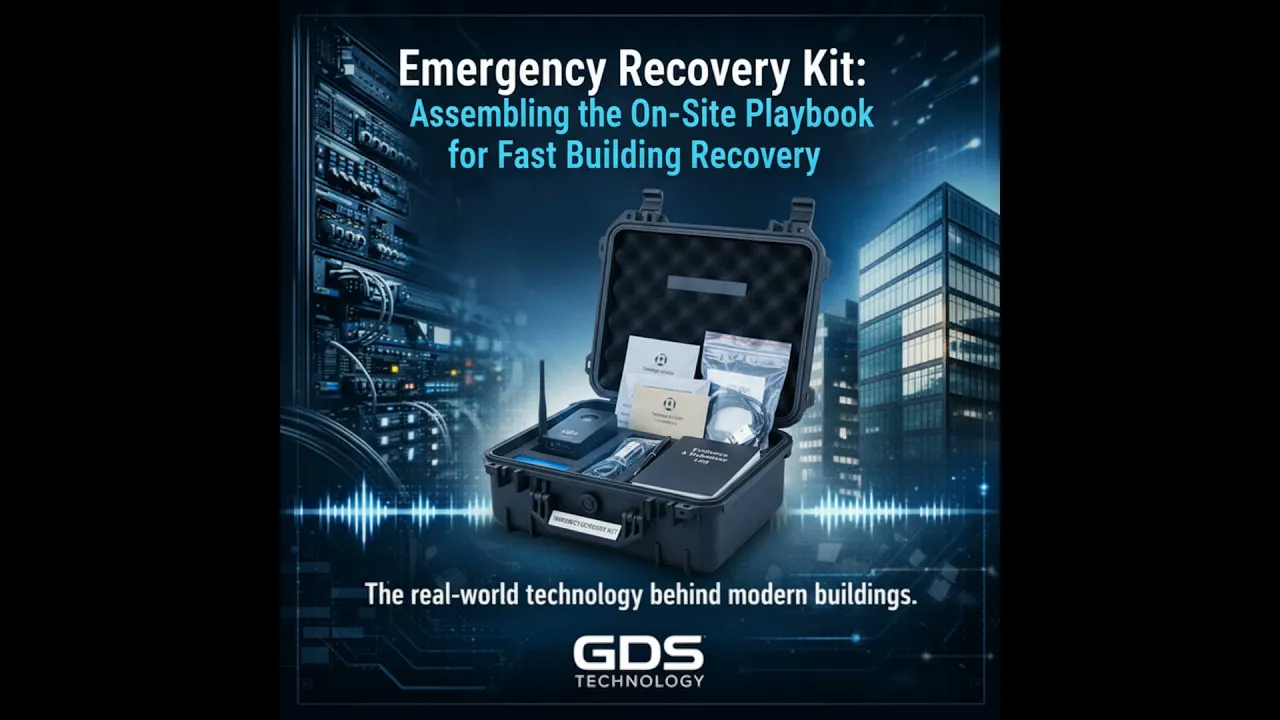
From there, the episode focuses on a simple but powerful concept: the Emergency Recovery Kit. Rather than treating recovery as a purely technical exercise, Alex and Michael frame it as a governance problem. The right small cache of tools, documentation, contacts, and controlled authorizations can reduce downtime dramatically without creating unnecessary security exposure.
This is not a technical walkthrough. Listeners will not hear product recommendations, configuration instructions, or credential handling procedures. Instead, the episode stays focused on decision rules, ownership, documentation, chain of custody, and lightweight validation drills that help facilities, operations, and property teams respond faster when something goes wrong.
Why Recovery Slows Down
Michael identifies three recurring failure modes that create drag during incidents:
- Missing spares, keys, small critical parts, or preconfigured temporary access items
- Authorization gaps, where the person on site does not have the right documented temporary access or approval
- Communications failures, including unreachable vendors or no vetted fallback communication path
One of the strongest points in the episode is the idea that recovery delays rarely come from one issue alone. They come from a chain of small failures. One missing item blocks the next decision. One undocumented contact prevents timely coordination. One unavailable approval turns a short incident into an extended outage.
That framing matters for building and operations leaders because it shifts the response from reactive improvisation to deliberate preparedness.
The Balance Between Speed and Security
A core theme in the episode is the tension between convenience and governance. If everything is made easy to access, the organization increases risk. If everything is locked down too tightly, teams lose valuable recovery time.
Michael offers a practical rule: design for the smallest possible convenient surface that still gets the job done. In other words, keep the Emergency Recovery Kit minimal, role-based, and tightly governed. Access should be limited. Use should be documented. Every handoff should leave evidence.
That principle gives listeners a realistic middle ground. The goal is not to make recovery frictionless at any cost. The goal is to introduce only the minimum amount of access necessary to restore operations safely and quickly.
What Belongs in an Emergency Recovery Kit
When Alex asks what a facilities team could assemble this week, Michael keeps the answer intentionally high level and compact. He recommends a short list of three to seven critical items, each tied to a role and a recovery decision.
- A small set of physical spares for items that commonly fail
- One vetted fallback communications device with preapproved contacts and a power plan
- Sealed temporary access tokens or authorization forms that are time-limited and signed
- A signed evidence packet template to document who accessed what, why, and when
- Basic identification materials and a printed contact escalation tree
The emphasis is not on quantity. It is on usefulness, accountability, and clarity. Each item should exist because it removes a known source of delay during an incident.
Governance Tools: Temporary Access and Evidence Packets
Two of the most important concepts in the episode are sealed temporary access tokens and signed evidence packets.
Michael explains that a sealed temporary access token is a physical or documented authorization prepared in advance, signed by an approving authority, and opened only when a defined recovery condition is met. It includes an expiration and clear use rules.
The evidence packet travels with the person using that authorization. It records what was accessed, why access was needed, timestamps, and signatures from the site lead and a witness. That documentation serves two purposes at once: it supports recovery in the moment, and it preserves an audit trail afterward.
For organizations trying to improve both operational discipline and post-incident accountability, this is one of the most actionable ideas in the episode.
Ownership, Storage, and Maintenance
Alex rightly points out that many good emergency plans fail at the ownership and storage stage. A kit is only useful if people know who owns it, where it lives, and how to retrieve it.
Michael recommends assigning a named operational owner, with a secondary owner in security or facilities. Storage should be secure, predictable, and documented. The kit should be kept in an access-controlled location with a defined retrieval procedure. Sealed containers help make openings visible, and every use should require sign-out and completion of the evidence packet.
Just as important, maintenance cannot be informal. Michael advises folding kit review into monthly or quarterly operating tasks so it does not become a forgotten box in a closet.
A Simple Chain of Custody Rule Set
For listeners who want a straightforward governance model, Michael outlines a short repeatable chain-of-custody process:
- Document the triggering condition before opening the kit and obtain an approving signature from the owner
- Require the person retrieving the kit to sign it out and take the evidence packet
- Have a witness or secondary contact sign the packet on site
- Return items immediately after use, document actions taken, and complete a post-use audit within a defined timeframe
These steps are simple by design. They do not add excessive operational weight, but they do create the accountability needed to keep speed from undermining security.
Three Lightweight Drills to Validate Readiness
The episode also stands out because it does not stop at kit design. Michael gives listeners three lightweight acceptance tests and drills:
- A 30-minute retrieval drill to confirm a staffer can locate, sign out, and arrive on site with the evidence packet within 30 minutes
- A quarterly evidence packet audit to check whether forms are filled out correctly and return actions are documented
- A fallback communications bootstrap every six months to verify alternate communications reachability with a short scripted exchange
These checks are practical, low-disruption, and realistic for busy property and operations teams. They also reinforce the point that preparedness is only real if it is tested.
Two Outcomes Listeners Can Picture
To make the concept tangible, Michael shares two anonymized examples. In the success case, a late-night fuse failure interrupted power to a small office cluster. Because the on-site kit included a sealed authorization and an approved fallback communications device, staff restored service in under an hour, documented actions properly, and handed the follow-up to the vendor the next morning.
In the failure case, a weekend network outage escalated because the only on-call vendor could not be reached and there was no documented fallback contact. Hours were lost simply trying to find the right people, turning a repair into a multi-day problem.
The contrast is clear: recovery speed is often less about heroic troubleshooting and more about disciplined preparation.
Three Immediate Actions to Take This Week
Michael closes with three steps listeners can implement immediately:
- Name the kit owner and backup, and place that responsibility in a role description or operations checklist
- Create a one-page contents list and a sealed evidence packet template focused on paperwork and decision points, not technical detail
- Schedule a 30-minute retrieval drill within 30 days and a fallback communications check within 90 days
It is a strong close because it converts strategy into action. The message of the episode is simple: be conservative about what goes into the kit and generous about documentation. That balance helps protect tenants, preserve accountability, and keep building operations moving when incidents happen.
Emergency Recovery Starts Before the Incident
In commercial buildings, downtime rarely feels small to the people experiencing it. A problem that looks minor on paper can quickly become a tenant-facing disruption if the response stalls. In this episode of Built, Wired & Secured, Alex Morgan talks with senior property manager Michael Harrington about one of the most overlooked drivers of recovery speed: whether a building has a compact, governed Emergency Recovery Kit ready before something goes wrong.
The conversation begins with a scenario many operations leaders will recognize. It is the weekend. The building is quiet. The night crew is gone. Then the phones start lighting up. What should have been a straightforward restoration turns into a long, frustrating incident because a single spare key is missing and the on-call vendor cannot be reached. The outage itself may not be unusually complex, but the recovery effort drags because the organization was not prepared for the chain of small operational failures that followed.
That is the heart of this episode. Fast recovery is not only about technical capability. It is also about planning, documentation, custody, and the discipline to make the right resources available under controlled conditions.
The Real Causes of Recovery Delay
Michael breaks recovery drag into three recurring failure modes. First, physical items are missing. That could mean keys, spares, small parts, or a temporary access item that was supposed to be available but is not. Second, the person on site lacks documented authorization or temporary access needed to move forward. Third, communication breaks down because vendor contacts are unreachable or there is no vetted fallback path for coordination.
What makes this especially useful is the way he describes incidents as chains. One missing item blocks another decision. One absent approval holds up access. One unreachable contact stalls the entire response. By the time teams realize what is happening, valuable time has already been lost.
For property managers and operations leaders, that framing changes the job. Instead of asking only how to fix the underlying problem, the better question becomes: what predictable administrative or logistical gaps are most likely to slow us down?
Why Governance Matters as Much as Speed
It is easy to talk about preparedness in a way that ignores security. But this episode does not do that. Alex raises the key tension directly: if access is made too easy, risk increases. If controls are too rigid, recovery slows down.
Michael’s answer is practical and disciplined. He recommends designing for the smallest possible convenient surface that still gets the job done. In plain terms, that means the Emergency Recovery Kit should be minimal, role-based, and controlled. It should contain only the resources needed to remove predictable bottlenecks. Access should be limited. Use should be documented. Handoffs should be auditable.
This is an important mindset for any organization responsible for tenant safety, building continuity, or regulatory accountability. Preparedness should not create a wide-open exception path. It should create a narrow, defensible one.
What an Emergency Recovery Kit Should Include
One of the strongest parts of the episode is how disciplined the recommended kit remains. Michael does not describe a large stockpile or a highly technical response box. He keeps it to a short list of critical components, ideally three to seven items, each tied to a role and a recovery decision.
His recommended categories include a small set of physical spares for common failures, one vetted fallback communications device with preapproved contacts and a power plan, sealed temporary access tokens or signed authorization forms, a signed evidence packet template, basic identification materials, and a printed contact escalation tree.
What stands out is the purpose behind each item. Nothing belongs in the kit because it seems generally useful. Each item belongs there because it addresses a known delay point in an incident.
That approach is worth copying. If a building team cannot explain who uses an item, under what authority, and for what recovery decision, that item probably does not belong in the kit.
Sealed Access and Evidence Preserve Both Trust and Speed
Two concepts deserve special attention because they make the episode especially actionable: sealed temporary access tokens and signed evidence packets.
Michael explains the temporary token as an authorization prepared in advance, signed by the right approving authority, and opened only when a specific recovery condition is met. It comes with an expiration and clear use rules. In governance terms, this matters because it avoids informal improvisation under pressure.
The evidence packet is equally important. It moves with the person using the token and records what was accessed, why it was necessary, when it happened, and who witnessed it. The site lead and a witness sign it. After the incident, the packet becomes a practical audit trail.
For operations teams, this solves two common problems at once. It enables action during the incident, and it reduces confusion, finger-pointing, and memory gaps afterward.
Ownership and Storage Are Where Good Plans Often Fail
Many emergency measures sound good until no one can answer basic questions: Who owns the kit? Where is it stored? Who is allowed to retrieve it? How is use documented? How is it maintained?
Michael’s guidance is clear. The kit needs a named owner on the operations side and a secondary owner in security or facilities. Storage should be predictable, secure, and documented, ideally in an access-controlled location with a clear retrieval process. The container should be sealed so opening is visible. Every use should require sign-out and completion of the evidence packet.
He also warns against the “forgotten box in a closet” problem. A recovery kit is not a one-time project. It has to be reviewed and maintained on a standing schedule, whether monthly or quarterly, so contents, contacts, and procedures remain current.
This is where building leadership can make the biggest difference. Ownership has to live in a role, not in good intentions.
A Chain-of-Custody Process Teams Can Actually Use
The chain-of-custody rules Michael outlines are simple enough to implement quickly, which makes them valuable. Before the kit is opened, the triggering condition should be documented and the owner should provide an approving signature. The person retrieving the kit signs it out and takes the evidence packet. A witness or secondary contact signs on site. After use, items are returned immediately, actions are recorded, and the owner completes a post-use audit within a defined window.
None of these steps are complicated. That is the point. Effective emergency governance is not about building an elaborate bureaucracy. It is about making the right actions repeatable when time is short and pressure is high.
Testing Readiness Without Disrupting Tenants
Preparedness only matters if it works under realistic conditions, and the episode offers three lightweight ways to validate that.
The first is a 30-minute retrieval drill. A staffer should be able to locate the kit, sign it out, and arrive on site with the evidence packet within 30 minutes. The second is a quarterly evidence packet audit to confirm forms are completed correctly and return actions are documented. The third is a fallback communications bootstrap every six months, using a short scripted exchange to confirm reachability and contact readiness without making system changes.
These drills are realistic because they respect both tenant experience and operational constraints. They can be run off hours where possible, and they are focused on readiness rather than technical intervention.
The Difference Between a Short Disruption and a Multi-Day Problem
Michael shares two anonymized examples that make the payoff clear. In the success story, a late-night fuse failure interrupted power to a small office cluster. Because the team had a sealed authorization and an approved communications device in the kit, service was restored in under an hour and the vendor handled follow-up in the morning. The impact on tenants stayed minimal.
In the failure example, a weekend network outage stretched because the only on-call vendor was unreachable and there was no fallback contact documented. Hours disappeared into trying to reach the right person. What should have been a repair became a much longer tenant-facing issue.
Those examples reinforce the business value behind the episode’s advice. Good recovery governance reduces downtime, lowers operational chaos, and protects tenant confidence when the stakes are highest.
Three Actions to Take This Week
The episode ends with three immediate actions that building and operations leaders can take now. First, name the kit owner and backup, and place that responsibility into a role description or operations checklist. Second, assemble a one-page contents list and create a sealed evidence packet template focused on decision points and documentation. Third, schedule a 30-minute retrieval drill within the next 30 days and a fallback communications check within 90 days.
Those recommendations are intentionally simple, but that is what makes them useful. They establish ownership, documentation, and validation without requiring a large project.
Final Takeaway
If there is one lesson from this conversation, it is this: recovery speed depends on more than technical expertise. It depends on whether the organization has already decided who can act, what they can access, how they prove it, and how they communicate when normal channels fail.
As Alex puts it near the end of the episode, teams should be conservative about what they put in the kit and liberal about their documentation. That balance helps preserve security while removing unnecessary friction during incidents.
If you want a clearer, faster, and more accountable recovery process in your building operations, this episode offers a strong place to start. Listen to the full conversation and use the checklist and custody template from the Built, Wired & Secured resource hub to turn these ideas into a working playbook. https://builtwiredsecured.com/episodes/emergency-recovery-kit-on-site-playbook-fast-building-recovery