
Show Notes
Why project closeouts fail in the real world
This episode of Built, Wired & Secured tackles a problem that almost every facilities and IT team recognizes: the project is technically complete, but the handover is not actually usable. The opening scenario says it all. Move-in morning arrives, badges fail, HVAC zones conflict, and Wi-Fi drops. The documentation exists, but it does not help the people on the ground restore service quickly. Instead of clarity, operations inherits a mystery.
Alex Morgan frames the issue as an accountability problem. When a system fails right after occupancy, tenants do not care whether the gap came from a contractor, a vendor, facilities, or IT. They feel the disruption immediately. Michael Harrington and James Rogers argue that the breakdown rarely comes from one single mistake. It usually starts with a combination of compressed timelines, vendor assumptions, unclear ownership, and contracts that require deliverables without ensuring those deliverables are useful in operations.
- Contractors deliver to a date, while operations inherits the system for years.
- Vendors often assume facilities or IT will fill in the missing details.
- Facilities and IT may assume the vendor already delivered what they need.
- The result is an assumption gap that becomes an operational risk.
That gap matters because reliability depends on disciplined maintenance. And disciplined maintenance depends on a verified, understandable handover.
Why as-builts are not enough
One of the clearest themes in the conversation is that a pile of as-built documentation is not the same as a useful closeout. The guests push back on the common habit of dumping dozens of PDFs, diagrams, and logs into a folder and calling the job done. That may satisfy a contractual checkbox, but it does not help the on-call technician at 2 a.m. or the operations leader trying to understand business impact.
The distinction they make is practical: in a failure, teams do not need theory first. They need fast recovery. A usable closeout should make it possible to answer immediate questions without digging through binders.
- What failed?
- What are the first restore steps?
- Where is the spare?
- Who owns the next step?
- Who should be called if the first fix does not work?
That is why the guests argue for role-based outputs instead of one giant handover package that tries to serve everyone the same way.
What a useful handover should include
Michael and James outline a more operationally sound model for closeouts. The first layer should be concise, role-based runbooks. A frontline technician needs one page with plain language, numbered restore steps, part numbers, spare locations, and vendor contacts. Leadership needs a different view focused on warranty ownership, cost centers, and the operational impact of failure. Full engineering detail still matters, but it belongs in appendices, not as the primary tool for an outage.
The episode also highlights verified spares as a major differentiator. A spare part only helps if it is the right revision, tested when possible, clearly labeled, and physically on site. The team warns against accepting vague promises that parts can be shipped later. That creates preventable downtime when something breaks.
- One-page frontline runbook per system
- Leadership summary with warranty and ownership details
- Appendices for deeper engineering material
- Verified and labeled spare list with part numbers
- Accessible network and power maps
- Vendor contact matrix and escalation timelines
The principle running through all of it is simple: practicality beats completeness in a crisis.
Reducing tribal knowledge risk
The conversation also addresses the human side of closeout failure. Even when some documentation exists, too much knowledge still walks out with the installer or lives only in a few people's heads. That is especially dangerous when the system has quirks, non-obvious sequences, or special dependencies that were learned during commissioning but never written down in a way operations can use.
To reduce that risk, James recommends two specific steps. First, hold a joint walkthrough at closeout so the owner can sign off on responsibilities instead of inheriting ambiguity. Second, capture a short vendor walkthrough video. The value of that video is not polish. It is preserving sequence, tone, and nuance that a static PDF often misses.
Just as important is the contact matrix. Teams often lose time because they call the wrong person, misunderstand who owns warranty support, or do not know the escalation timeline. In that sense, clear escalation paths are as important as technical diagrams.
The long-term cost of weak closeouts
When Alex asks for the three-year view, Michael paints a clear picture of what weak handovers become over time. Operating expenses rise because teams repeat service calls that could have been avoided. Capital surprises appear when undocumented equipment fails without a known baseline. Tenant frustration grows as comfort, access, or connectivity issues become recurring problems instead of isolated ones.
The business impact is a major point in this episode. Reliability is not just a technical goal. It affects tenant trust, reputation, and ultimately lease conversations. A poorly documented system does not just create more work for operations. It can also make the property feel less dependable to the people occupying it.
- Higher opex from repeated callouts
- Unexpected capital expenses from undocumented failures
- Faster asset decay from lack of baseline maintenance
- Tenant frustration tied to inconsistent performance
- Reputational damage that affects renewals and negotiations
Two contrasting real-world outcomes
The episode becomes especially concrete when the guests compare two handover outcomes. In the success story, a retrofit team insisted on three basics: a one-page frontline runbook, a verified spare list with part numbers and labeled bins, and a clear network handoff map. The vendor stayed for the joint walkthrough and signed the checklist. Six months later, when an access controller failed, the on-call technician used the runbook and the spare on the shelf to restore service in 20 minutes. Tenants barely noticed, and the issue generated only one help desk ticket that closed the same day.
The failure story is the mirror image. Another building had a closeout that looked complete on paper because it included 20 binders and a spare box. But the spare was untested and the wrong revision. When a chilled water actuator failed, the vendor quote took three weeks, tenants complained, and leadership absorbed a reputational hit that could have been avoided with better verification.
The contrast is powerful because the line item was effectively the same: documentation and handover. The difference was whether that work was done for real operational use.
Four actions listeners can take this week
The episode closes with four immediate actions teams can adopt without waiting for a major process overhaul.
- Create a one-page runbook per system for the frontline technician.
- Capture a five-minute vendor walkthrough video and store it in the ops workspace.
- Verify and label spares on site, and record that verification.
- Hold a joint walkthrough and get owner signoff on a compact handover checklist.
The final message is direct: do not wait for perfect documentation. Start with usable, verified basics and iterate. In other words, make closeouts something operations can actually use when it matters most.
The Handover Problem Nobody Wants to Own
Building technology projects usually look finished long before they are truly ready for operations. The ribbon gets cut, the contractor moves on, the systems appear to be installed, and everyone assumes the hard part is over. But in practice, the first real test often comes later, when tenants arrive, a device fails, or a facility team has to respond without the people who originally built the environment.
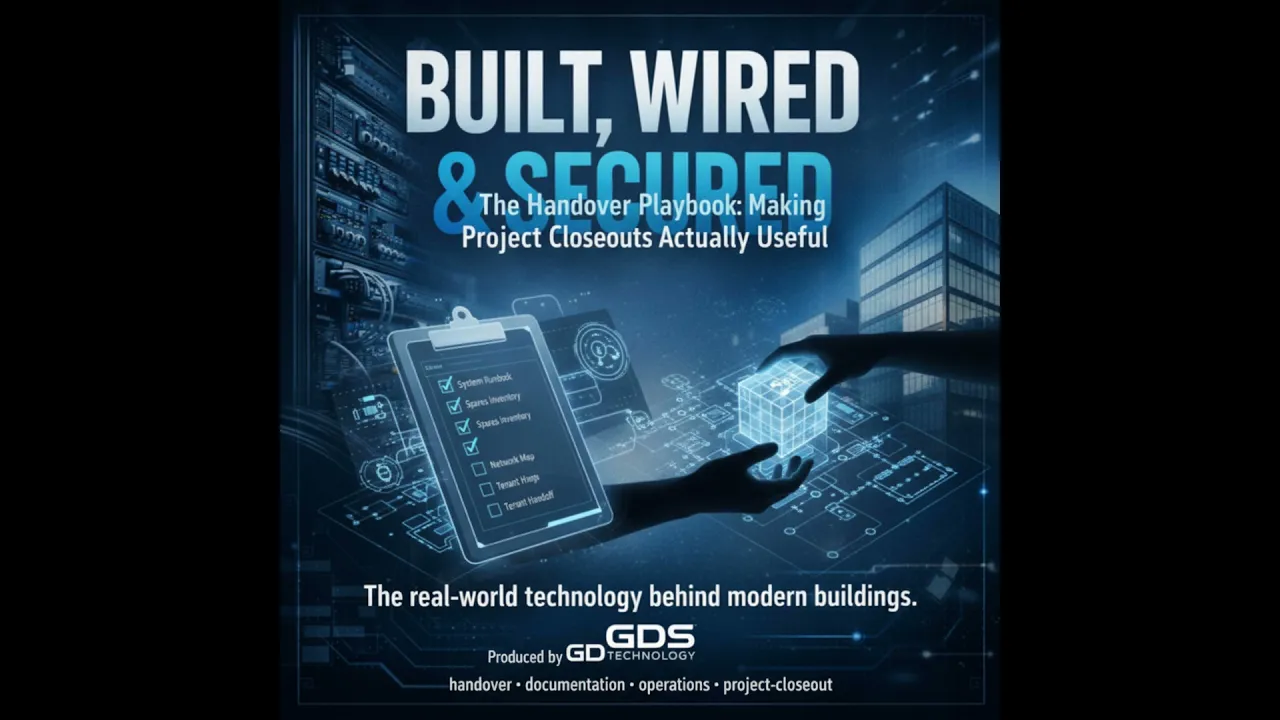
That is the core theme of this episode of Built, Wired & Secured. Alex Morgan sits down with Michael Harrington and James Rogers to discuss why most project closeouts are far less useful than they should be and what teams can do to fix that. Their argument is straightforward: closeout packages often satisfy paperwork requirements, but they do not give facilities and IT teams what they actually need to operate, maintain, and restore systems under pressure.
The opening example makes the stakes obvious. Move-in morning arrives. Badges are not working. HVAC zones are conflicting. Wi-Fi is unstable. The documentation exists, but it is buried inside a large binder or an oversized folder full of diagrams and PDFs that nobody can quickly interpret. At that point, the question is no longer whether deliverables were technically provided. The question is whether the handover was useful.
Why Closeouts Break Down
One of the strongest points in the discussion is that handover failures rarely come from one isolated issue. Instead, they emerge from a stack of assumptions. Contractors are focused on delivering by a specific date. Operations will live with the system for years. Vendors assume facilities or IT will complete the final story internally. Facilities and IT may assume the vendor already turned over everything important. That gap between assumptions creates operational risk before anyone realizes it is there.
Contracts do not necessarily solve the problem. As the guests point out, contracts may require as-builts or documentation, but that does not guarantee a usable handover. A folder full of PDFs is not the same as a verified runbook. A spare line item is not the same as a tested part sitting on the shelf with the correct revision number. A project can be contractually closed and still operationally incomplete.
This matters because reliability is built on maintenance discipline, and maintenance discipline starts with a verified baseline. If the handover is weak, teams never really get that baseline. They end up reacting to symptoms instead of managing systems.
The Difference Between Documentation and Usability
A major theme in the episode is that many teams confuse volume with value. If a closeout includes 50 PDFs, 10 wiring diagrams, and a stack of engineering material, it may look comprehensive. But during an outage, the goal is not to admire completeness. The goal is to restore service quickly and confidently.
That is why Michael and James advocate for role-based outputs instead of one giant package meant to serve everyone equally. A frontline technician needs something very different from what a leadership team or engineering reviewer needs. The technician needs plain language, a sequence of actions, spare locations, part numbers, and contact information. Leadership needs visibility into warranty ownership, critical failure impact, and cost responsibility. Engineering may still need deeper diagrams and logs, but those materials should support the operation, not replace the operational layer.
The most practical formulation in the episode is the three-question test for frontline runbooks:
- What failed?
- Where is the spare?
- Who is next on the hook?
If the handover package cannot answer those questions quickly, it is not ready for real operations.
What Good Closeouts Look Like
The guests do not argue for less rigor. They argue for better structure. Thorough technical material still has value, but it should be organized so the most important operational content is immediately accessible.
A useful closeout starts with a one-page runbook for each system. That runbook should be written for the person most likely to use it under pressure. It should use plain language. Steps should be numbered. Part numbers and spare locations should be easy to find. Vendor contacts should be listed clearly. The idea is to reduce decision friction during the first critical minutes of an incident.
From there, the closeout should include a compact leadership layer that explains ownership, warranty, and business impact. If a system goes down, leaders need to understand not just the technical issue but who owns response, what the financial implications are, and how the problem affects occupants or tenants.
Supporting documentation still matters, but it belongs behind those practical layers. Appendices are the right place for full engineering depth, detailed diagrams, or tuning logs that may be needed later.
Why Verified Spares Matter More Than People Think
Another strong lesson from the episode is that spare parts are often treated too casually. Teams may hear that spares are included and move on. But in a real incident, a spare only helps if it is physically on site, correctly labeled, and actually compatible with the installed system.
The guests specifically warn against the phrase “we’ll ship it.” That promise can turn a manageable failure into a prolonged outage. Their recommendation is simple and operationally grounded: have the vendor bring the spare, verify it, label it, and record that verification. If possible, test it.
This is a good example of how small closeout steps can produce outsized operational value. Verifying a spare may feel minor during a project timeline. Months later, it can be the difference between a same-day fix and a multi-week disruption.
Protecting Against Tribal Knowledge Loss
Not every critical detail fits neatly into a PDF. Systems often have quirks, informal sequencing logic, or practical lessons learned during installation and commissioning. If those details stay only in the installer’s head, they leave the building the moment the vendor leaves the site.
To reduce that risk, James recommends a short vendor walkthrough video at closeout. Five minutes is enough to capture practical insights that are hard to document well on paper. The point is not production quality. The point is preserving nuance in a format people will actually use.
Equally important is a joint walkthrough with owner signoff on responsibilities. Many post-closeout problems are not purely technical. They come from unclear ownership. A joint review helps clarify who owns what, where escalation begins, and how support should work once the project transitions into steady-state operations.
The contact matrix supports that same goal. Teams should know who to call, who holds the warranty, and what the escalation timeline looks like. Calling the wrong person at 2 a.m. wastes time and reduces confidence even when the technical fix is straightforward.
The Three-Year Cost of Weak Handover
One of the best moments in the episode is when Alex asks what weak closeouts look like over a three-year period. Michael’s answer connects operations back to business outcomes. Weak handovers increase operating expenses because teams repeat avoidable service calls. They create surprise capital expenses because undocumented equipment fails without a known maintenance baseline. They frustrate tenants because service becomes inconsistent.
That final point is especially important in commercial property environments. Reliability is not just a technical metric. It is part of the tenant experience. If comfort, access, or connectivity feels unreliable, trust erodes. And once trust erodes, lease renewals and negotiations become harder. In other words, documentation quality can influence business outcomes far beyond the facilities office.
Two Stories, Two Outcomes
The episode reinforces its point with two practical examples. In the positive case, a retrofit team insisted on three items: a one-page frontline runbook, a verified spare list with part numbers and labeled bins, and a clear network handoff map. The vendor stayed for the joint walkthrough and signed the checklist. Six months later, when an access controller failed, the on-call technician restored service in 20 minutes using the runbook and the spare on the shelf. Tenants barely noticed.
In the negative case, another building had what looked like substantial closeout material: multiple binders and a spare box. But the spare was untested and the wrong revision. When a chilled water actuator failed, the team faced a three-week vendor delay, tenant complaints, and reputational damage. The difference between the two outcomes was not budget category. It was whether the handover work had been made operationally usable.
Four Steps Teams Can Take Now
The episode closes with four immediate actions that listeners can implement this week:
- Create a one-page runbook per system for the frontline technician.
- Record a five-minute vendor walkthrough video and store it where operations already works.
- Verify and label spares on site, and document that verification.
- Conduct a joint walkthrough and secure owner signoff on a compact handover checklist.
The bigger message is not to chase perfect documentation. It is to start with the basics that keep systems usable after the vendor leaves. That is the real handover playbook: concise runbooks, verified spares, accessible maps, clear ownership, and operational signoff.
If your building technology projects already include closeout documentation, the right next question is not whether a binder exists. It is whether your team could restore service from it quickly. That is the standard that matters, and it is the one this episode challenges listeners to adopt. To hear the full conversation and apply the lessons to your own closeout process, listen to the episode and review where your handovers still depend on assumptions instead of verified operational readiness.