
Show Notes
Why Small Failures Become Big Building Problems
This episode of Built, Wired & Secured focuses on a problem building owners and operators know well: a small technical issue can quickly turn into a tenant-facing outage when nobody has a clear picture of what depends on what. The opening example is simple but familiar. A tiny temperature sensor drops offline, automated sequences react, and suddenly a fourth-floor tenant is sweating through an all-hands meeting while facilities starts getting heat calls. The point is not that the sensor failed. The point is that the failure chain was invisible until it became disruptive.
The conversation centers on one practical tool: the operational dependency map. Rather than treating it like an engineering drawing, the guests argue for an owner-friendly artifact that answers the questions decision-makers need in the first 10 minutes of an incident. What breaks if this goes down? Who gets affected? Who owns the issue? Who gets called first? How fast does service degrade?
What an Owner-Facing Dependency Map Should Include
The episode makes a clear distinction between the summary executives and operators should use and the deeper technical appendix technicians may need. On the owner-facing side, the map should stay focused on impact, accountability, and escalation.
- Major building systems such as HVAC, access control, elevators, and security monitoring
- Primary dependencies including incoming power, external network links, and cloud services tied to operations
- The owner of each node or system
- The business or tenant impact if that node fails
- The immediate escalation contact for each dependency
This approach keeps the map usable during real incidents. Instead of overwhelming non-technical teams with engineering detail, it gives them a fast operational view of how service is affected and what should happen next.
What Belongs in the Secured Technical Appendix
The technical appendix is where the more sensitive and detailed material belongs. The guests stress that this appendix should be locked down and visible only to vetted staff and contractors. It can include the information technicians need to diagnose and resolve outages, but it should not live in an open shared drive.
- Network segments
- Console endpoints
- Vendor support details
- Service-level agreements
- Maintenance notes
One of the clearest warnings in the episode is simple: no credentials on a shared drive. Sensitive details should be separated from the owner summary so organizations can balance operational usefulness with security.
How to Mark Single Points of Failure Without Creating Risk
A strong section of the discussion deals with a common concern: how do you document fragile dependencies without turning the map into a guide for attackers? The answer is to label consequence, not technical detail. Instead of exposing an internal server name or IP, the map should explain what function would be lost and how critical that loss would be.
The example given is effective. Rather than documenting a specific technical asset in a way that exposes entry points, describe it in plain language as a central control point that affects building access and BAS operations. The guests also recommend noting available workarounds, such as local badge failover, while clearly flagging assumptions that may no longer be true.
That last point matters. If the map assumes a spare pump is still on site or a manual badge override still exists, and no one has verified it lately, the map can create false confidence instead of resilience.
A Lightweight Way to Build the First Map
The episode avoids overcomplicating the process. For owners with limited time, the recommendation is a 60- to 90-minute workshop with operations, IT, and one vendor. Start on a whiteboard. Identify major systems. Draw the lines showing power and network dependencies. Add who to call and what fails.
The argument is straightforward: one focused hour often produces more operational clarity than weeks of scattered emails. From there, the summary should live in a shared read-only location, while the technical appendix belongs in a secure vault. The team recommends piloting the process in one building, validating it during a maintenance window, and then scaling it across the portfolio.
- Discover the dependencies
- Map them in plain language
- Validate them during a controlled window
- Schedule the next review so the document stays current
How Much Detail Smaller Portfolios Really Need
The conversation also addresses the reality that not every owner can maintain a highly detailed 50-node map. For smaller portfolios, the guidance is to keep the first version narrow and actionable: identify three critical dependencies, one fallback for each, and a single tested escalation path.
That simplicity comes with an important caveat. Vendor accountability still has to be real. It is not enough to write that a vendor manages a system. The map should capture standby SLA expectations, expected on-site times, and a named escalation path. That is where outcomes change during a real event.
The resulting compromise is practical: a one-page owner map for clarity and a locked appendix for the technical team.
How to Use the Map So It Actually Prevents Outages
The guests name three operational moments where the map should be used: commissioning, outage drills, and handoffs. During commissioning, teams should verify that dependencies behave the way the documentation says they do. During drills, they should simulate a failure and practice both escalation and restoration. During handoffs, the map should travel with the vendor or owner packet so institutional knowledge does not disappear during transitions.
One concrete example stands out. A 90-minute drill exposed a 12-minute vendor callback delay. Fixing that gap materially reduced outage impact. It is a good reminder that resilience is not just about equipment. It is also about response timing, contacts, and decision flow.
Three Actions to Take This Week
The episode closes with direct, useful next steps.
- Run a 60-minute workshop with ops, IT, and one vendor to draft a one-page map
- Document the escalation contact and expected response SLA for each critical node
- Schedule a 30- to 60-minute outage drill next month to validate one dependency
The guests add two more practical habits: capture assumptions in plain language and review the map after any major vendor change or capital project. They also recommend setting a spares policy for critical parts, because having a replacement on site can turn a two-hour outage into a 20-minute fix.
Why This Matters
The core message of the episode is that dependency maps are not paperwork. They are operational tools. If teams use them in decisions, tests, and handoffs, they reduce uncertainty during the moments that matter most. If they do not, the map becomes historical noise. For owners and operators managing commercial properties, that is the difference between a quiet day nobody notices and a preventable disruption that tenants feel immediately.
Invisible Dependencies Create Very Visible Outages
In commercial buildings, disruptions rarely begin with a dramatic failure. More often, they start with something small: a sensor goes offline, a network path drops, a cloud-connected service stalls, or a vendor response takes longer than expected. What makes those moments expensive is not always the original fault. It is the hidden chain of dependencies behind it.
That is the central idea in this episode of Built, Wired & Secured. The discussion starts with a scenario many owners and operators will recognize. A minor temperature-sensor issue in a closet triggers automated sequences, and before long a tenant on the fourth floor is dealing with a room that is getting hotter by the minute. Phones light up. Facilities is pulled in. Teams begin responding. But if nobody has a clear view of what depends on what, the response becomes reactive instead of precise.
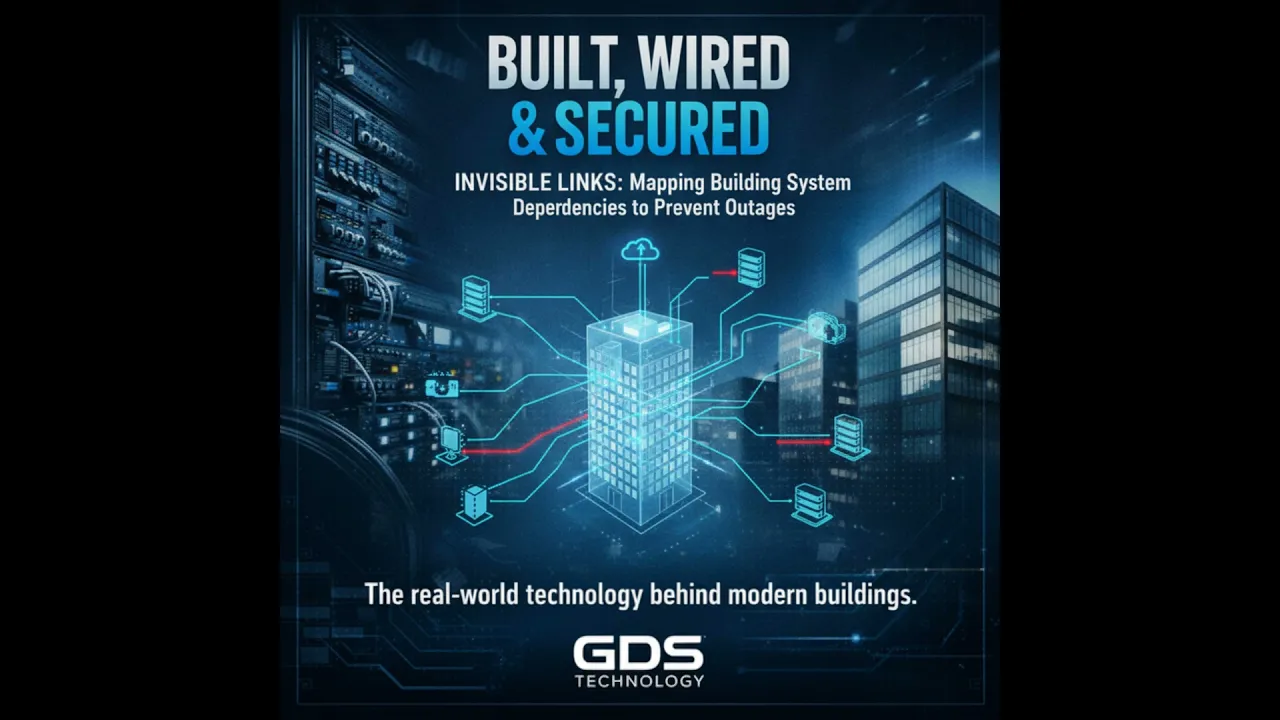
The practical answer presented in the episode is an operational dependency map: a compact, owner-friendly document that shows which systems rely on power, network connectivity, cloud services, vendors, and people. Done well, it helps teams answer the first question that matters during any incident: what breaks if this goes down?
Why Impact-First Mapping Matters
One of the strongest themes in the conversation is that the map should not begin as an engineering schematic. It should begin as an operational decision tool. Owners, operators, and facilities teams do not need to start with every technical setting or every network detail. They need to understand impact first.
That means a useful dependency map should tell them what service will fail, who will be affected, who owns the problem, and how fast degradation will happen. In the first few minutes of an outage, that level of clarity matters more than a dense technical diagram that only a specialist can interpret.
This distinction is important for commercial real estate teams because outages are rarely judged only by technical severity. They are judged by tenant disruption, business interruption, response quality, and how quickly the right people are involved. A concise map can shorten that path.
What Belongs on the One-Page Owner Map
The episode outlines a clean structure for the owner-facing version of the map. It should include major systems such as HVAC, access control, elevators, and security monitoring. It should also identify the primary dependencies behind those systems, including incoming power, external network links, and any cloud services that control operations.
For each item, the map should answer a few plain-English questions:
- Who owns this node, service, or system?
- What happens if it fails?
- Who is the immediate escalation contact?
- Is there a known fallback or manual workaround?
That format keeps the map readable under pressure. It helps decision-makers move from uncertainty to action without forcing them to interpret low-level technical documentation in the middle of an incident.
Why Sensitive Technical Detail Needs a Separate Appendix
The guests make another useful distinction: the owner summary and the technical appendix should not be the same document. The appendix can and should contain the deeper details technicians and vetted vendors need to restore service. That includes network segments, console endpoints, support contacts, SLAs, and maintenance notes.
But it should be secured. The conversation is explicit about this point. Sensitive technical content should be locked down and shared only with vetted staff and contractors. Credentials should not be sitting in an open shared drive. Console URLs, VLAN IDs, and administrative steps should not be casually distributed just because they are operationally useful.
This separation creates a better balance between resilience and security. Owners get the clarity they need. Technical teams still get the information required to work effectively. But the building is not exposed unnecessarily.
Document Consequence, Not Attack Surface
One of the more practical insights in the episode is how to mark single points of failure without turning the map into a security liability. The recommendation is to describe consequence, not technical specifics.
In other words, do not document a critical system in a way that exposes precise infrastructure details on a broad-use map. Instead, explain the business or operational consequence if that system fails. For example, rather than publishing an internal identifier and address, describe it as a central control point for building access and BAS operations, then note the severity of loss and any available workaround.
That keeps the map useful for operators while reducing unnecessary exposure. It also helps non-technical stakeholders understand what truly matters. A board member, owner representative, or property manager may not care about the device name, but they do care that a single failure could impair access control or delay restoration across the building.
Assumptions Can Become Hidden Risks
The conversation also highlights a subtle but important risk: assumptions age out. A map may assume that a spare pump is available on site. It may assume a manual badge override still exists. It may assume a fallback process is ready. But if those conditions are no longer true, the map can mislead teams at the worst possible moment.
That is why the episode recommends labeling assumptions clearly and attaching an expiration or verification date where appropriate. A statement like temporary manual bypass available should not float indefinitely without verification. If nobody has checked that path in months, responders may rely on a fallback that no longer works.
For building operations, this is a strong reminder that resilience is not just a design exercise. It is an upkeep discipline.
Start Small: The 60-Minute Workshop
For teams worried that dependency mapping will become a large, slow documentation effort, the episode offers a straightforward starting point: run a 60- to 90-minute workshop with operations, IT, and one relevant vendor. Put the major systems on a whiteboard. Draw the power and network dependencies. Annotate what fails, who owns the issue, and who gets called.
That is intentionally lightweight. The goal is not to solve every edge case in one session. The goal is to create an artifact that is useful enough to guide action and simple enough that teams will actually maintain it.
After the workshop, the summary should be stored in a shared read-only location so the right people can find it fast. The technical appendix should be stored in a secure vault. Then the process moves from theory to practice: pilot the map in one building, validate it during a maintenance window, and scale what works.
How Smaller Portfolios Can Keep It Practical
Not every owner or operator has the capacity to maintain a large, deeply detailed dependency model. The episode addresses that reality directly. For smaller portfolios, the recommendation is to focus first on three critical dependencies, one fallback for each, and a single tested escalation path.
That narrower scope is practical, but the guests also warn against oversimplifying vendor accountability. If a critical dependency is outsourced, the map should still capture who is responsible, what standby SLA applies, what on-site response expectation exists, and who the named escalation contact is. Writing vendor manages this is not enough if nobody knows how quickly help arrives when service is failing.
This is where the map becomes more than documentation. It becomes a management tool that shapes contracts, response expectations, and operational readiness.
Use the Map in Commissioning, Drills, and Handoffs
The episode outlines three places where a dependency map becomes especially valuable.
- Commissioning: Verify that systems behave as documented and that dependencies are real, not assumed.
- Outage drills: Simulate a failure, run the escalation path, and time the response.
- Handoffs: Include the map in owner and vendor transition packets so knowledge survives staffing or contract changes.
The drill example shared in the conversation is especially useful. A 90-minute scenario revealed a 12-minute vendor callback delay. That kind of issue might not appear in a static document review, but it becomes obvious during a live exercise. Fixing it reduced the impact of future outages. That is exactly the kind of operational improvement owners care about because it connects planning directly to service continuity.
Three Actions to Take Next
The close of the episode is appropriately tactical. First, run a 60-minute cross-team workshop and draft a one-page map for three critical dependencies. Second, document the escalation contact and expected response SLA for each of those dependencies. Third, schedule a short outage drill next month to validate one of them under controlled conditions.
The guests add two more strong recommendations: review the map after any major vendor change or capital project, and establish a spares policy for critical parts when appropriate. A replacement part on site can compress restoration time dramatically.
Make the Map a Working Tool, Not Shelfware
The final takeaway from the episode is simple and worth repeating: treat the dependency map like an SOP, not like historical paperwork. Use it during decisions. Use it during tests. Use it during handoffs. If teams do not consult it, it becomes stale. If they do, it becomes one of the most practical ways to reduce outage confusion and improve response quality.
For commercial property owners and operators, that is the real value. A good dependency map helps teams see the invisible links before those links fail in public. If you want a better handle on how to build one and operationalize it, this episode is well worth a listen at https://builtwiredsecured.com/episodes/invisible-links-mapping-building-system-dependencies.