
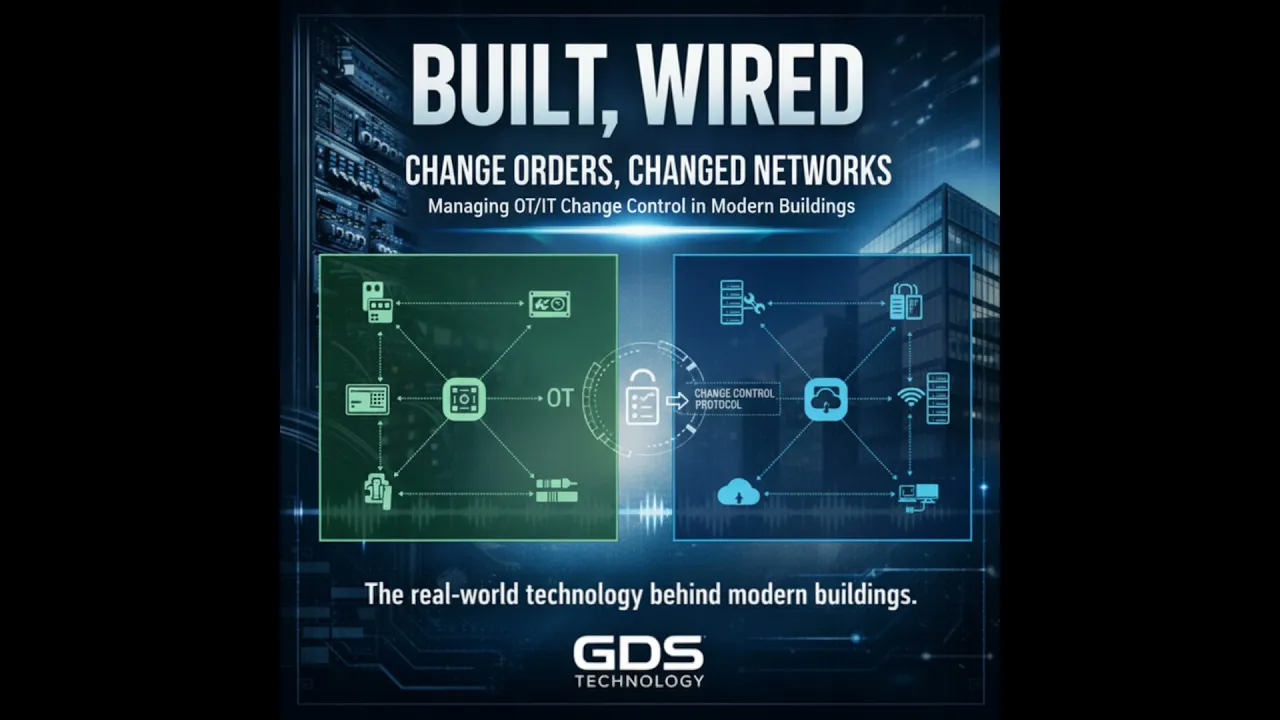
Show Notes
Why Routine Building Changes Turn Into Major Operational Problems
Modern buildings depend on constant change. Firmware updates, BAS adjustments, network patches, access control changes, tenant requests, and vendor handoffs all happen in the background of normal operations. This episode focuses on a hard truth: those changes are often treated as isolated technical tasks when they are actually shared operational events.
The conversation opens with a realistic scenario. A routine midweek firmware update triggers an HVAC controller reboot, access control authentication problems, and a flood of calls to the front desk. The damage is immediate: lost productivity, reduced trust, and confusion about who approved the change in the first place. That framing sets up the core message of the episode: small changes create big problems when nobody owns coordination.
- Routine changes can create tenant-facing disruption within minutes
- The real cost is not just downtime, but confusion and finger-pointing
- A change does not have to be dramatic to carry real operational risk
The Root Cause: Silos Across Facilities, IT, Vendors, and Tenants
One of the clearest takeaways from the episode is that most failures are not caused by bad intent. They are caused by separation. Facilities may manage one vendor relationship for building systems, IT may manage another for switches and wireless, and tenants may introduce their own contractors. Each group schedules work against its own priorities. Without a shared view, those changes collide.
The speakers describe how weak documentation and fragmented ownership create "parallel change cascades" that never meet until something fails. What looks isolated on paper often turns out to be a shared dependency in practice. A BAS controller may sit on the same VLAN as an access control component. A network update may affect authentication for systems facilities assumed were independent. The issue is not just technology design. It is a lack of visible coordination.
- Different teams often approve and schedule changes independently
- Shared dependencies are missed when documentation is weak
- No single escalation path makes incidents harder to contain
Speed Versus Safety: The Practical Middle Ground
The episode does not argue for heavy bureaucracy. In fact, it argues the opposite. The speakers push back on the idea that reliability requires a complicated approval board. Instead, they recommend clearer thresholds and tiered ownership.
That distinction matters. Rather than forcing every update through the same process, teams should separate low-risk work from changes that affect critical systems. Minor, non-disruptive updates can move quickly with a brief checklist. Anything touching authentication, routing, or emergency systems should require joint review by IT and operations, plus more deliberate testing and scheduling.
The point is not to slow people down. It is to match process to operational risk. A simple framework helps teams move faster on safe work and more carefully on changes that can impact tenants, safety, or building access.
- Thresholds matter more than committees
- Low-risk changes can stay lightweight
- Higher-risk changes need joint signoff, testing, and scheduled outage planning
Low-Effort Controls That Prevent Most Outages
The most useful part of the episode is how practical the recommendations are. The speakers focus on controls that can be implemented immediately, without expensive tooling or a major governance program.
The first is a visible shared change log. Not a spreadsheet buried on one person's drive, but a record that facilities, IT, and tenant services can all access. Each entry only needs a few essentials: a one-line summary, scheduled time, who is performing the work, and a reference to the rollback plan. The value is visibility, not volume.
The second is a two-minute pre-flight. Before making the change, confirm backups, confirm a baseline of key telemetry, confirm the person responsible for rollback is available, and confirm the communication channel if something goes wrong. If any of those are missing, pause the work.
The third is to define a small telemetry baseline and an agreed rollback threshold. The episode keeps this intentionally simple. Examples include controller CPU, uptime, authentication success rates, and a few key sensors. Capture a short baseline before the change, then agree in advance what deviation means the change must be rolled back.
- Use a shared, searchable change log
- Require a short pre-flight before non-trivial updates
- Capture a small telemetry baseline before the change
- Agree in advance on the threshold that triggers rollback
Why Rollback Discipline Matters More Than Debate
A strong theme throughout the conversation is reversibility. The speakers emphasize that teams perform better under stress when the rollback trigger is defined before the change begins. If a health metric crosses the agreed threshold, rollback happens immediately. That removes debate during the most chaotic moments.
They also stress the importance of a named escalation path. When incidents happen, people lose time simply figuring out who to call. A single phone line or shared channel with clear on-call ownership is more valuable than a long procedure nobody can navigate during an outage.
This is where operational maturity shows up. The best teams are not the ones that never experience change risk. They are the ones that can restore service quickly, communicate clearly, and diagnose the problem without allowing disruption to spread.
Real-World Contrast: Coordinated Recovery Versus Uncoordinated Failure
The episode uses two short examples to make the point. In one case, a tenant-requested control tweak affected ventilation schedules. Sensors began reporting unexpected set points 90 minutes later. Complaints started rising within 30 minutes, but the team rolled back in 20 minutes. That outcome is presented as a win because reversibility contained the disruption.
In contrast, a network refresh was scheduled without notifying facilities. Access control servers lost reachability and doors defaulted to fail safe during a busy delivery window. The result was tenant disruption, manual escorts, and hours of recovery work. The comparison is simple and effective: notification plus reversibility dramatically reduces the blast radius.
A Three-Step Starter Plan for Building Teams
For listeners who want a practical way to start, the episode closes with a three-step pilot:
- Create a visible shared change log for any non-trivial update
- Adopt a two-minute pre-flight checklist that includes rollback confirmation
- Define one escalation path with clear on-call responsibilities
The recommendation is to run those steps as a four-week pilot, track prevented incidents, and use actual results to build buy-in. That reflects the broader philosophy of the episode: practical controls beat policy theater. Teams are more likely to adopt lightweight disciplines that clearly prevent pain.
The final reminder is especially strong: keep the focus on reversibility. If you can return systems to a known-good state quickly, you create room to investigate, learn, and improve without turning every change into a building-wide event.
OT/IT Change Control in Modern Buildings Does Not Need to Be Complicated
Commercial buildings now operate on a constant stream of technical change. Firmware updates, BAS adjustments, access control changes, network patches, wireless updates, tenant fit-out requests, and vendor maintenance all happen in the background of daily operations. The problem is not that change is happening. The problem is that many properties still treat those changes as separate technical events instead of shared operational risks.
That gap is where preventable outages begin.
In this episode of Built, Wired & Secured, the discussion centers on a simple but often overlooked reality: a "routine" update can quickly become a tenant-facing disruption when no one owns coordination. A midweek firmware push can trigger controller reboots, authentication failures, front-desk call volume, and a scramble to determine who approved the work. By the time teams sort out responsibility, productivity has already taken a hit.
The lesson is clear. In modern buildings, change control is not just an IT process and it is not just a facilities concern. It is an operational discipline that sits between building systems, network infrastructure, tenant experience, and business continuity.
Why Building Changes Fail in Predictable Ways
One of the strongest points in the episode is that most failures are not caused by reckless people. They are caused by fragmented workflows.
Facilities may work with one vendor for building automation. IT may work with another for switches, routing, and Wi-Fi. Tenants may bring in their own contractors. Each group makes reasonable decisions based on its own scope. But when those decisions are made in silos, hidden dependencies get missed.
That is especially dangerous in commercial real estate environments where systems overlap more than they appear to. A BAS controller might share network dependencies with access control. An authentication change might affect systems the operations team assumed were isolated. A network refresh may look straightforward to one team and become a safety or access issue for another.
The result is what the episode describes as parallel change cascades: separate changes moving on separate calendars, with no shared checkpoint until something breaks.
That is why the first operational question matters so much: what breaks if this goes down? If the answer includes tenants, front-desk operations, door access, HVAC behavior, or emergency systems, the change is not isolated, even if the task ticket says it is.
The Real Goal Is Not More Process. It Is Better Thresholds.
A common mistake in change governance is jumping straight to bureaucracy. Teams hear "change control" and imagine long meetings, slow approvals, and a process nobody wants to follow. This episode argues for a more useful approach.
The answer is not bigger committees. It is clearer thresholds.
Low-risk updates should move through a lightweight process. If a change is operationally minor and non-disruptive, it can be handled quickly with a short checklist and defined accountability. But changes that touch authentication, routing, emergency systems, or core building operations should trigger a different level of coordination. Those changes need joint visibility between IT and operations, plus a more deliberate plan for testing, timing, and rollback.
That tiered model helps teams avoid two bad outcomes at once. It prevents overprocessing harmless work, and it prevents underestimating risky work. In other words, it protects speed where speed is appropriate and introduces discipline where the blast radius is larger.
The Most Effective Controls Are Often the Simplest
Another strength of the episode is its focus on low-effort controls that reduce incidents without forcing a major program rollout. Three controls stand out.
First, create a shared change log that is visible to facilities, IT, and tenant services. Visibility is the point. If a change is non-trivial, the people most likely to feel the impact should be able to see what is being changed, when it is scheduled, who is doing it, and where the rollback plan lives. That does more than improve recordkeeping. It helps prevent overlapping work, bad assumptions, and avoidable surprises.
Second, run a two-minute pre-flight before the change begins. The episode keeps this refreshingly practical. Confirm backups. Confirm a short telemetry baseline. Confirm the person responsible for rollback is available. Confirm the communication path if the change fails. If one of those pieces is missing, pause. That is not bureaucracy. That is basic operational readiness.
Third, define a small set of baseline metrics and agree in advance on the point that triggers rollback. That is important because incidents become harder to manage when teams argue in real time about whether the issue is "bad enough" to reverse course. If authentication success rates drop below the agreed threshold, or controller behavior moves outside expected range, the decision has already been made. Roll back first. Diagnose second.
Reversibility Is a Competitive Advantage
The episode repeatedly returns to one idea: keep the focus on reversibility.
That is a powerful concept for building operators, property managers, and technology teams because it changes how maintenance windows are viewed. A well-managed change is not just one that succeeds on the first try. It is one that can be safely and quickly reversed when conditions move outside the planned range.
That matters because the cost of indecision during an incident is high. When people do not know who owns the call, what threshold matters, or how to restore the last known-good state, small problems become prolonged outages. Tenants do not experience that as a process gap. They experience it as lost trust.
By contrast, a team with a rollback plan, a visible escalation path, and a clear threshold buys itself something valuable: time. Time to stabilize service. Time to diagnose the issue carefully. Time to learn from what happened without letting disruption spread across the building.
A Short Example That Explains the Difference
The conversation shares two simple scenarios that make the operational difference easy to understand.
In one case, a tenant-requested control tweak affected ventilation schedules. Unexpected set points appeared after the update, complaints began to rise, and the team rolled back within 20 minutes. That response did not eliminate the issue, but it contained the impact. That is exactly what disciplined change control is supposed to do.
In the other example, a network refresh moved forward without notifying facilities. Access control systems lost reachability, doors defaulted to fail safe, and staff had to manually escort people during a busy delivery window. Recovery took hours. The contrast is sharp: when coordination is missing, the incident grows beyond the technical task that started it.
A Practical Three-Step Pilot for Building Teams
If your property or portfolio does not have formal OT/IT change governance today, the episode offers a realistic place to start. Do not launch a giant policy initiative. Start with a four-week pilot built around three steps:
- Create a visible shared change log for every non-trivial update
- Use a two-minute pre-flight checklist that confirms rollback readiness
- Define one escalation path with clear on-call responsibility
Then measure outcomes. Track near-misses, prevented overlaps, avoided confusion, and faster recovery decisions. Results create buy-in faster than policy language ever will.
That is one of the most useful business lessons in the episode. Teams adopt process more willingly when they can see how it protects uptime, tenant experience, and staff time. For owners, operators, and technology leaders, that translates directly into fewer avoidable disruptions and stronger confidence in building operations.
The Bottom Line
Modern buildings cannot avoid change, but they can stop treating change as an isolated technical event. The systems that run a property are too interconnected for that mindset to hold up. What matters most is not complexity. It is coordination, visibility, and reversibility.
If your team can answer three questions quickly, you are already on stronger footing: who is changing what, when is it happening, and what does rollback look like?
That is not red tape. That is operational maturity.
If this topic sounds familiar inside your building environment, listen to the full episode and use the starter framework to test a more disciplined approach on your next maintenance cycle.