
Show Notes
Episode overview
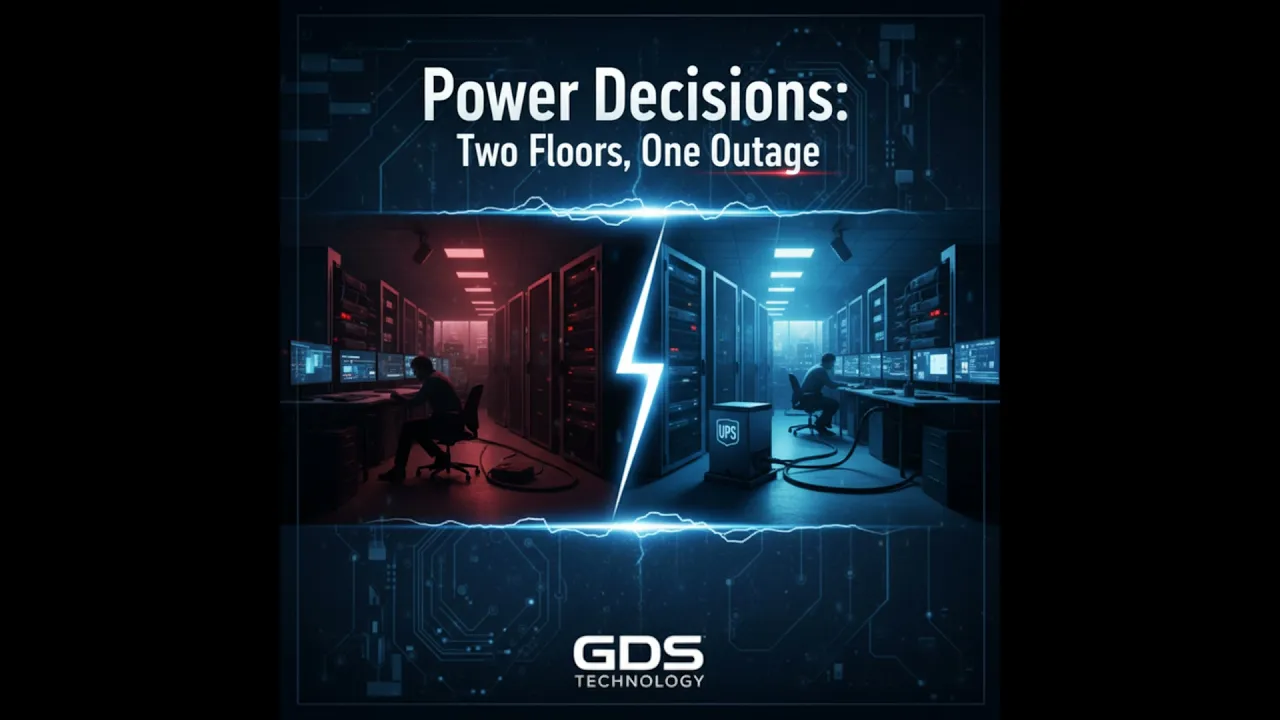
This episode follows a simple but useful contrast: two neighboring tenant floors in the same building experience the same upstream power event at 2 a.m., but their outcomes are completely different. One floor stays down for about four hours, losing phones, access systems, HVAC schedules, and services tied to a handful of server racks. The other restores most critical services in under 30 minutes. The difference was not a massive capital project or a premium product stack. It came down to modest early power decisions, clear ownership boundaries, and a testing routine that had actually been documented and run.
Rather than turning power resilience into a product pitch, the episode focuses on decision rules that owners, facilities teams, tenant IT leaders, and project stakeholders can use in real design reviews. The through-line is practical: define what matters, assign accountability, and make handoff steps testable before an outage forces everyone to improvise.
The three-item checklist introduced early
- Define and agree critical loads.
- Match redundancy to downtime tolerance.
- Require testable handover documentation.
These three points are presented as an immediate filter for design meetings that often get bogged down in vague assumptions. The episode argues that saying these items out loud can quickly expose confusion around what must stay up, who is responsible for it, and whether the handoff process has ever been proven under realistic conditions.
The anonymized micro-case
The first floor relied on basic strip UPS units under desks and a small tenant-supplied generator plan that had never been properly validated. Metering was sparse, so the building team lacked a clear picture of the tenant's actual load. Critical load ownership was also unclear. Tenant IT believed facilities owned the UPS responsibility, while facilities assumed tenants handled it. Once the upstream issue occurred, the result was confusion, manual switching, and a long recovery cycle that stretched into roughly four hours of downtime and substantial productivity loss.
The second floor was not outage-proof, but it was outage-ready. It had modestly sized UPS capacity covering defined critical loads, explicit written ownership for each piece of equipment, and a simple documented test that was executed quarterly. Because the outage playbook had already been clarified and exercised, the team had enough breathing room to restore most critical services in under 30 minutes with no major tenant disruption.
The root causes behind long recoveries
The episode identifies three recurring root causes that show up repeatedly in real environments.
- Undermetering hides true demand and makes sizing decisions less reliable.
- Mixed tenant loads on building panels make it harder to isolate critical circuits.
- Ownership ambiguity causes maintenance, testing, and response steps to fall through the cracks.
Together, these issues create fragile systems even when some backup equipment exists on paper. A site can appear to have redundancy while still lacking the clarity needed to use it effectively under pressure.
How the episode frames backup strategy choices
One of the strongest parts of the discussion is its refusal to reduce resilience planning to a single preferred architecture. Instead, the episode offers heuristics that help match technical choices to operational reality.
For tenant UPS versus building UPS, the suggested rule is straightforward. If the load is exclusively tenant-owned and likely to change frequently, tenant-managed UPS can make sense because the tenant controls upgrades and variability. If the load supports shared services such as access control, elevators, or shared Wi-Fi, building-level UPS or centralized battery capacity is usually the better fit because it reduces surprises and aligns maintenance with shared operational responsibility.
For generators, the episode pushes listeners to define the objective before sizing the asset. The real question is not whether a generator should cover everything forever. It is whether the goal is indefinite runtime until utility service returns or a shorter bridge period until UPS support or selective load shedding takes over. Once that answer is clear, sizing can be based on realistic critical loads and an appropriate growth margin rather than fear-based oversizing.
For centralized batteries versus distributed UPS modules, the trade-off centers on coordination and accountability. Centralized systems can be easier to monitor and maintain at the building level, while distributed systems may provide tenant isolation and lower initial cost. The right answer depends less on theory and more on staffing model, tenant churn, and who is actually expected to own ongoing operations.
Why testing and documentation matter more than binders
The episode repeatedly returns to the same operational truth: resilience plans fail when documentation exists only as a handoff binder that no one revisits. Testable handover documentation means more than a checklist hidden in a drawer. It means a simple script that someone can actually run, clear acceptance criteria, and a named owner who confirms the test was performed.
The recommended baseline is quarterly or semiannual testing for critical loads in many commercial settings, supported by automated monitoring and alerting wherever possible. If a UPS shows capacity loss or a generator fails a self-test, the right time to learn that is before tenants are affected, not during an incident.
Five repeatable design-review questions
- Which circuits are legally owned by the tenant and which are building provided?
- What are the defined critical loads and what is the agreed downtime tolerance for each?
- How will the handover be tested, who runs the script, how often, and where do results live?
- Who monitors UPS and generator health, and what alert thresholds are in place?
- If batteries are centralized, how will tenant churn and energy-capacity billing be handled?
These questions are valuable because they force alignment across ownership, expectations, and operations before a failure event exposes weak assumptions.
Realistic trade-offs, not one-size-fits-all answers
The episode closes the gap between theory and practice with a few grounded examples. In some cases, adding a modest UPS for communications closets and access control is more practical and less expensive than sizing a generator for whole-floor HVAC. In other cases, a tenant with a small lab or compute cluster may need to fund and manage its own redundancy. The point is not that one model always wins. The point is that resilience decisions should reflect risk tolerance, budget, and staffing reality.
Key takeaway
The final message is crisp: write down critical loads, choose redundancy based on downtime tolerance and operational ownership, and require verifiable handover documentation. Done well, those steps materially reduce the chances that the next grid hiccup turns into a four-hour disruption. The episode also reminds listeners to use the show's resource hub for a downloadable checklist and to consult licensed electricians and local code officials for implementation and compliance decisions.
Why two similar tenant floors had completely different outage outcomes
Power resilience is often treated like a budget problem or a hardware problem. This episode makes a stronger point: many painful outages are really ownership and planning failures that happen long before the lights go out.
The episode opens with a sharp comparison. Two neighboring tenant floors in the same building experience the same upstream grid event when a breaker trips at 2 a.m. One floor remains down for about four hours. Phones go offline, access systems fail, HVAC schedules are disrupted, and a handful of server racks lose service. Tenants are frustrated, facilities is under pressure, and the incident report becomes a long record of confusion and delay.
The floor next door experiences the same event and gets most critical services back in under 30 minutes.
That contrast is the entire lesson. The difference was not luck. It was not a premium product decision. It was not a giant overspend. According to the episode, the winning factors were modest UPS sizing tied to defined critical loads, written ownership boundaries, and a documented testing cadence that had actually been performed.
The three questions every team should settle before a failure
Early in the episode, listeners are given a three-item checklist that cuts through the noise in design meetings:
- Define and agree critical loads.
- Match redundancy to downtime tolerance.
- Require testable handover documentation.
These points sound simple, but they reach the heart of why resilience planning often breaks down. Too many projects move ahead with broad assumptions like “we have backup power” or “the tenant is covering that” without pinning down exactly which systems must stay up, how long they need to stay up, and who owns each step when utility power fails.
When those questions remain vague, even decent equipment can fail operationally because no one knows what it is supposed to support or who is supposed to act first.
What went wrong on the four-hour floor
The episode’s anonymized micro-case is useful because it isolates operational mistakes that are easy to miss during normal project turnover.
On the floor with the longer outage, backup planning was fragmented. There were basic strip UPS units under desks and a small generator plan supplied by the tenant, but the generator plan had never been validated. Metering was sparse, which meant the building team did not have a reliable picture of actual demand. Critical loads were not clearly separated from general loads, and ownership of the UPS responsibility was ambiguous. Tenant IT assumed facilities handled it. Facilities assumed the tenant handled it.
Once the upstream issue occurred, that ambiguity translated directly into delay. There was confusion about what was protected, what could be switched, who had authority, and what sequence should be followed. Recovery became manual, reactive, and slow.
This is a practical reminder for commercial real estate, mixed-use environments, and multi-tenant operations: resilience fails when accountability is fuzzy. A recovery plan that exists only in assumptions is not really a plan.
Why the under-30-minute floor recovered faster
The second floor did not avoid the outage. It avoided the chaos that often follows the outage.
Its power strategy covered defined critical loads with modestly sized UPS capacity. Ownership for each equipment area had been explicitly documented. A simple handover test had been written down and executed quarterly.
That combination matters because it turns resilience from a theoretical design feature into an operational routine. When people already know what is critical, what is protected, and what handoff steps to follow, the outage window shrinks. The UPS does not solve every problem by itself. It buys the team time to act without panic.
That distinction is important for decision-makers trying to balance resilience and cost. The episode’s case suggests that moving from a four-hour outage to a 30-minute recovery may come less from buying the largest possible backup system and more from making modest, well-scoped decisions early and supporting them with real accountability.
The three root causes the episode keeps returning to
The discussion identifies three recurring sources of failure:
- Undermetering, which hides real demand and leads to poor planning.
- Mixed tenant loads, which make it difficult to isolate critical circuits when building and tenant equipment are intertwined.
- Ownership ambiguity, which causes maintenance and testing tasks to fall through the cracks.
These are not niche technical issues. They are management issues with technical consequences. If metering is incomplete, sizing decisions become guesswork. If loads are mixed, selective backup becomes harder. If ownership is unclear, everyone assumes someone else is watching the system.
For property stakeholders, facilities leaders, and tenant IT teams, that means the best resilience investment may begin with clarity rather than capacity.
How to think about tenant UPS versus building UPS
The episode deliberately avoids product recommendations and instead offers decision heuristics.
For tenant-managed UPS versus building-level UPS, the choice should follow the nature of the load. If the load is exclusively tenant-owned and likely to change often, a tenant-managed model can make sense because the tenant controls equipment refresh cycles and demand growth. If the protected systems support shared operations such as access control, elevators, or shared Wi-Fi, building-level UPS or centralized battery capacity is usually the more stable choice.
The real lesson is that technical boundaries should mirror operational boundaries. Shared services should not depend on informal assumptions about who will maintain or replace backup equipment. Tenant-specific variability should not be forced into a building-wide model without understanding upgrade and support implications.
The smarter way to think about generator sizing
The episode also challenges a common instinct: oversizing a generator to cover everything “just in case.”
That approach may feel safer, but it brings capital costs, fuel implications, and additional maintenance complexity. Instead, the episode recommends starting with a more strategic question: what is the actual runtime objective?
Does the generator need to sustain operations indefinitely until utility power returns? Or is its purpose to bridge a shorter event while UPS systems maintain critical services and selective load shedding reduces demand? That answer should drive sizing philosophy.
In other words, resilience is not just about maximum coverage. It is about appropriate coverage aligned to business risk and operational intent.
Centralized batteries or distributed UPS modules?
The same principles apply to battery architecture. Centralized systems can simplify monitoring, maintenance, and building-level visibility. Distributed UPS modules may reduce initial cost and create cleaner tenant-level accountability.
The deciding factors are not abstract engineering preferences. They are operational realities: how much coordination is needed across shared systems, how much tenant churn the property expects, and whether the staffing model supports centralized oversight.
The episode’s guidance is practical: if coordinated blackout tolerance for shared systems matters and you want unified visibility, centralization may be the better fit. If tenant isolation and churn management matter more, distributed ownership may be easier to sustain.
Why documentation must be testable, not decorative
One of the strongest warnings in the episode is about handoff culture. Many projects conclude with a binder and a quick walkthrough, after which the documentation disappears into a drawer.
The episode argues for something better: testable handover documentation. That means a simple script that can actually be run, acceptance criteria that are easy to verify, and a clearly assigned owner who confirms testing happened. Quarterly or semiannual testing is presented as a reasonable baseline for many commercial environments.
Automated monitoring and alerting also play a critical role. If UPS capacity degrades or a generator self-test fails, those warnings should surface before tenants feel the impact. A resilience system that cannot report its own weakness is already on borrowed time.
Five design-review questions worth repeating
The episode closes with a set of repeatable questions that are just as useful in owner meetings as they are in project reviews:
- Which circuits are legally tenant-owned and which are building-provided?
- What are the defined critical loads and the agreed downtime tolerance for each?
- How will the handover be tested, by whom, how often, and where will results live?
- Who monitors UPS and generator health, and what alert thresholds apply?
- If batteries are centralized, how will tenant churn and energy-capacity billing be handled?
These questions work because they expose mismatches between design intent and operational reality before an incident does.
The real business takeaway
The final takeaway is clear. Write down critical loads. Choose redundancy based on downtime tolerance and operational ownership. Require and verify testable handover documentation.
That is the thread running through the entire episode: resilience is not about paying for the biggest possible system. It is about making sure the right systems stay up for the right amount of time under a model that people can actually operate.
If this episode’s scenario feels familiar, it is worth listening to the full discussion and using the checklist from the show’s resource hub as a starting point for your next design review. Sometimes a short conversation about boundaries, testing, and critical loads prevents hours of avoidable downtime later.