
Show Notes
Why prioritization matters when power is constrained
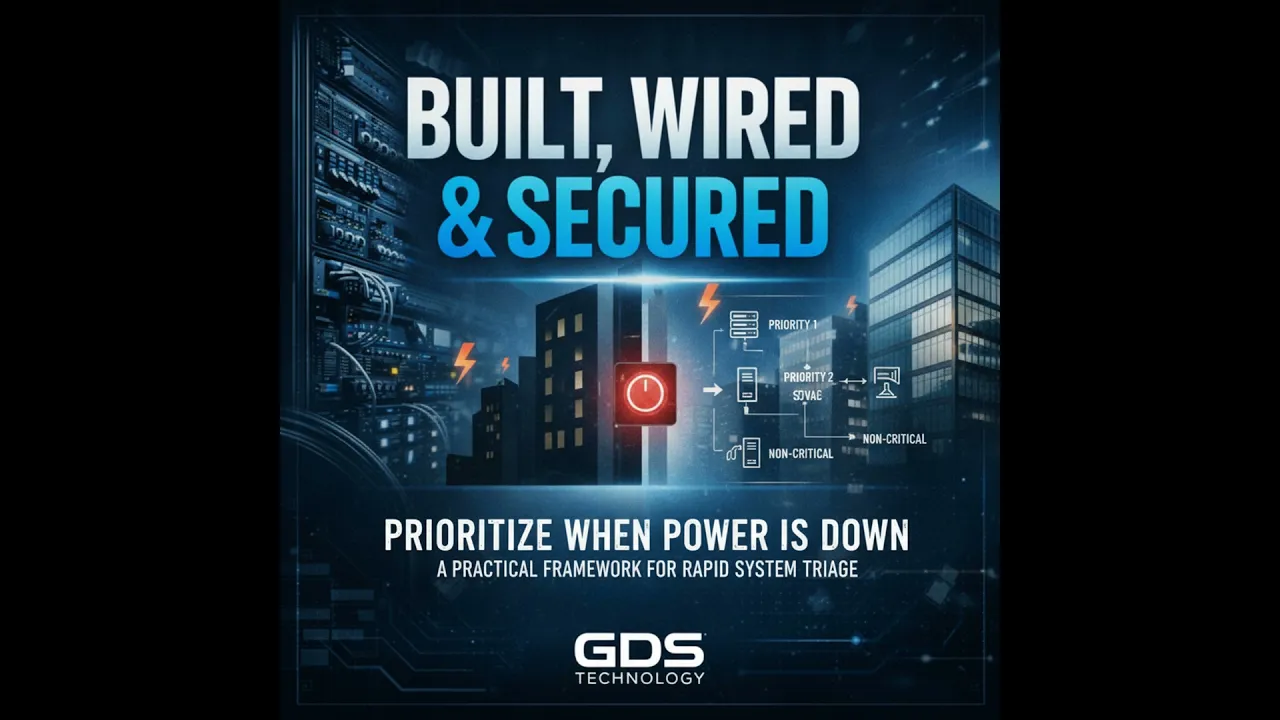
This episode of Built, Wired, and Secured focuses on a problem that becomes urgent the moment a campus or building loses part of its available power: when multiple important systems cannot all stay online, someone has to decide what remains energized, what gets scaled back, and how those choices are communicated. The discussion opens with a realistic scenario: a partial utility outage, limited backup power, and several competing demands including lobby doors, clinical pumps, and network switches. The central point is simple but high stakes: the first question is not technical preference, but operational priority.
The conversation frames constrained operations as an issue of consequence, tempo, and preparation. When teams have already categorized systems, practiced response steps, and documented exceptions, they can make fast decisions without creating chaos. When they have not, every decision becomes political, stressful, and slow.
What repeatedly puts buildings and teams into this position
The episode identifies several recurring causes of constrained operations:
- Utility brownouts or scheduled curtailments
- Partial generator failures
- Aging battery systems
- Human error during switching sequences
- Cascading failures, such as a UPS drop that forces other systems to reboot
One of the most useful distinctions in the episode is tempo. A utility brownout may give operators minutes or even a few hours to respond, which can allow staged shedding and better tenant communication. A switchgear failure can force immediate action. That difference changes the playbook. Slower events may support a managed reduction approach. Faster events require preapproved rules that people can apply without debate.
The guests stress that teams should not organize decisions only around how systems are connected. Instead, they should organize around consequence. If one failure point can trigger multiple downstream issues, the better question is what business, safety, and recovery outcomes each system supports.
A practical four-part decision framework
The episode lays out a compact four-dimension prioritization matrix designed to make real-time choices more defensible and repeatable. Those four dimensions are:
- Life safety
- Critical services that prevent irrecoverable loss
- Revenue impact systems
- Recovery speed, meaning whether keeping a system online helps restore everything else faster
This framework is intentionally plain-English. It gives incident leaders a way to classify loads and functions before an event, instead of trying to negotiate priorities in the middle of one. The discussion also makes clear that prioritization is not just a technical exercise. It involves operations, tenants, stakeholders, and in some cases clinical or research needs.
One especially practical point is that recovery speed deserves its own category. Some systems may not be the most visible to tenants, but keeping them online can shorten the overall outage and reduce total disruption.
How to prevent mid-event lobbying and confusion
The conversation addresses a predictable problem: once an outage begins, managers and occupants often push to have their area treated as more important than originally planned. The guests recommend procedural controls rather than ad hoc arguments.
- Use a pre-registered exception form
- Require two-person signoff for any mid-event reclassification
- Timebox the decision, such as a 10-minute approval window
- Default back to the pre-agreed tier if approval does not happen in time
- Log the request and rationale for post-event review
They also recommend making the tier structure tenant facing. In the episode, Tier A is associated with life safety and clinical care, Tier B with critical systems and high-revenue tenants, and Tier C with convenience. Special needs such as research labs or data closets should be published as exceptions only if they have been filed ahead of time. The larger theme is transparency. When people know the rules before an event, there is less friction during the event.
The two-minute verification every team should know
Another standout takeaway is the idea of a two-minute verification before operators start flipping breakers or shedding loads. That check includes:
- Confirming generator auto-start
- Verifying transfer switch positions
- Checking key breaker loads against expected baselines
If one of those checks fails, the team is dealing with a technical blocker that can undermine the entire shedding plan. The point is not complexity. It is discipline. Short checks only work when preventative maintenance has already made the equipment and process reliable.
Real-world examples that show the impact
The episode shares two examples that make the framework tangible. In one mixed-use campus incident, a utility curtailment threatened to overload a single generator. Operators followed a pre-agreed shedding plan that kept life safety systems and core emergency communications closets online while shedding non-essential lighting, reducing HVAC, and isolating two non-critical data closets. Because tenants already understood the tiers, operations staff were able to move quickly. What might have become a two-day outage was reduced to under eight hours.
The second example comes from a hospital-related environment where an exception had been missed. A lab freezer was not listed, was shut down during a shed, and approximately 1,200 samples thawed. The result was several weeks of research loss and a costly recovery effort. Afterward, the team required exception registration, linked exceptions to the escalation log, and scripted tenant messages with exact wording and timelines. The lesson is that administrative discipline can be as important as electrical or mechanical readiness.
What facilities and operations leaders can do this week
The episode closes with a practical action list for leaders who want to make prioritization real instead of theoretical:
- Map systems to simple tiers and publish them to tenants
- Run a two-minute verification on transfer switches and key breakers
- Collect exception requests and move them into a documented escalation log
- Build a one-page decision matrix for the incident commander
- Get stakeholder signoff on priority categories
- Schedule quarterly tabletops that include vendors and tenant representatives
The guests also call out vendor readiness as part of execution. A vendor arriving without the right keys, access, or scope can become another bottleneck. Drills should include logistics, communications, and role clarity, not just technical response steps.
Final takeaway
The strongest message in this episode is that prioritization should never be improvised under pressure. Teams need a simple framework, published tiers, documented exceptions, fast verification checks, and regular practice. When those pieces are in place, split-second decisions become controlled, repeatable, and more tenant friendly. For owners, facilities leaders, and IT or operations teams, that preparation can materially shorten outages, reduce business loss, and protect trust when resources are limited.
When power is down, priority becomes the real operating system
When a building, campus, or facility loses part of its available power, the immediate pressure is not just technical. It is operational. Multiple systems may all appear essential in the same moment, but limited backup capacity forces a harder question: what absolutely must stay on, what can be reduced, and who has the authority to make that call quickly?
That is the central theme of this episode of Built, Wired, and Secured. The discussion does not get lost in vendor-specific controls or product features. Instead, it focuses on a practical framework that owners, facilities leaders, and IT or operations teams can use when resources are constrained. The goal is not perfect uptime under impossible conditions. The goal is to make fast, defensible, repeatable decisions that reduce tenant impact and speed recovery.
The scenario is familiar, even if the details change
The episode opens with a realistic example: a Tuesday morning utility issue creates a partial outage across a campus. Backup power is limited. Two critical systems both need the same feed. Lobby doors, clinical pumps, and network switches all want to remain energized. In that moment, someone has to decide which loads stay alive and which ones are shed.
That situation could happen in a medical environment, a mixed-use campus, a commercial office property, or a research facility. The specific equipment may differ, but the decision pattern is the same. You do not have enough capacity for every preferred outcome, so your response depends on preparation more than improvisation.
One of the most important ideas in the conversation is that chaos increases when teams are trying to invent priorities in real time. The faster systems are categorized by consequence, the faster response teams can move from uncertainty to action.
Why constrained operations happen more often than teams expect
The episode identifies several recurring causes that put organizations into this squeeze. Utility brownouts and scheduled curtailments are obvious examples, but the discussion goes further. Partial generator failures, aging batteries, and human error during switching sequences all show up repeatedly. There is also the risk of cascading failures, where a single issue such as a UPS drop can cause several downstream systems to reboot or fail together.
This matters because teams sometimes plan around connection diagrams rather than consequences. If a single point of failure can create several different operational problems, your response needs to be organized around what each dependent system actually means to safety, business continuity, and recovery.
The episode also introduces the idea of tempo. Not every event unfolds at the same speed. A utility brownout may give operators minutes or a few hours to act. That creates room for controlled load shedding, staged communications, and more deliberate execution. A switchgear failure is different. It may demand immediate action and leave no time for debate. Slow events let you manage transition. Fast events require preapproved rules.
A four-part matrix that keeps decisions simple
The core framework discussed in the episode uses four dimensions to prioritize systems. The categories are intentionally straightforward:
- Life safety
- Critical services that prevent irrecoverable loss
- Revenue impact systems
- Recovery speed
This structure is useful because it forces teams to think beyond convenience. Life safety comes first. After that, the next priority is not simply what is loudest or most visible, but what prevents permanent or hard-to-reverse damage. The episode gives listeners a strong example of why that matters: if a freezer supporting research is omitted from exceptions planning, the outcome is not temporary discomfort. It can be weeks of lost work and a costly recovery effort.
Revenue impact adds another business lens. Some systems directly affect tenant operations, service continuity, or billable activity. And the fourth category, recovery speed, is especially practical. Keeping certain systems online can reduce overall outage duration even if those systems are not the most visible during the event. That makes recovery speed a strategic category, not an afterthought.
The politics of outages are real, so plan for them too
One of the most honest parts of the episode is its recognition that priorities are often challenged mid-event. Managers want their space elevated. Occupants argue that their needs are special. Without structure, those requests can derail response.
The guests recommend a simple governance approach. Use pre-registered exception forms. Require two-person signoff for any mid-event reclassification. Put a time limit on approval. If that time window expires, default back to the existing tier. And log every request with the reason behind it for post-event review.
That guidance matters because it turns emotional escalation into a controlled process. It also keeps the incident commander from being overwhelmed by ad hoc lobbying.
The episode also recommends making the tier structure visible to tenants ahead of time. In the discussion, Tier A covers life safety and clinical care. Tier B covers critical systems and high-revenue tenants. Tier C covers convenience. Research labs, data closets, and other special cases should be published as formal exceptions when filed in advance. This kind of transparency reduces friction because expectations are set before the emergency begins.
Operational discipline beats technical heroics
A repeated theme in the episode is that reliability starts long before the outage. Teams that practice tabletops, maintain simple checklists, and perform preventative maintenance respond differently under stress. They do not waste precious time deciding who should act or whether a process can be trusted.
The guests highlight a two-minute verification that teams can run before shedding loads:
- Confirm generator auto-start
- Verify transfer switch positions
- Check key breaker loads against expected baselines
This is a small but powerful idea. In a constrained event, even a well-designed shedding plan can fail if the underlying mechanical or electrical state is not what operators assume it is. That short verification helps catch blockers before the team makes the situation worse by acting on bad assumptions.
The conversation connects this directly to preventative maintenance. Quick checks are only useful when the equipment and operating environment have been maintained well enough for those checks to be trustworthy.
Two case studies that show the difference preparation makes
The episode includes a mixed-use campus example where a utility curtailment threatened to overload a single generator. The team followed a pre-agreed plan. Life safety systems and core emergency communications closets remained online. Non-essential lighting was shed. HVAC was reduced. Two non-critical data closets were isolated. Because the tenant-facing tiers had already been established, operations could move quickly instead of negotiating every action in the moment.
The result was significant. What could have become a two-day outage was reduced to under eight hours. That is not a marginal gain. It is the difference between major business disruption and a contained event.
The hospital-related example drives home a different lesson. In that case, one lab freezer had not been listed as an exception. It was shut down during the shedding process, and roughly 1,200 samples thawed. The consequence was the loss of several weeks of research and an expensive recovery effort. The fix was not a new buzzword or platform. It was tighter operational discipline: required exception registration, linking exceptions to the escalation log, and scripted tenant communications with exact wording and timelines.
That is a useful reminder for any technology, facilities, or operations leader. Process failures can be just as damaging as equipment failures.
Do not forget vendor readiness
The episode adds one more operational detail that is easy to overlook: vendor logistics. A vendor truck at the gate does not solve the problem if the team lacks keys, scoped access, or the right contact window. That is why drills should include vendors and tenant representatives, not just internal technical staff. If teams practice only the technical steps, they may still be improvising around access, communications, and decision authority when the real event happens.
What to do next
The advice at the end of the episode is direct and useful. Facilities and operations leaders can start this week by mapping systems into simple tiers, publishing those priorities to tenants, running quick verification checks on transfer switches and key breakers, and collecting exception requests into a documented escalation log.
They can also build a one-page decision matrix for the incident commander using the four dimensions discussed in the episode: life safety, critical services, revenue impact, and recovery speed. Most importantly, they can schedule a quarterly tabletop that includes not only technical teams, but vendors and tenant representatives too.
The message is clear: if you do not practice the politics, communications, and operational tradeoffs together, you will still be improvising when the pressure is highest.
Why this matters beyond outages
This framework is useful because it translates technical constraints into business decisions. It helps organizations protect people, reduce loss, preserve trust, and recover faster. That is why prioritization is not just a facilities issue or an electrical issue. It is a leadership issue.
If your building or campus depends on multiple interconnected systems, constrained operations are not a hypothetical problem. They are a planning problem you can solve before the next event. This episode offers a strong starting point: define the tiers, register the exceptions, verify the basics, and practice the response until split-second decisions become repeatable.
For teams looking to strengthen operational resilience without overcomplicating the process, this conversation is a useful reminder that the best time to decide what matters most is before the lights start flickering. Listen to the full episode for the complete framework and practical examples.