
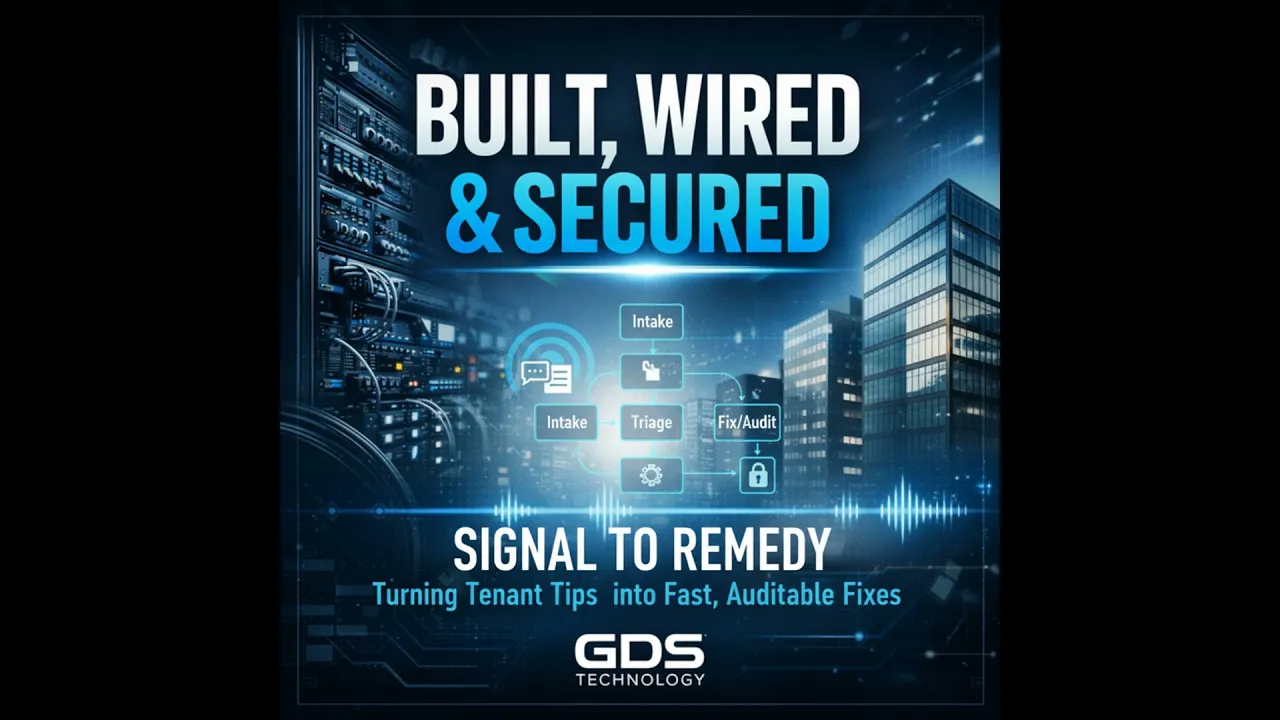
Show Notes
Small Signals Become Big Outages When Nobody Owns Them
This episode of Built, Wired, and Secured starts with a simple but costly scenario: a tenant casually mentions that a conference room floor feels warm late on a Friday, but no ticket gets opened. Two days later, the boiler controller trips, the thermostat network flaps, the building loses heat for the weekend, tenants are frustrated, trades are scrambling, and the post-mortem begins with the question nobody wants to answer: why was that small signal ignored?
Host Alex Morgan and guest Michael Harrington, a senior property manager with decades of hands-on operations experience, use that story to frame the core problem. Tenants often notice issues before dashboards, alerts, or scheduled checks do. The challenge is not whether a signal exists. The challenge is whether the team has a lightweight, repeatable way to capture it, prioritize it, assign it, and close the loop.
The episode delivers a governance-first playbook for turning hallway comments, quick texts, and one-off observations into auditable, prioritized work that can actually prevent bigger failures.
Segment One: Define the Signal in Plain Language
The first section focuses on one of the biggest process failures in operations: overcomplicating intake. Instead of jumping straight into technical troubleshooting, Michael breaks tenant reports into three simple categories:
- Symptom: what the person feels or sees, such as “it’s warm in conference room 3.”
- Repeatable issue: something that can be observed more than once, like the same room, same time, or the same report returning.
- Safety sign: anything that could threaten people or property and needs immediate escalation.
That framework matters because it gives front desk and operations staff a common language without requiring them to diagnose the system. Instead of asking for technical certainty, the process starts by asking for situational clarity.
The single follow-up question Michael recommends is simple: “Is this happening now or has it happened before?” That one question helps separate an isolated observation from a pattern that needs reproduction or escalation. It is practical, fast, and easy for any team member to use consistently.
Segment Two: Lightweight Intake That Builds Trust
The second segment moves from definitions to action. Alex and Michael role-play a front desk interaction to show what good intake sounds like in real life.
In the example, the front desk agent asks for:
- The tenant’s name
- The room or location
- A photo, if possible
- When the issue was noticed
- Whether it is still happening now
- A contact number for follow-up
Michael then shows how that becomes a usable ticket: “warm floor, conference room C, photo attached, timestamp noted,” plus a short reproduction note that the tenant reported warmth at 10:20 and that it was ongoing at the time of intake.
The point is not to interrogate the tenant or demand deep diagnostics. The point is to preserve enough context that the next person can act without losing time. As discussed in the episode, the lightweight intake pattern has four core pieces:
- Photo: visual evidence when available
- Timestamp: when the issue was noticed
- Short repro note: a brief sentence showing the issue is happening
- Location alias: a simple location reference anyone on the team understands
That pattern keeps trust intact while making the ticket actionable. The tenant feels heard, the front desk has a repeatable method, and operations gets enough detail to triage quickly.
Segment Three: Triage Fast, Assign Clearly, Close the Loop
The final main segment covers what happens after intake. Michael outlines three straightforward rules for triage and closure:
- Prioritize by impact and safety. If it is a safety sign, escalate immediately and stop other work.
- Use a single-owner handoff. Assign the ticket to one person so accountability is clear.
- Require a closure check. After the work is done, confirm in the ticket and contact the tenant to verify the issue is resolved before closing it.
The closure message example is intentionally short and specific: the team addressed the warm floor in conference room C at 1400, and the tenant is asked to confirm they no longer feel warmth. That final confirmation matters because it reduces repeat tickets and reinforces trust that the report was taken seriously.
Michael also names the two KPIs that show whether the process is working:
- Average time to closure
- Repeat ticket rate for the same location and symptom
If both numbers go down, the team is doing more than collecting noise. It is converting signals into outcomes.
Two Micro-Cases That Show the Difference
The episode closes the theory-to-practice gap with two short cases.
In the success case, repeated hallway odor reports from three tenants over two weeks were logged as tenant signals with photo, timestamp, and a short reproduction note. The team assigned a single owner and required tenant confirmation before closure. That process revealed a faulty pump seal. The fix was completed in one shift, repeat reports stopped, and tenants noticed the professional follow-up.
In the stalled case, the intake process was left free-form. Emails, hallway comments, and texts were all treated differently. Nobody enforced single ownership. Tickets sat unassigned, trades arrived without context, and the tenant kept chasing updates. The repair process improved only when the team enforced the intake checklist, required assignment within 30 minutes, and made closure confirmation mandatory.
The key lesson is clear: the process failed before the system did. Governance fixed the gap.
Three Actions You Can Take in 30 Minutes
Alex and Michael end with three practical actions listeners can implement quickly:
- Post the tenant report triage checklist where front desk and operations teams can see it and run a 30-minute drill.
- Standardize intake around photo, timestamp, short repro line, location alias, and contact information.
- Enforce single-owner assignment and require tenant confirmation before closing the ticket.
The episode’s one call to action is to download the one-page Tenant Report Triage Checklist from the show notes and schedule that short intake drill this week.
Why This Episode Matters
This conversation is not about adding bureaucracy. It is about creating a simple operating habit that helps teams respond faster, document better, and avoid preventable failures. For commercial property teams, the lesson is practical: if tenants are already surfacing early warning signs, the real operational risk is failing to capture and govern those reports consistently.
That is what makes this episode useful. It offers a plain-language framework, a usable intake script, a triage structure, measurable KPIs, and three next steps that can be implemented immediately.
Why Tenant Signals Matter More Than Most Teams Realize
A hallway comment does not usually feel like the beginning of a building outage. That is exactly why it is easy to ignore.
In this episode of Built, Wired, and Secured, host Alex Morgan opens with a sharp scenario that captures a common operations failure. A tenant casually mentions that a conference room floor feels warm late on a Friday. No ticket gets opened. By the weekend, the boiler controller trips, the thermostat network starts flapping, the building loses heat, tenants are upset, and trades are reacting under pressure. The post-mortem starts with the question that should have been answered much earlier: why did nobody act on the first signal?
That setup drives the central point of the conversation with Michael Harrington, a senior property manager with decades of hands-on operations experience. Tenants often notice problems before formal monitoring does. The real issue is not awareness. It is whether the team has a reliable process to turn informal reports into auditable, prioritized work.
This episode offers a governance-first playbook for doing exactly that.
Start with Better Definitions, Not Better Jargon
One of the most useful parts of the episode is how plainly the problem is framed. Instead of pushing front desk or operations staff toward technical troubleshooting, Michael introduces a simple taxonomy for tenant reports.
A symptom is what the tenant sees or feels. In the episode’s example, that is the statement that the floor feels warm. A repeatable issue is something that shows up more than once, whether in the same room, at the same time, or through repeated reports from the same location. A safety sign is in its own category entirely because anything that could threaten people or property needs immediate escalation.
This matters because many teams lose momentum at the intake stage. They either ask for too little and create vague tickets, or they ask for too much and make the reporting process feel burdensome. Michael’s approach avoids both mistakes by keeping the first layer of intake practical and non-technical.
The episode also gives listeners one follow-up question that does a lot of work without creating friction: “Is this happening now or has it happened before?”
That single question helps establish scope. It tells the team whether they are dealing with an isolated observation, a pattern, or something that may need faster escalation. It also gives staff a repeatable script they can use consistently, regardless of how technical they are.
The Best Intake Process Is Lightweight and Repeatable
From there, the conversation moves into a short role-play between a front desk agent and a tenant. It is one of the strongest moments in the episode because it turns process language into something operational teams can actually use.
The front desk script is simple. Thank the tenant for reporting the issue. Ask for their name and room. If possible, ask for a photo. Ask when the issue was noticed and whether it is still happening now. Get a contact number in case the team needs to confirm the fix later.
That is not a long list, but it captures the pieces that make a ticket usable:
- A clear location
- A timestamp
- Evidence when available
- A short note showing the issue is real and current
- A path to close the loop with the reporting tenant
Michael then demonstrates how to log the issue in practical terms: warm floor, conference room C, photo attached, tenant reports warmth at 10:20 and says it is ongoing. That short reproduction note is important because it preserves context without making the tenant perform diagnostics.
The episode repeatedly comes back to trust. If intake feels like an interrogation, people stop reporting. If intake is too loose, the operations team loses the context needed to respond effectively. The process has to be light enough for the tenant and structured enough for the team. That balance is what makes the playbook useful.
Triage Only Works When Ownership Is Clear
Once the signal is captured, the next risk is organizational drift. This is where Michael’s triage rules are especially practical.
First, prioritize by impact and safety. If the report is a safety sign, stop and escalate immediately. That sounds obvious, but naming it as the first rule matters because it keeps teams from treating every incoming issue as operationally equal.
Second, assign a single owner. The episode is very direct on this point. One person owns the ticket. That might be a maintenance technician, a vendor coordinator, or someone else depending on scope, but the accountability has to be crystal clear. Without single-owner assignment, work stalls between departments, updates become inconsistent, and nobody can confidently say who is driving resolution.
Third, require a closure check. Once the work is done, the owner confirms the work in the ticket and reaches back to the tenant with a short message asking whether the issue has truly been resolved. In the episode’s example, that means confirming the warm floor was addressed and asking whether the tenant still feels heat in the room.
This final step is easy to skip, especially when teams are busy. It is also one of the most valuable controls in the entire workflow. Closure confirmation does more than mark a task complete. It verifies the outcome, reduces repeat tickets, and tells tenants their report did not disappear into the system.
The Right KPIs Are Simple
Many teams overcomplicate measurement, but the episode keeps the KPI discussion tight and useful. Michael recommends tracking two numbers:
- Average time to closure
- Repeat ticket rate for the same location and symptom
Those metrics work because they reveal whether the process is actually reducing operational drag. If time to closure drops and repeat ticket rates drop, the team is not just documenting work better. It is handling signals more effectively from intake through resolution.
That is an important distinction. Good governance should not create paperwork for its own sake. It should make the operation more responsive and more reliable.
Two Cases That Show Process Failure vs. Process Improvement
The episode reinforces the framework with two micro-cases.
In the first, repeated hallway odor reports came in from three different tenants over two weeks. Because those reports were logged with photo, timestamp, and a short reproduction note, and because a single owner was assigned with closure confirmation required, the team identified a faulty pump seal. The repair was completed during one shift, repeat complaints stopped, and tenants noticed the professional follow-up.
In the second, the process broke down because intake was free-form. Reports came through emails, hallway conversations, and texts. No one enforced ownership. Tickets sat unassigned. Trades arrived without context. The tenant kept following up because the system never really took control of the problem.
The fix was not a technical tool. It was governance: enforce the checklist, require assignment within 30 minutes, and make closure confirmation mandatory.
That distinction is one of the strongest lessons in the episode. Sometimes what looks like a facilities issue or a service issue is really a workflow issue first.
Three Actions You Can Take This Week
Alex closes the episode by narrowing the advice down to three actions that can be completed in about 30 minutes:
- Post the tenant report triage checklist where front desk and operations teams can see it, then run a short drill.
- Standardize intake around photo, timestamp, short repro line, location alias, and contact information.
- Enforce single-owner assignment and require tenant confirmation before ticket closure.
Those steps are intentionally modest. They do not require a platform change, a major retraining program, or a complicated workflow redesign. They require consistency.
The Bigger Takeaway
What makes this episode effective is that it reframes tenant reporting as an operational advantage. Informal observations are not noise by default. They are early signals. But they only become useful when the organization has a disciplined way to capture them, classify them, assign them, and verify the result.
For teams managing buildings, tenants, and service workflows, that is the real opportunity. Better intake is not about bureaucracy. It is about reducing missed context, speeding up response, improving accountability, and preventing small issues from becoming expensive outages.
If you want a practical framework you can put in front of a front desk team and an ops team today, this episode delivers it clearly. And if the opening scenario felt uncomfortably familiar, that is probably the point. The gap between signal and remedy is often smaller than it looks. It just needs to be governed on purpose.
Listen to the full episode for the complete walkthrough, the front desk role-play, the two micro-cases, and the one-page Tenant Report Triage Checklist mentioned in the show notes.