
Show Notes
Why Spare Parts Strategy Belongs in Operations
In this episode of Built, Wired & Secured, Alex Morgan and Michael Harrington break down a problem that feels small until it becomes urgent: a critical building technology component fails, the issue is diagnosed quickly, and then everything stalls because there is no usable spare on hand. The opening scenario is simple but familiar. A network switch that supports access control and guest Wi-Fi goes down in the middle of a busy weekday. The facilities team identifies the issue in minutes, but the replacement timeline is driven by a three-week lead time instead of operational need. That gap turns a routine hardware failure into a tenant-facing outage.
The conversation reframes spare parts as an operational risk decision rather than a purchasing afterthought. Michael explains that the purpose of spares is to reduce mean time to repair while protecting revenue, tenant trust, and occupant experience. If a failed component affects safety, security, access, connectivity, or business continuity, there should already be a plan for how the building responds.
What Creates Hidden Downtime Risk
A major takeaway from the episode is that spare-parts problems rarely come from a single bad decision. They usually result from several operational realities colliding at once.
- Downtime costs more than the replacement part. Teams may focus on hardware cost, but the bigger issue is lost trust, SLA exposure, and operational disruption.
- Procurement is slower and less predictable than many teams assume. Standard SKUs get discontinued, and lead times can stretch to six to eight weeks or longer.
- BOM drift makes documentation unreliable over time. Tenant contractors, refresh projects, or convenience replacements can change components without updating the official record.
- Untested inventory creates false confidence. A part may be sitting on a shelf, but if it has not been tested or its firmware is out of sync, it may not actually reduce downtime.
Together, those issues create hidden single points of failure. The episode makes the case that modern building operations need a repeatable method for identifying those risks before a live incident exposes them.
Where Spare Parts Programs Usually Fail
Michael outlines four common failure points that show up in real projects. The first is BOM drift, where the original bill of materials no longer reflects what is actually installed. The second is a buy-to-fail mindset, where teams assume replacement parts will always be available when needed. The third is dependency on single-source or proprietary components that are difficult to replace quickly. The fourth is poor storage discipline, where parts are kept without testing, labeling, or accountability.
That combination is especially dangerous in commercial buildings where multiple systems are interconnected. A switch, controller, or module may look like a small item in a rack or enclosure, but if it supports access, security, or tenant connectivity, the operational impact of failure can be much larger than its size or price suggests.
How to Decide What to Stock
One of the most practical parts of the episode is the framework for classifying which components deserve immediate spare coverage. Michael recommends asking three questions for each item:
- Does its failure affect life safety or security?
- Does it interrupt tenant revenue-generating activity?
- Does it create cascading failures in other systems?
If the answer to any of those questions is yes, the item should be treated as critical. For critical equipment, the recommendation is straightforward: keep one hot spare on site and one additional backup offsite or with a trusted partner. For lower-impact items, teams can look at vendor consignment, managed inventory, or just-in-time procurement instead.
The discussion also highlights the value of standardization. If one SKU can support multiple locations or floors, inventory requirements go down without increasing risk. That is a strong example of how operational discipline can lower cost while improving resilience.
How to Operationalize a Repeatable Program
The episode moves beyond theory and lays out a practical workflow teams can implement.
- Start with an inventory audit that maps systems to SKUs, lead times, and end-of-life dates.
- Classify components by impact using business and operational criteria, not just replacement cost.
- Set a testing cadence. Michael recommends quarterly smoke tests for network and access control spares and semiannual power-up checks for controllers.
- Label every item with a unique ID, last test date, and next test due date.
- Store electronics in climate-controlled, static-safe conditions with clear labeling and a single point of accountability.
- Explore procurement options such as vendor consignment or negotiated RMA windows for expensive or bulky parts.
- Build spare management into annual capital planning, vendor handovers, and day-to-day operations governance.
Michael also shares a simple labeling structure teams can use immediately: system type, SKU, location code, inventory ID, and last test date. The key idea is traceability. The box and the item inside it should both be identifiable, and the same record should live in a CMMS or inventory spreadsheet.
Real-World Lessons and a Simple Starting Checklist
The episode closes with two clear examples. In one success case, a multi-tenant office tower standardized access controllers and kept two hot spares on site. When one controller failed at 8:00 a.m., the technician swapped it in within 20 minutes and tenants never felt the disruption. In the failure case, a proprietary network module technically had a spare available, but it had not been tested in two years and a firmware mismatch made it unusable. The outage lasted three days.
The lesson is direct: holding inventory is not enough. Testing, firmware policy, documentation, and accountability matter just as much as the decision to buy the spare.
For teams ready to act, the rapid-start checklist from the episode is clear: audit inventory, map lead times, classify by impact, hold hot spares for critical items, test and document them on a schedule, standardize where possible, store and label properly, include spares in capital planning and vendor handovers, and assign operational ownership with annual reviews. If your building technology environment supports tenant operations, this episode makes a strong case for replacing reactive panic buying with a deliberate spare-parts strategy.
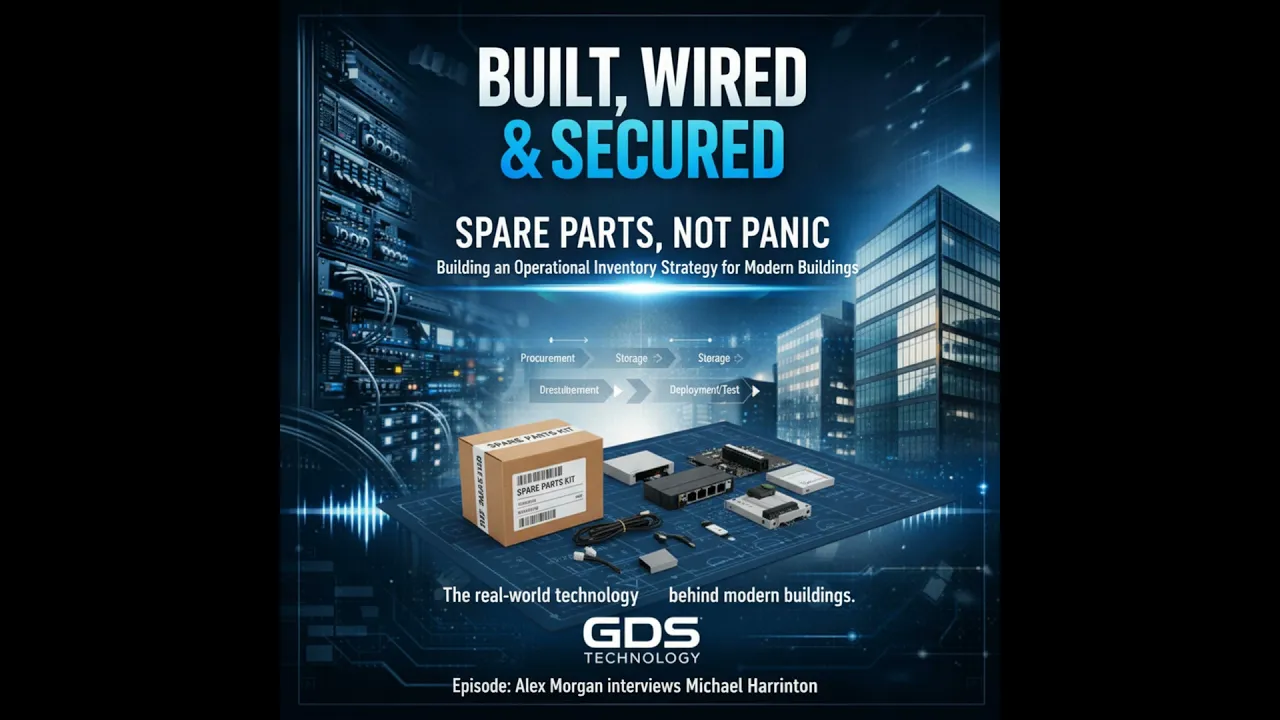
Spare Parts, Not Panic: Building an Operational Inventory Strategy for Modern Buildings
When a critical building technology component fails, most teams can diagnose the hardware problem faster than they can solve the business problem that follows. The real delay often is not troubleshooting. It is the moment someone asks, “Where’s the spare?” and the answer is either unclear or uncomfortable.
That is the central issue explored in this episode of Built, Wired & Secured. Alex Morgan and Michael Harrington focus on a practical challenge facing property operators, IT leaders, and facilities teams: how to create a spare-parts strategy that protects uptime without turning inventory into wasted capital. The discussion stays grounded in operational reality, and that is what makes it useful. This is not a theoretical procurement conversation. It is a framework for reducing downtime risk in modern buildings.
A Small Hardware Failure Can Become a Big Operational Event
The episode opens with a scenario many teams can picture immediately. It is the middle of a busy weekday. Tenants are on calls. A building automation alarm appears. The key network switch supporting access control and guest Wi-Fi fails. The facilities team traces the issue in ten minutes, which should be a success. But then comes the blocker: there is no spare available, and the vendor lead time is three weeks.
That is the moment where a routine replacement turns into a tenant-impacting outage.
What makes this framing effective is that it shifts the conversation away from pure hardware cost. A spare switch or controller may not look strategic on a balance sheet, but the absence of that spare can create outsized operational consequences. The cost of waiting is not just replacement price. It can include loss of tenant confidence, service disruption, emergency procurement, and damaged vendor relationships.
Why Spares Are Really About Risk, Not Just Inventory
Michael Harrington explains the role of spares in straightforward terms: they reduce mean time to repair and protect revenue and occupant experience. That idea matters because it moves spare-parts planning out of a narrow purchasing lens and into an operational one.
The test is simple. Ask what breaks if a component goes down. If the answer affects safety, security, access, connectivity, or business operations, then a spare strategy belongs in the conversation.
This approach is especially relevant in modern buildings where infrastructure systems overlap. A single failed component may touch more than one experience at once. Something as ordinary as a network device can influence guest Wi-Fi, access control, building systems visibility, and the daily flow of tenant operations. That interconnectedness means spare planning cannot be handled casually.
The Three Forces That Turn Missing Spares Into Real Downtime
One of the strongest sections of the episode is the explanation of why this issue keeps surfacing. Michael identifies three forces that converge.
First, there is the cost of downtime, which is not only financial. Tenant trust is hard to rebuild once a preventable outage exposes weak planning.
Second, there are procurement realities. Standard SKUs get discontinued. Lead times stretch longer than expected. What looks easy to replace on paper may be unavailable for six to eight weeks or more in practice.
Third, there is BOM drift. Over time, installed environments change. A contractor swaps a controller. A tenant refresh introduces different hardware. A convenience replacement is made without documentation being updated. Eventually, the baseline record no longer reflects what is live in the building.
Those forces create hidden single points of failure. Teams may believe they understand their environment, only to discover during an incident that the documented inventory, actual installed hardware, and current procurement options no longer line up.
Why Spare Parts Programs Break Down
The episode does a good job of naming the operational habits that undermine spare-parts programs.
The first failure point is BOM drift. The project handoff may have started with a clean bill of materials, but years later the field reality is different. If a building team is using outdated documentation, it may think it has a replacement strategy when it really has a documentation problem.
The second is a buy-to-fail mentality. This is the assumption that parts can always be purchased when needed. It feels efficient until a key item is discontinued or backordered.
The third is single-source dependency. Proprietary modules and limited-availability components increase risk because they remove flexibility when speed matters.
The fourth is poor storage discipline. A shelf full of parts is not a resilience strategy if those parts are untested, mislabeled, or stored badly. A spare that does not boot, or does not match current firmware, is not an operational control. It is just an expense.
How to Decide What Deserves a Spare
Not every component should be stocked the same way, and the episode gives a practical method for making that decision. Michael recommends asking three questions for each component:
- Does its failure affect life safety or security?
- Does it interrupt tenant revenue-generating activity?
- Does it create cascading failures in other systems?
If any of those answers is yes, the component should be classified as critical.
That criticality framework is useful because it connects technical inventory decisions to business outcomes. It helps teams avoid two common mistakes: overbuying low-impact inventory and underpreparing for high-impact failures.
For critical items, the guidance is clear: keep one hot spare on site and one backup offsite or with a trusted partner. For lower-impact components, teams can consider alternatives such as vendor consignment, managed inventory, or just-in-time procurement.
The conversation also highlights standardization as a cost-control strategy. If one spare can support multiple floors or locations, that improves coverage while reducing the amount of capital sitting idle in storage.
What a Repeatable Spare Strategy Actually Looks Like
Where this episode becomes especially actionable is in the operational process it lays out. A strong spare-parts strategy is not just about deciding what to buy. It is about managing the full lifecycle of that inventory.
The process starts with an inventory audit. Teams need to map systems to SKUs, document lead times, and note end-of-life dates. Without that baseline, classification and planning will be unreliable.
Next comes impact classification. Once components are categorized by operational consequence, teams can decide what deserves on-site coverage and what can be handled through other channels.
Testing is the next major control. Michael recommends quarterly smoke tests for network and access control spares and semiannual power-up checks for controllers. That recommendation addresses a common blind spot. Many organizations assume a spare is good simply because it has not been used. In practice, the opposite can be true. Idle inventory can become outdated, damaged, or mismatched if no one owns its readiness.
Labeling and storage also matter more than many teams admit. The suggested label format is simple and practical: system type, SKU, location code, inventory ID, and last test date. The same identifier should be tracked in a CMMS or inventory spreadsheet. Storage should be climate-controlled where needed, electronics should stay in static-safe packaging, and there should be clear accountability for who owns the program.
The final piece is governance. Spare management should not live as a one-time capital project or an afterthought left behind at handover. It belongs inside operations responsibilities, annual capital planning, and vendor transition processes.
The Difference Between Holding a Spare and Having a Real Strategy
The episode’s examples make this distinction clear. In the success story, a multi-tenant office tower standardized access controllers across floors and kept two hot spares on site. When one controller failed at 8:00 a.m., a technician swapped it in within 20 minutes. There was no tenant impact, and the failed unit went out for repair the same afternoon. In that case, the cost of holding spares paid for itself in avoided SLA credits.
In the failure example, another site technically had a spare for a proprietary network module. But it had not been tested in two years, and a firmware mismatch made it unusable. The outage lasted three days while the correct module was expedited, and the tenant relationship suffered.
That contrast is the core lesson of the episode. Inventory alone is not readiness. A real strategy includes testing, documentation, standardization, storage discipline, and operational ownership.
What Decision-Makers Should Do Next
If your building technology environment supports tenant access, connectivity, security, or revenue-generating operations, this conversation points to a practical next step: move spare-parts planning out of reactive procurement and into ongoing operations.
Start with the checklist shared in the episode. Audit inventory. Map lead times. Classify by impact. Hold hot spares for critical items. Test them on a schedule. Standardize where possible. Label and store them properly. Include spare planning in capital and vendor conversations. Assign ownership and review it annually.
None of that requires an overhaul overnight. But it does require treating spare readiness as part of operational resilience instead of a detail to solve during an outage.
If your team is responsible for keeping building systems available and tenant disruptions low, this episode offers a strong framework for getting there. Listen to the full conversation for the complete checklist and examples, then use it to pressure-test your current inventory strategy before the next preventable failure turns into a much bigger problem.