
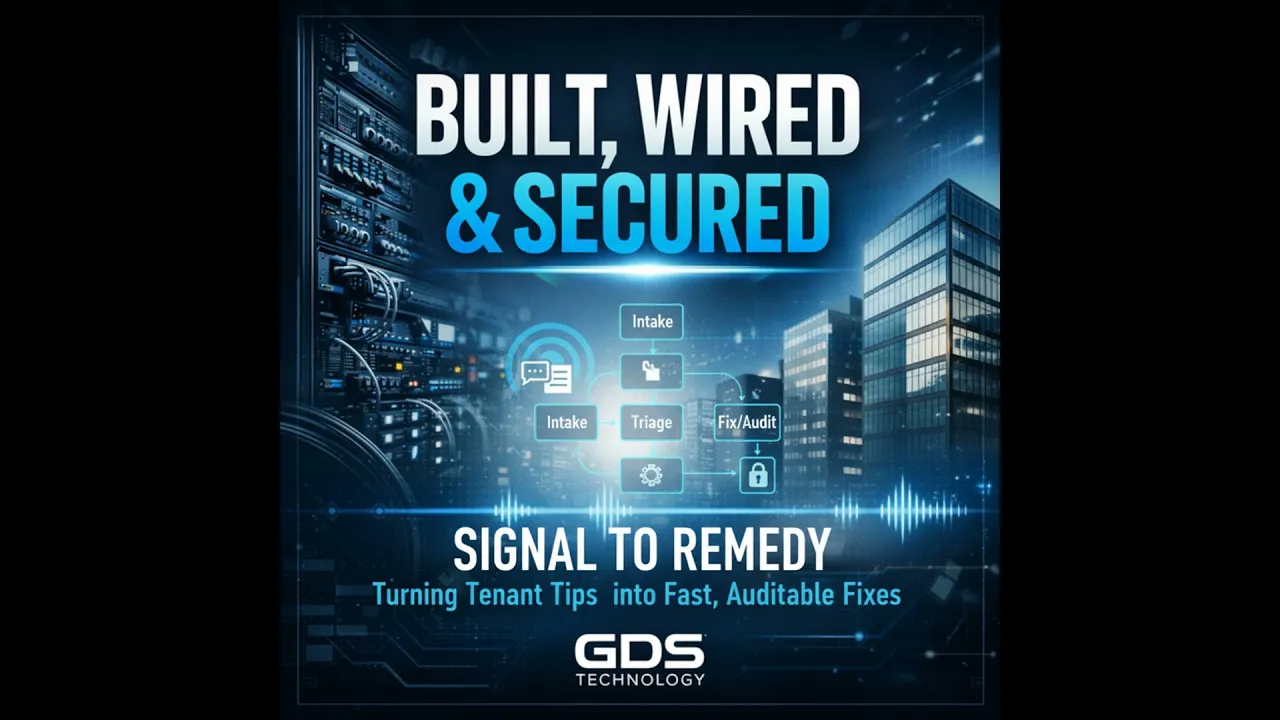
Show Notes
From hallway comment to auditable work
A tenant’s early observation can be the first warning of an operational issue, but it only protects the building if the observation becomes visible, assigned, and verified work. This episode opens with a Friday hallway comment that a conference room floor feels warm. No ticket is created. Two days later, a boiler controller trips, the thermostat network flaps, and the building loses heat for the weekend. The resulting scramble raises the question that matters in every post-mortem: why was the small signal not acted on?
The conversation presents a governance-first playbook for turning tenant tips into prioritized work without making tenants feel interrogated. The focus is not deep technical diagnosis at the front desk. It is a repeatable process for capturing enough context, assigning clear ownership, escalating safety concerns immediately, and confirming the result with the tenant.
Start with a plain-language signal taxonomy
The first step is to distinguish what a tenant is reporting without requiring technical troubleshooting.
- Symptom: What a person feels or sees, such as a warm floor in conference room 3.
- Repeatable issue: Something observed more than once, in the same room, at the same time, or through repeated tenant reports.
- Safety sign: Anything that could threaten people or property and requires immediate escalation.
The most useful follow-up question is deliberately simple: “Is this happening now or has it happened before?” It helps separate an isolated observation from a condition that needs to be reproduced or escalated. It also gives the person receiving the report situational clarity without forcing them into technical language they may not know.
Use a lightweight intake pattern
The front-desk role-play demonstrates how to preserve trust while collecting information a building-operations team can use. When a tenant reports warmth in conference room C on the third floor, the agent asks for the tenant’s name and room, then requests a photo if possible, the time the condition was noticed, and whether it is occurring now.
The resulting ticket includes a straightforward record: warm floor, conference room C, photo attached, timestamp noted, and a short reproduction note stating that the tenant reported warmth at 10:20 and that it was ongoing. The agent also collects a contact number for the closure check.
The standard intake pattern is:
- Photo, when available
- Timestamp
- Short reproduction line that shows whether the condition is occurring
- Location alias that the team recognizes
- Tenant contact for closure confirmation
This is intentionally lightweight. It creates an actionable ticket without turning a tenant report into an interrogation or asking the tenant to perform diagnostics.
Triage by impact, safety, and ownership
Fast triage follows three rules. First, prioritize by impact and safety. A safety sign receives immediate escalation, ahead of other work. Second, assign one owner. The assigned person may be a maintenance technician, vendor coordinator, or another person who owns the scope, but the handoff must make accountability clear. Third, complete a closure check.
After work is completed, the owner documents the result in the ticket and sends the tenant a concise message. In the example, the owner confirms that the warm floor in conference room C was addressed at 1400 and asks the tenant to confirm that they no longer feel warmth. Only then is the ticket marked closed.
This final confirmation is more than a courtesy. It prevents repeat tickets, closes traceability gaps, and shows tenants that their observations are being taken seriously.
Micro-cases: what worked and what stalled
In the successful example, casual reports of hallway odors from three tenants over two weeks were logged as tenant signals with photo, timestamp, and a short reproduction note. A single owner was assigned and tenant confirmation was required at closure. That process revealed a faulty pump seal. The repair was completed in one shift, repeat reports stopped, and tenants said the follow-up felt professional. The operational process improved relationships while reducing operational debt.
The stalled case had the opposite pattern: free-form intake through emails, hallway comments, and texts; no enforced ownership; unassigned tickets; trades arriving without context; and tenants continuing to follow up. The correction was governance rather than a new system: enforce the intake checklist, require assignment within 30 minutes, and make closure confirmation mandatory.
Three actions to take in 30 minutes
- Post the Tenant Report Triage Checklist where front desk and operations staff can see it, then run a 30-minute intake drill.
- Standardize every intake around photo, timestamp, short reproduction line, location alias, and contact information.
- Require single-owner assignment and tenant confirmation before a ticket is closed.
Measure whether signals become outcomes
Track average time to closure and repeat-ticket rate for the same location and symptom. When both decline, the organization has evidence that its intake and closure process is working. Small tenant observations are no longer disappearing into noise; they are becoming auditable, prioritized outcomes.
Download the one-page Tenant Report Triage Checklist in the show notes and schedule the intake drill this week.
Tenant observations are an operational early-warning system
Many building problems do not begin with an alarm, dashboard, or formal service request. They begin with a person noticing something small: a floor that feels warm, an odor in a hallway, a room that feels different than it did earlier in the day. Those observations can be easy to dismiss because they arrive informally. They may be mentioned in a hallway late on a Friday, sent by text, buried in an email, or raised as a one-off ticket without enough context to act on.
That is exactly why they need a reliable governance process.
In this episode of Built, Wired & Secured, the discussion centers on a simple operational problem: how to turn small tenant tips into auditable, prioritized work before they become expensive outages. The opening scenario makes the risk clear. A tenant casually reports that a conference room floor feels warm at 4:30 on a Friday. No ticket is opened. Two days later, a boiler controller trips, the thermostat network flaps, and the building loses heat for the weekend. Tenants are angry, trades are scrambling, and the post-mortem begins with a familiar question: why did no one act on the small signal?
The answer is not that every observation needs an immediate technical investigation. The answer is that every useful observation needs a dependable path from report to closure.
Define what the tenant is reporting before trying to diagnose it
One of the strongest ideas in the episode is to keep classification plain-language and practical. The person receiving a tenant report does not need to diagnose a boiler controller, thermostat network, pump seal, or other building system. They need to identify the kind of signal being reported and preserve the context that operations needs.
A symptom is what a person feels or sees. “The floor is warm in conference room 3” is a symptom. A repeatable issue is a condition that can be observed more than once: the same room, the same time, or the same report occurring again. A safety sign is different. It is anything that may threaten people or property and must be escalated immediately.
This distinction helps teams avoid two common failures. The first is overcomplicating intake by asking a tenant for technical information they cannot reasonably provide. The second is treating every report as identical, even though a possible safety condition needs a different response than an isolated observation.
The episode offers one follow-up question that creates useful clarity without jargon: “Is this happening now or has it happened before?” That question helps establish whether the condition is current, repeatable, or potentially escalating. It is a small addition to intake, but it changes the quality of the record and the speed of the next decision.
Make the tenant report easy to give and easy to use
Trust is part of the process. If reporting an issue feels burdensome, tenants will be less likely to share early observations. If the report disappears into an inbox or gets passed around without an owner, they will become repeat callers. A better approach is lightweight, specific, and consistent.
The front-desk example in the episode shows the pattern. When a tenant reports warmth in conference room C on the third floor, the agent asks for the tenant’s name and the room, then requests a photo if one is available. The agent asks when the condition was noticed and whether it is occurring now. Finally, the agent collects contact information so the team can confirm the result after work is complete.
The ticket itself does not need a long narrative. It needs a usable operational record:
- A photo, when available
- A timestamp
- A short reproduction line describing the reported condition and whether it is ongoing
- A location alias that everyone on the team understands
- A contact for the closure check
In the example, the short reproduction line is direct: the tenant reported warmth at 10:20 and the warmth was still ongoing. That gives building operations a clear starting point. It also keeps the language close to what the tenant actually experienced rather than pretending an unverified diagnosis has already been made.
These details create an auditable record. They tell the assigned owner what was observed, where it happened, when it was reported, whether it was still occurring, and who can validate the repair. Just as important, they prevent a technician or vendor from arriving without context.
Prioritize safety, establish one owner, and close the loop
The triage process described in the episode uses three rules. First, prioritize by impact and safety. If the report indicates a safety sign, it receives immediate escalation. That means stopping lower-priority work rather than letting an urgent issue compete in an ordinary queue.
Second, make the handoff a single-owner handoff. One person must own the ticket. Depending on the scope, that may be a maintenance technician, a vendor coordinator, or another responsible party. The role can change from case to case; the requirement for clear accountability should not. When a ticket has no owner, it can sit unassigned. When several people appear to own it, each person can assume someone else is handling it.
Third, use a closure check. Once work is complete, the owner confirms the action in the ticket and contacts the tenant. In the floor-warmth example, the message says the issue in conference room C was addressed at 1400 and asks whether the tenant still feels warmth. The ticket is marked closed after that confirmation.
This is not an administrative extra. The closure check tests whether the fix resolved the tenant’s actual experience, rather than merely whether an internal task was completed. It also demonstrates follow-through. The episode makes the business outcome clear: confirmation prevents repeat tickets and preserves tenant trust.
Why governance fixes process failures
The two micro-cases show that the operational value comes from consistent process discipline.
In the success case, three tenants casually reported hallway odors on one floor across two weeks. Each observation was logged as a tenant signal using a photo, timestamp, and short reproduction note. A single owner was assigned, and tenant confirmation was required at closure. That structured pattern revealed a faulty pump seal. The repair was completed during one shift, repeat reports stopped, and tenants specifically noticed the follow-up message. The response felt professional because the process made the tenants’ input visible and connected it to an outcome.
The stalled case had familiar symptoms of process breakdown. Intake was free-form across emails, hallway comments, and texts. Nobody enforced single ownership. Tickets remained unassigned. Trades arrived without context. The tenant kept following up.
The correction was not a new technical system. It was governance: enforce the intake checklist, require assignment within 30 minutes, and make closure confirmation mandatory. Those steps corrected the process that allowed useful information to vanish or stall.
Use two metrics to see whether the process works
The episode recommends tracking average time to closure and repeat-ticket rate for the same location and symptom. Together, these measures answer two important questions. Is work being resolved faster? And are reported conditions actually staying resolved?
A lower average time to closure suggests that intake, prioritization, and handoffs are becoming more effective. A lower repeat-ticket rate suggests that the organization is not simply closing tickets faster, but resolving the reported condition in a way tenants recognize. When both measures improve, teams have evidence that tenant signals are becoming outcomes instead of recurring operational noise.
Three steps to begin this week
The episode closes with three actions that can be completed in 30 minutes. First, post the Tenant Report Triage Checklist where front-desk and operations teams can see it, then run a 30-minute intake drill. Second, standardize the intake fields: photo, timestamp, short reproduction line, location alias, and contact. Third, require a single owner and tenant confirmation before closing a ticket.
For building teams, this is a practical way to create a dependable bridge between what tenants notice and what operations can verify. Listen to the full episode of Built, Wired & Secured for the complete walkthrough, then download the one-page Tenant Report Triage Checklist and schedule the intake drill with your team.