
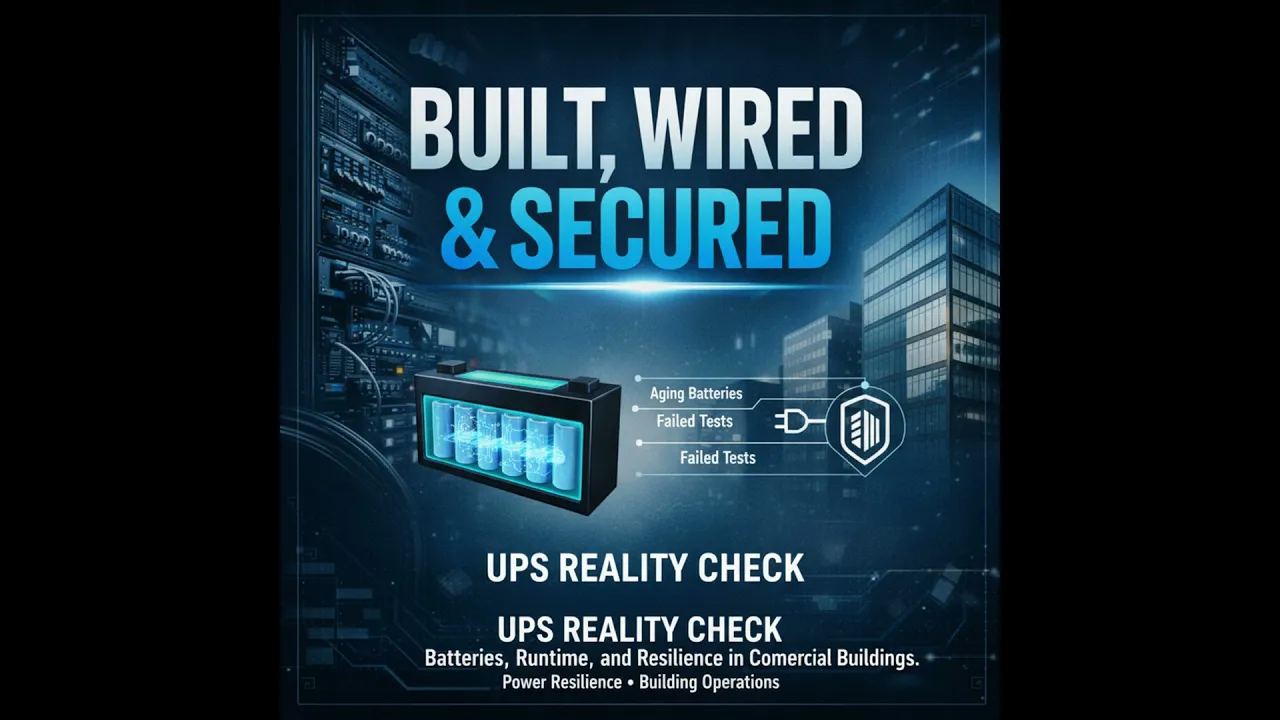
Show Notes
UPS Reality Check: What a Short Outage Can Reveal
A UPS is often treated as a simple insurance policy: utility power drops, batteries take over, and critical systems keep running. This episode challenges that assumption with a realistic commercial-building scenario. During a three-minute neighborhood-wide outage, tenant leasing card readers went offline, lobby doors failed to respond, and point-of-sale terminals rebooted unpredictably. Everyone was safe, but tenant operations stopped and building teams had to explain why expected backup power did not perform.
The central lesson is straightforward: a UPS is not a guarantee of runtime unless its batteries, load assumptions, testing practices, maintenance, and ownership have all been verified. For owners, facilities teams, and IT leaders, backup power needs to be managed as a primary asset when it supports tenant-facing systems or business-critical IT.
Why UPS Systems Fail in Practice
The discussion identifies three common categories of UPS failure and underperformance:
- Battery aging: Batteries lose capacity over time, sometimes much sooner than asset paperwork implies. A battery with a nominal 10-year rating can behave like a far shorter-duration battery after four to six years when environmental conditions or maintenance are poor.
- Unrealistic testing: A UPS may pass a brief simulated outage or a light staged-load test while still failing to support actual building loads for the required duration.
- Ownership blind spots: Problems compound when no one owns load profiles, runtime targets, maintenance sign-off, or the response when alarms occur.
These issues can turn a UPS into a silent single point of failure. The equipment may appear healthy until the moment a real outage exposes that expected runtime was never measured under realistic conditions.
Test the Runtime You Expect to Receive
Testing should mirror the operational outcome the building expects. If a tenant-facing system is expected to run for 10 minutes during an outage, the UPS should be tested for 10 minutes at a representative load. Testing at 20% load for 30 seconds may confirm that equipment turns on, but it does not confirm that the system can sustain critical operations.
A meaningful verification program includes battery discharge testing under actual environmental conditions and records performance data over time. Teams should log voltage, current, and temperature so declining battery performance becomes visible before an outage. Initial commissioning tests have value, but they are not a substitute for scheduled, instrumented verification throughout the asset lifecycle.
The distinction matters: a checklist can show that a test occurred; an operational assurance program shows whether the UPS can deliver the runtime the building depends on.
Centralized vs. Distributed UPS Design
Architecture decisions involve a trade-off between efficiency, cost, maintenance complexity, and resilience.
- Centralized UPS: A centralized system can efficiently support a long runtime objective with one battery bank and one maintenance contract. Its risk is concentration: if the central battery bank fails, multiple systems can fail together.
- Distributed UPS: Smaller UPS units at door controllers, communications closets, and critical racks can reduce exposure to a single failure. They can also align runtime more closely to the requirements of each protected system. The trade-off is a larger number of assets to monitor and maintain.
- Parallel UPS strings: Parallel strings can provide immediate failover, but they require matching equipment and coordinated maintenance. Without those controls, common-mode failures can undermine the intended redundancy.
- Staged redundancy: Assigning one UPS to critical loads and another to non-critical loads can be more cost-effective, but only when the load-priority map and transfer logic are clearly documented and tested.
The right design begins with a business question: what exactly must remain available, and how much downtime is acceptable? Protecting meeting rooms across an entire floor is a different objective from protecting a small number of racks that support emergency services. Criticality and tenancy should guide the design decision.
Maintenance, Documentation, and Vendor Oversight
UPS resilience is operational, not just technical. The episode recommends an owner-focused program that includes an annual representative-load or full-load discharge test, quarterly health checks, and battery replacement triggers based on measured capacity rather than age alone.
Vendors should provide trend logs and a failure-mode report after each service visit. This gives facilities and IT teams evidence they can use to identify deteriorating capacity, recurring weaknesses, and unresolved risks. It also makes vendor conversations more productive because expectations are documented instead of assumed.
Asset handoffs also matter. Load studies, single-line diagrams, and runtime-target documentation should move from construction and commissioning into operations. When these materials do not follow the asset, teams may inherit equipment without knowing what it protects, what it is designed to sustain, or who owns its ongoing performance.
Examples of Practical Improvements
A low-cost mitigation involved adding distributed, remotely monitored UPS modules to communications closets serving tenant access control and payment terminals. The change reduced outage complaints by 80% for a single-digit percentage of the original capital estimate.
A larger capital correction addressed an aging centralized battery bank at a multi-tenant campus. The system was replaced with a modular, serviceable design, and critical loads were separated onto a dedicated UPS. While the initial cost was significant, the change eliminated a recurring failure mode, extended usable runtime during sustained outages, and reduced tenant-disruption costs over a three-year horizon.
UPS Audit Checklist
- Identify critical loads and document required runtime targets.
- Verify that tests use representative loads and realistic durations.
- Require performance trending data, including voltage, current, and temperature.
- Replace batteries based on measured capacity thresholds, not only years in service.
- Consider distributed UPS protection for high-impact tenant-facing systems.
- Assign clear ownership for maintenance, testing, and uptime accountability.
- Use tabletop exercises to walk through a three-minute outage, a sustained 15-minute outage, and a warm-weather battery-failure scenario.
The goal is not to assume every system needs the longest possible runtime. It is to define the intended outcome, test it under realistic conditions, and ensure the people responsible for the system can act on clear documentation and data.
UPS Runtime Is an Operational Promise, Not a Nameplate Rating
Commercial buildings depend on systems that tenants and visitors may only notice when they stop working. Access-control readers, lobby doors, payment terminals, communications closets, and business-critical IT can all be affected by a short utility outage. A UPS is supposed to bridge that gap, but the presence of backup power equipment does not automatically mean critical systems will remain available.
Consider a three-minute neighborhood-wide outage. The interruption is brief, yet tenant leasing card readers go dead, lobby doors fail to respond, and a bank of point-of-sale terminals reboots unpredictably. People are safe, but operations stall. Tenants need answers, and the building team must determine why a system expected to provide backup power did not deliver the outcome everyone assumed it would.
That gap between expectation and reality is the real UPS risk. Building owners, facilities teams, and IT leaders often assume UPS means guaranteed runtime. In practice, runtime depends on battery condition, actual load, environmental conditions, testing quality, maintenance discipline, and clear accountability.
Start With the Business Impact of Failure
The first question property leaders should ask is simple: what breaks if this goes down? If the answer includes tenant-facing systems or business-critical IT, the UPS should be treated as a primary asset rather than an afterthought.
This changes the conversation from equipment specifications to operational consequences. A building does not need to protect every load equally. It needs to identify the systems where interruption creates unacceptable tenant impact, operational disruption, or loss of service. From there, leaders can set a runtime target that reflects what the business actually needs.
That target should be explicit. If a system needs 10 minutes of support to remain operational while power is restored or another process takes over, document 10 minutes. If a system can tolerate an orderly shutdown after a shorter interval, document that outcome instead. Vague assumptions about backup power make meaningful design, testing, and maintenance impossible.
The Three Failure Modes That Create False Confidence
UPS underperformance usually falls into three categories: battery aging, unrealistic testing, and ownership blind spots.
Battery aging is the most visible issue, but it is often misunderstood. Batteries lose capacity over years, and their decline can occur much faster than paperwork suggests. A unit rated for 10 years can effectively behave like a shorter-duration battery after four to six years when maintenance is poor or environmental conditions are unfavorable. A battery may remain installed and appear normal while no longer supporting the duration the building expects.
Testing that does not reflect real loads creates the next major risk. A quick vendor run test, a short simulated outage, or a staged test at light load may indicate that a UPS can switch to battery power. It does not demonstrate that the system can sustain the actual protected environment for the required runtime.
Ownership blind spots are often what turn technical weakness into operational failure. Who documents load profiles? Who owns runtime targets? Who reviews service records? Who signs off on maintenance? Who is accountable for the uptime expectations of tenant-critical systems? When those answers are unclear, the UPS becomes a silent single point of failure.
Test What You Expect to Deliver
Realistic testing is the difference between a maintenance checklist and an operational assurance program. If tenants expect 10 minutes of runtime, test the UPS for 10 minutes at representative load. Do not rely on a 30-second test at 20% load and assume the requirement has been met.
Testing should include battery discharge tests under actual environmental conditions. Teams should capture voltage, current, and temperature during those tests and retain the data as a trend record. This helps reveal performance degradation before a real outage turns it into a tenant-facing incident.
Initial acceptance testing during commissioning is useful, but it has a limited purpose. It establishes that the system performed at the beginning of its lifecycle. It does not prove that the equipment will deliver the same performance after years of use. Scheduled instrumented verification is needed to evaluate ongoing capability.
For facilities and IT teams, this approach also improves conversations with vendors. Rather than asking whether the UPS passed a service visit, teams can ask whether measured capacity remains aligned with the documented runtime target and whether trend data shows deterioration that requires action.
Choose Architecture Based on Criticality
Centralized and distributed UPS architectures each offer real benefits, but each carries different risk.
A centralized UPS can be efficient when a building has a single long-runtime objective. It can mean one battery bank, one maintenance contract, and a straightforward approach to protecting a broader load. The concern is concentration of risk. If the central bank fails, multiple dependent systems can go dark at once.
Distributed UPS systems can reduce that concentration. Placing UPS modules at door controllers, communications closets, or critical racks helps prevent one failure from affecting all critical systems. Distributed systems can also be sized around the specific needs of each protected load. The trade-off is operational complexity: more devices need monitoring, maintenance, and service coordination.
Parallel UPS strings can provide immediate failover, but they must use matching equipment and coordinated maintenance. Otherwise, a common-mode failure can defeat the redundancy. Staged redundancy can be a more cost-effective alternative, with one UPS supporting critical load and another supporting non-critical load. That approach depends on a clearly documented priority map and automated transfer logic that has been tested.
The decision should not be driven only by equipment cost. Leaders should ask whether they are protecting a whole floor of meeting rooms or a few racks hosting emergency services. The answer determines whether the efficiency of a centralized design outweighs the operational exposure, or whether distributed protection provides a better resilience outcome.
Manage UPS Equipment as an Operational Asset
A practical UPS program requires recurring testing, measured replacement criteria, documentation, and accountable ownership.
At minimum, the recommended cadence includes an annual full-load or representative-load discharge test and quarterly health checks that record capacity and internal temperatures. Battery replacement should be triggered by capacity thresholds, not simply by years in service. Age is relevant, but measured performance is more useful when determining whether the asset can still meet its required runtime.
Vendor oversight should also be evidence-based. Require trend logs and a failure-mode report after each visit. These records provide the operational history needed to spot repeated issues and make informed capital decisions.
Documentation must survive the transition from construction to commissioning to daily operations. Load studies, single-line diagrams, and runtime-target documents should move with the asset. Without them, facilities and IT teams can inherit equipment without knowing which systems it protects, which loads may be shed during transfer, or which commitments it was designed to support.
Finally, accountability needs a named owner. If the person responsible for tenant-critical uptime is not clear before an outage, the organization will end up debating responsibility during the incident instead of managing the recovery.
Low-Cost and Capital-Level Resilience Improvements
Resilience improvements do not always begin with a large capital project. In one example, distributed UPS modules were added to a limited number of communications closets that supported tenant access control and payment terminals. The modules were inexpensive, monitored remotely, and reduced outage complaints by 80% for a single-digit percentage of the original capital estimate.
In another example, a large multi-tenant campus replaced an aging centralized battery bank with a modular, serviceable system and separated critical loads onto a dedicated UPS. The upfront investment was significant, but it eliminated a recurring failure mode, extended usable runtime during sustained outages, and reduced tenant-disruption costs over a three-year horizon.
Both examples began with the same questions: what are we trying to protect, and how much downtime are we willing to tolerate? Those questions create a clearer path to prioritization than starting with a generic equipment replacement discussion.
A Practical UPS Review for Building Teams
On the next site walk, identify critical loads and record the runtime target for each. Confirm that tests are conducted at representative loads and for the required duration. Require performance data rather than relying only on pass-or-fail maintenance statements. Establish battery replacement triggers based on measured capacity. Evaluate whether tenant-facing, high-impact systems should receive distributed UPS protection. Assign one accountable owner for maintenance, testing, and uptime expectations.
It is also useful to include realistic failure scenarios in tabletop exercises. Walk through a three-minute outage, a sustained 15-minute outage, and a battery failure during warm weather. Identify what breaks in each case, determine the tenant impact, and document the mitigation.
UPS resilience is not about assuming that backup equipment will work. It is about proving that it will support the loads that matter, for the duration the business requires, under the conditions the building is likely to face. Listen to this episode of Built, Wired & Secured for the full discussion on realistic runtime expectations, testing practices, architecture trade-offs, and operational ownership.