
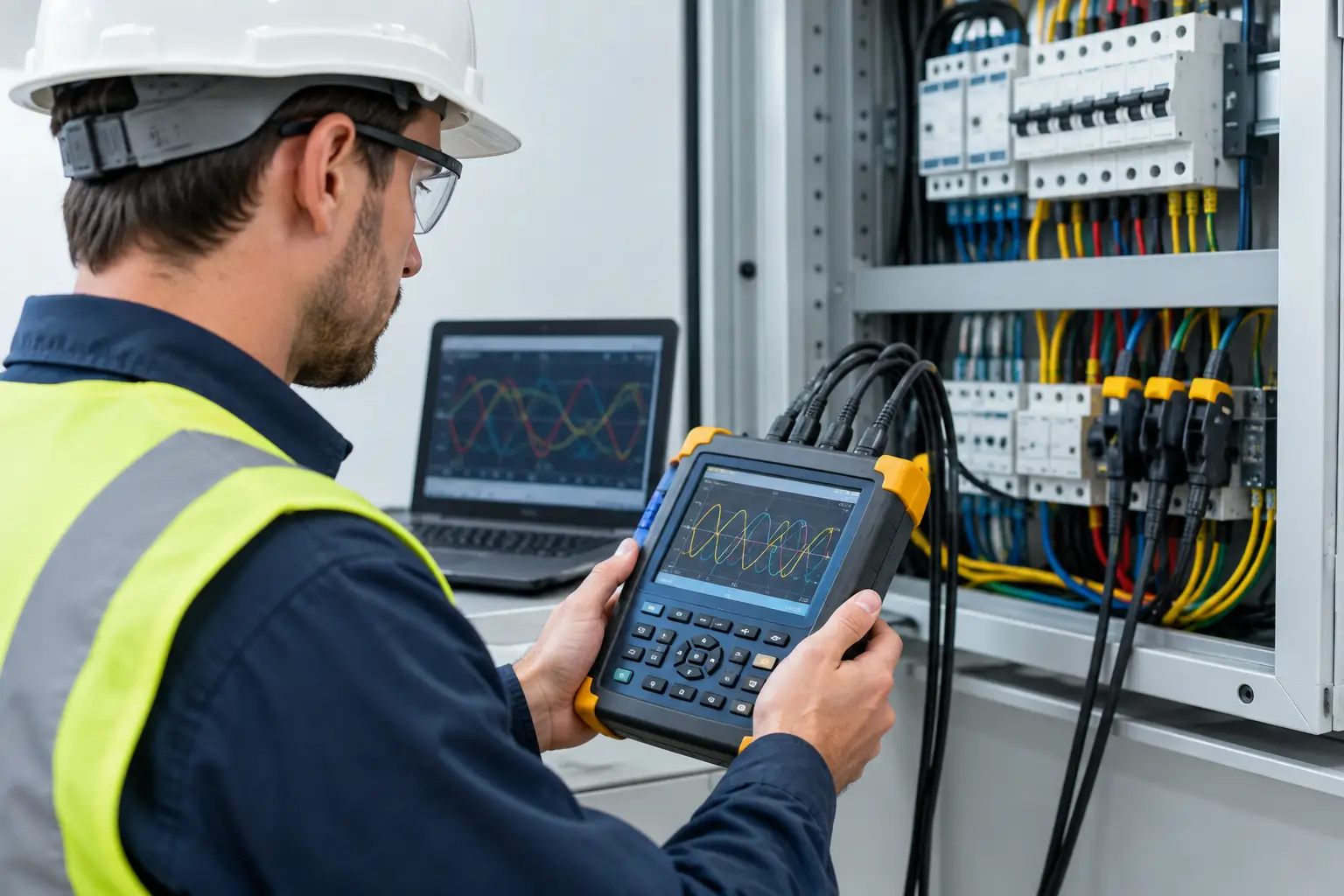
A building can have utility power, a working generator, and a healthy-looking UPS fleet - then still lose a network switch, access-control panel, server, controller, or tenant-critical system to an electrical event nobody captured. The gap is usually not a lack of equipment. It is a lack of visibility, ownership, and a defined response. This guide to power quality monitoring explains how commercial teams can turn electrical data into operational control.
Power quality monitoring is not a facilities-only task and it is not an IT-only task. Electrical disturbances move across the same environment that supports networks, security systems, building automation, tenant operations, and data equipment. When ownership is split among utility providers, electrical contractors, facilities teams, and technology vendors, each party can explain its portion while no one owns the outcome.
What Power Quality Monitoring Actually Measures
Power quality monitoring tracks whether electrical supply remains within the conditions equipment needs to operate safely and predictably. Voltage is only part of the picture. A meter may show acceptable voltage during a routine walk-through while high-speed disturbances, waveform distortion, phase imbalance, or brief interruptions continue to damage equipment or trigger unexplained faults.
A useful monitoring program captures both long-term trends and event-level detail. Trend data identifies recurring conditions, such as voltage consistently running high during low-load periods or rising neutral current as nonlinear loads increase. Event data records the precise shape, duration, timing, and magnitude of a sag, swell, transient, interruption, or harmonic condition.
The distinction matters. A monthly utility bill can indicate consumption. It cannot explain why a building automation controller resets at 2:15 a.m., why UPS units transfer unexpectedly, or why a sensitive device fails sooner than expected.
The Conditions That Deserve Attention
Voltage sags are short reductions in voltage, often caused by motor starts, faults, switching activity, or utility events. A sag can be brief enough to go unnoticed by occupants but long enough to affect electronics, controls, and communications equipment.
Swells and sustained overvoltage can stress insulation and shorten equipment life. Transients, sometimes called spikes, are fast high-energy events that can damage sensitive components. Harmonic distortion changes the expected electrical waveform and is commonly associated with nonlinear loads such as variable frequency drives, LED lighting, switch-mode power supplies, and large IT loads.
Phase imbalance, frequency variation, poor power factor, and elevated neutral current may also point to design, loading, or equipment problems. None of these measurements should be interpreted in isolation. The operational question is whether the condition is creating risk for a specific system, circuit, room, or business function.
Start With Critical Loads, Not Meter Locations
A common mistake is installing monitors wherever there is available panel space, then hoping the data proves useful. Start instead with a critical-load map. Identify the systems whose loss would create a safety issue, security exposure, operational shutdown, tenant impact, data loss, or costly recovery effort.
For many commercial properties, the first group includes main electrical service equipment, emergency distribution, generator output, UPS input and output, data room distribution, security and access-control power, network closets, building automation panels, and critical mechanical controls. The exact list depends on the building and its operational profile. A multi-tenant office tower, a distribution facility, and a data-intensive corporate campus do not have the same priorities.
Then trace dependencies. A network closet may have a UPS, but its cooling, upstream electrical panel, fiber pathway, grounding system, and monitoring connection can each become a single point of failure. A power quality meter located only at the service entrance may confirm a utility event, yet miss a disturbance introduced downstream by a failing breaker, overloaded circuit, loose connection, or local equipment.
Monitoring should therefore be layered where the risk justifies it. Service-level monitoring establishes what entered the facility. Monitoring at critical distribution points shows how the electrical environment changes as power moves toward sensitive loads. UPS monitoring helps determine whether the UPS is protecting equipment as intended or repeatedly compensating for an upstream issue.
Build a Guide to Power Quality Monitoring Around Ownership
The meter is the easy part. The operating model is harder and more valuable.
Every monitored point needs a named owner for review, escalation, and corrective action. That does not mean one person must diagnose every electrical event. It means there is no ambiguity about who opens the record, coordinates the right technical parties, verifies remediation, and closes the issue with evidence.
Facilities may own electrical distribution and site access. IT may own server, network, and application impact. Security may own access-control or surveillance continuity. An electrical contractor may perform testing or repairs. These responsibilities can remain separate, but the incident record must connect them. A disturbance is not resolved because a vendor replaced a component. It is resolved when the condition is validated, affected systems are checked, and the documentation explains what changed.
Define escalation thresholds before an event occurs. For example, a single minor transient may be recorded and trended. Repeated events on the same feeder may require investigation. Any interruption affecting a critical load should create a cross-functional review, even if systems recover automatically. Automatic recovery can hide a condition that will become a larger outage later.
Select Monitoring That Produces Usable Evidence
Monitoring capability should match the consequences of failure. Basic meters can provide consumption, demand, voltage, current, and power factor. That is useful for energy management and load planning, but it may not be enough for troubleshooting intermittent operational events.
For critical electrical paths, look for monitoring that can capture high-resolution waveforms and time-stamped disturbance events. Event recording should provide enough detail to distinguish a utility-side issue from an internal distribution problem. Accurate time synchronization is essential. If power data, UPS logs, network alerts, and building-system alarms do not share a reliable time reference, teams will spend hours debating sequence instead of identifying cause.
Data retention also matters. Some events only reveal a pattern after weeks or months. Keep enough historical data to compare conditions before and after equipment changes, tenant buildouts, generator testing, or recurring failures. At the same time, avoid collecting data with no review process. A dashboard full of alerts is not a control.
There is a trade-off between broad coverage and deep visibility. Monitoring every panel with basic metrics may identify loading concerns across a portfolio. Deep event capture at selected critical points may better support root-cause analysis. Most organizations need both, deployed intentionally rather than uniformly.
Establish a Response Runbook Before the First Alarm
Power quality data becomes operationally useful when it triggers a repeatable workflow. The runbook should state what is reviewed, who is notified, what evidence is preserved, and when an event becomes a corrective-action item.
For a material event, begin by preserving the power monitor record, UPS alarms, generator status, building automation alarms, network logs, and security-system events. Record the time window and any known operational impact. Then determine whether the event appeared at the service entrance, at downstream distribution, or only near a specific load.
This sequence narrows the investigation. If the event appears at the service entrance and multiple systems show corresponding alarms, outside supply conditions may be involved. If it appears only on one branch, investigate local distribution, connections, load changes, and equipment condition. If a UPS logged repeated transfers without an upstream event, review the UPS itself, its batteries, bypass configuration, and maintenance history.
Do not allow “no current impact” to become a closure reason. Repeated low-level events can degrade equipment, expose poor grounding, reveal capacity constraints, or indicate a developing failure. Close the ticket only after the likely cause, action taken, validation result, and responsible owner are documented.
Use the Data During Change, Not Only After Failure
The best time to establish a baseline is before a problem is reported. Capture electrical conditions before major tenant occupancy, network refreshes, equipment replacements, generator work, electrical upgrades, or building automation changes. Then compare conditions after the work is complete.
This creates a meaningful acceptance process. If a new load introduces higher harmonic distortion, imbalance, or nuisance UPS transfers, the team has evidence tied to the change. Without that baseline, the issue often becomes a vendor handoff: the installer points to the equipment manufacturer, the manufacturer points to utility conditions, and operations is left managing the disruption.
Power quality monitoring also supports lifecycle planning. Rising distortion, overloaded neutrals, recurring sags, and increased UPS transfers can signal that a distribution design is no longer aligned with actual building use. The response may be a repair, a load redistribution, additional conditioning, a redesign, or more focused monitoring. It depends on the source and the business consequence, not on a generic threshold alone.
Make Electrical Visibility Part of Operational Governance
Review power quality trends on a scheduled basis, not only during incidents. A quarterly review may be sufficient for stable, lower-risk environments. Critical facilities or sites with known issues may need monthly review and event-based reporting. The review should include open corrective actions, recurring event locations, changes in critical load, UPS transfer history, generator test results, and unresolved ownership gaps.
The goal is not to turn every facilities or IT leader into a power engineer. The goal is to ensure electrical conditions that threaten operations have one standard for evidence, one path for escalation, and full accountability through resolution.
When a building depends on connected systems, power quality is not background infrastructure. It is a measurable operating condition. Treat it that way before the next unexplained reset becomes a tenant complaint, a security gap, or a preventable outage.