
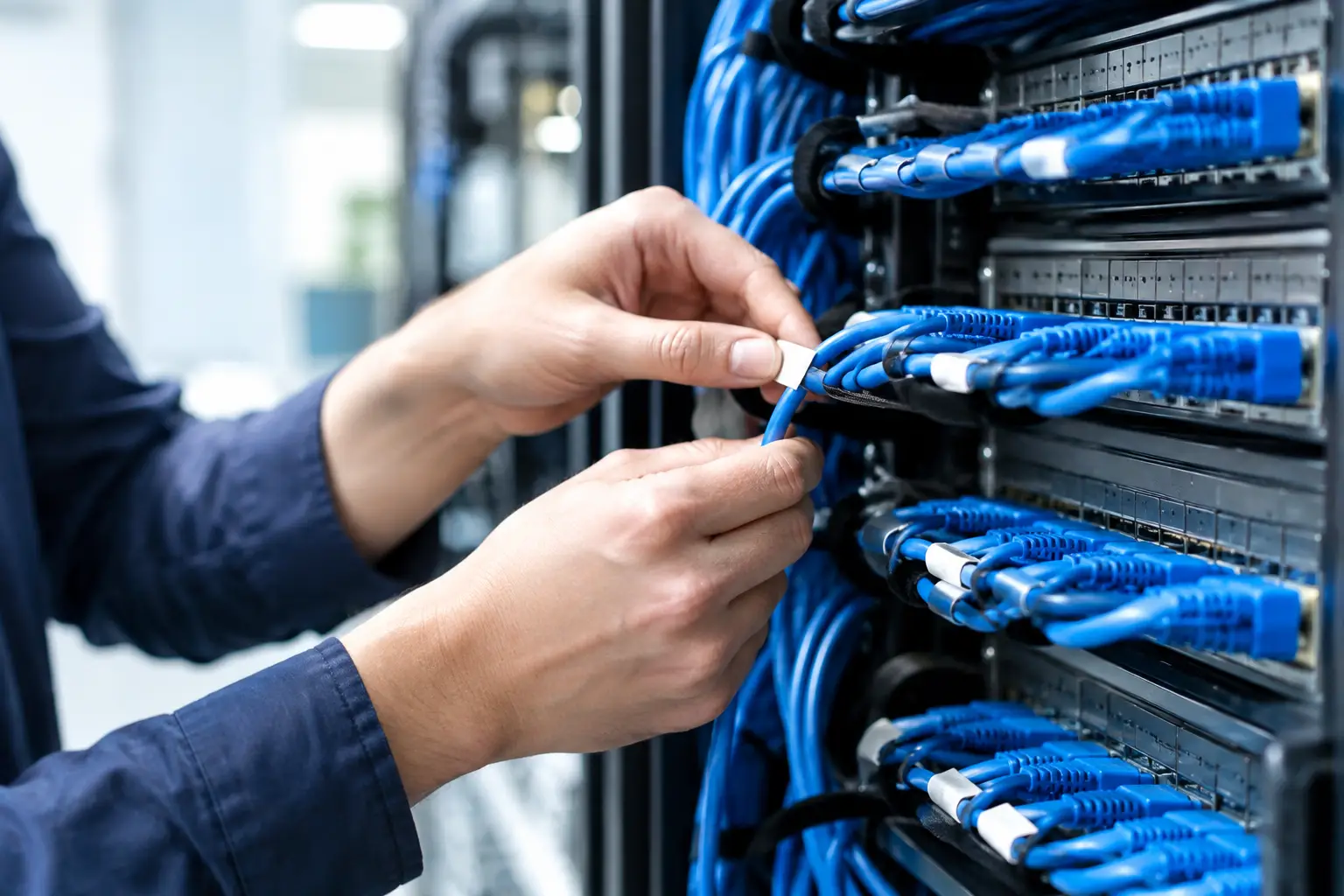
A cable label is a small control with outsized consequences. During an outage, a technician should be able to identify a cable, trace its path, understand its service impact, and make a change without guessing. That is the operating standard behind how to label data cabling well. Labels are not cosmetic closeout work. They are part of the infrastructure record that protects uptime, supports safe changes, and establishes accountability after the installer leaves.
Poor labeling creates the opposite condition: crowded telecom rooms, undocumented patching, questionable ports, and every incident starting with a manual trace. The immediate problem may be a disconnected workstation or camera. The larger problem is that no one can confidently determine what else could be affected by moving one cord.
Start With an Identifier, Not a Description
The most durable labeling approach gives every permanent horizontal cable a unique identifier. That identifier should appear at both ends of the cable: at the work-area outlet or device end and at the patch-panel end. It should also match the cable schedule, test record, and as-built documentation.
Keep the identifier short enough to read in a crowded rack but structured enough to locate the cable. A format such as `BLD1-03-TR2-PP04-18` can identify a building, floor, telecom room, patch panel, and port. The exact syntax matters less than consistency. A portfolio with multiple buildings should use one naming rule, not a different scheme created by each contractor or site.
Avoid making the cable ID depend entirely on a tenant, employee, switch name, or device role. Those conditions change. A stable cable identifier should remain valid when a room is repurposed, a tenant moves, or a network is redesigned. The documentation can show that a cable currently supports a camera, access-control panel, wireless access point, desk outlet, or building controller. The cable itself should retain its permanent identity.
This distinction prevents a common failure: relabeling infrastructure repeatedly because operations changed. Change the service record when the use changes. Change the physical cable label only when the cable itself changes.
How to Label Data Cabling at Both Ends
Apply labels after the cable has been terminated and tested, but before final acceptance. Each permanent cable needs a readable label at both ends, placed where a technician can see it without removing bundles or disturbing adjacent terminations.
At the telecom-room end, label the cable close to the patch-panel termination. The label must remain visible when patch cords are installed and cable management is in place. At the outlet end, place the matching identifier on the faceplate, outlet module, or a nearby permanent location that stays associated with the termination. For ceiling-mounted devices, use a durable identifier at the cable termination and a corresponding label on the device mounting point or enclosure where practical.
Do not use dangling flag labels in dense racks. They snag, fold, and disappear into the bundle. Use self-laminating wrap labels or approved sleeve-style labels sized for the cable diameter. The printed area should be protected by clear laminate, and the material should tolerate heat, dust, humidity, cleaning activity, and normal service work.
Fiber requires additional discipline. Label each fiber enclosure, adapter position, trunk, and breakout leg in a way that maps clearly from one endpoint to the other. Fiber paths can cross rooms, floors, and buildings, so a vague label such as “Fiber to MDF” is not an operational record. Identify the originating and terminating locations, enclosure or panel positions, and strand or port assignment.
Color can help technicians distinguish systems, but color is not an identifier. Colors fade, get substituted during repairs, and mean different things across projects. Use color as a secondary visual aid only, backed by a printed unique ID.
Label More Than the Cable
A cable can be labeled correctly and still be difficult to manage if the surrounding infrastructure is anonymous. The physical record must connect the cable to its pathway, room, rack, panel, and active equipment.
Telecom rooms should identify the room itself, racks or cabinets, patch panels, cable managers, grounding points, pathways, and major power components. Faceplates and consolidation points should use the same location logic. If an outlet is labeled `03-214-A`, the records should make clear what that means and where it lands.
Patch cords need a different treatment than permanent cabling. They are movable and routinely replaced, so they should not be documented as though they are fixed infrastructure. However, patching that supports critical services needs an accurate record. Label or document the panel port and equipment port relationship, especially for uplinks, wireless access points, cameras, access control, building automation, voice gateways, and any device powered over Ethernet.
Critical circuits deserve visible service-impact marking. A technician should be able to recognize that a port supports life-safety-adjacent operations, security, building controls, executive communications, or a business-critical application before disconnecting it. The label should warn without replacing the formal record. “Critical service - verify before change” is more useful than a cryptic color code understood only by the original installer.
Build the Record That Makes Labels Useful
A label only works when the organization can look it up. The cable schedule or infrastructure management record should be the controlled source of truth, maintained through moves, additions, changes, and incident response.
For each permanent cable, record the unique ID, cable type and category, origin, destination, pathway or route where needed, patch-panel position, outlet or device location, test result, installation date, and current service assignment. For fiber, include fiber type, strand assignment, connector type, loss-test results, and polarity information where applicable.
The operational trade-off is straightforward. A detailed record takes more effort at project closeout, while an incomplete record transfers that effort into every future service call, renovation, and outage. In commercial properties, the cost does not stay with IT. Facilities teams lose time opening ceilings or tracing pathways, security teams face uncertainty about connected devices, and property teams inherit a building that is harder to operate.
Use machine-readable labels when the environment and operating model support them. A barcode or QR code can accelerate lookup, but only if it resolves to a maintained internal record and can still be read after installation. It should supplement the human-readable cable ID, not replace it. During an urgent event, technicians should not need an application, account access, or internet connection just to read a port number.
Make Labeling Part of Acceptance, Not Punch List Cleanup
The right time to govern labeling is before construction starts. Include the naming convention, label material, placement rules, documentation fields, and closeout requirements in the scope. Require the installer to submit a sample label and a sample cable record early, when corrections are inexpensive.
At final acceptance, verify labels in the field against the test results and cable schedule. A desk review is not enough. Select a meaningful sample across floors, telecom rooms, device types, and critical systems. Confirm that the same identifier appears at both ends, the label is readable after patching, and the record points to the correct physical locations.
The acceptance check should also test usability. Ask a technician unfamiliar with the project to locate several cables from the record, identify the related ports, and explain the service impact before making a simulated change. If that task requires tribal knowledge, the labeling system has not achieved its purpose.
Do not accept placeholder labels, handwritten tape, or documentation promised “after turnover.” Those are not minor omissions. They are signals that no one has taken ownership of the infrastructure record.
Keep Labels Accurate Through Change
A clean turnover package decays quickly when moves and changes bypass the documentation process. Every change ticket involving a permanent cable, panel assignment, device relocation, or critical patch should require the physical label and record to be verified before closure. The person making the change should not be allowed to declare the work complete while leaving the next technician a mystery.
Periodic audits are especially valuable after tenant improvements, security upgrades, network refreshes, and emergency repairs. Compare a selected set of active ports and endpoints to the record. Look for duplicate IDs, missing labels, abandoned cabling, mislabeled patch fields, and services that have changed function without updated documentation.
The goal is not a prettier telecom room. It is a building where the physical layer can be operated with confidence. When labels, records, testing, and change control use one standard, a cable becomes traceable infrastructure rather than a hidden dependency waiting to slow down the next incident.