
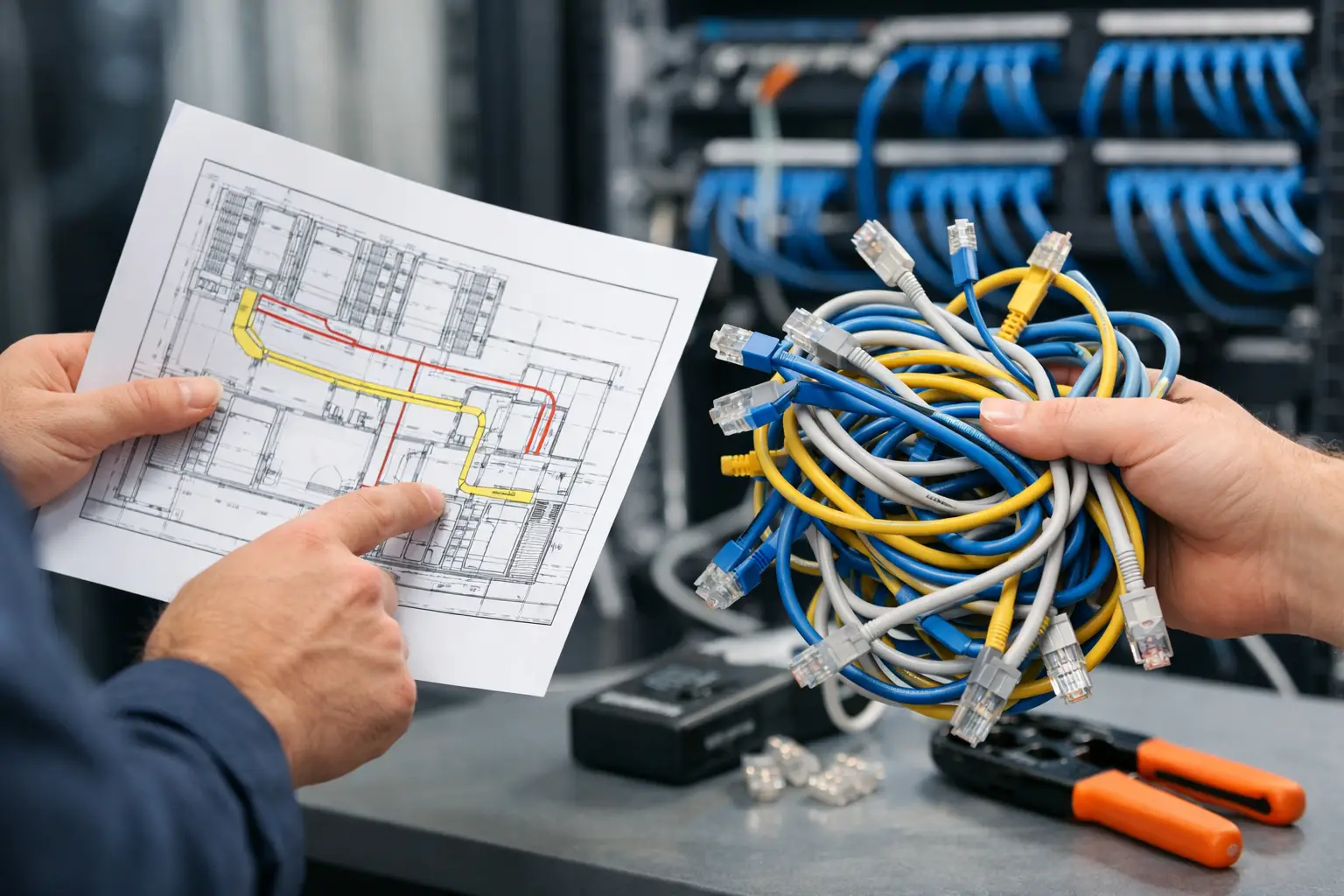
A tenant moves in, the access-control readers are online, Wi-Fi is visible, and the building appears ready. Then a door controller drops offline, a camera will not negotiate its connection speed, or a new workstation cannot get a reliable link. The problem is often blamed on the network. But structured cabling is frequently where the failure was created - months earlier, behind finished walls, above ceilings, or inside a telecom room no one documented properly.
For commercial property and enterprise leaders, cabling is not a low-voltage construction detail to delegate and forget. It is the physical layer supporting tenant operations, security, life-safety-adjacent systems, building automation, wireless coverage, and the network itself. When its ownership is fragmented, the consequences are predictable: delayed turnover, disputed defects, costly rework, and outages that no vendor will fully own.
Structured Cabling Is an Operating Asset
A cable plant has a much longer useful life than most of the electronics attached to it. Switches, wireless access points, cameras, and controllers will be replaced several times. The pathways, racks, horizontal cabling, backbone connections, labeling scheme, grounding approach, and room layout may need to support those changes for years.
That makes early decisions matter. A design that merely supports the devices listed on a current floor plan may be undersized the moment a tenant adds more wireless coverage, smart locks, occupancy sensors, video analytics, or connected building equipment. The goal is not to install the most cable everywhere. The goal is to establish a documented physical infrastructure that can accommodate realistic growth without turning every change into demolition.
This is where commercial projects often go wrong. The owner sees cabling as a subcontractor scope. IT sees it as a construction deliverable. Facilities sees it only after the ceiling is closed. Security procures devices separately. Each party has a reasonable view of its own work, but no one is responsible for the integrated outcome.
One standard and one accountable owner do not mean one person performs every trade function. They mean someone governs the requirements, dependencies, evidence, and final acceptance across those functions. If a pathway is blocked, a closet lacks power, a cable is mislabeled, or a device port cannot deliver the required service, the issue is managed as an operational risk, not passed between scopes.
Design for service, not just installation
The first question should not be, "How many drops are needed?" It should be, "What services must this location support now and later?" A conference room, for example, may need data, wireless coverage, conferencing equipment, room controls, digital signage, and physical security nearby. A warehouse may need mobile devices, cameras, access points, industrial controls, and future sensor capacity. Those needs affect pathway capacity, cable type, outlet locations, telecom-room space, heat management, and power planning.
Distance matters as much as device count. A cable route that looks short on a drawing can exceed supported limits when routed through corridors, risers, tray systems, and ceiling pathways. Poor routing choices also create service problems: inaccessible joints, bend damage, congested tray, exposure to electrical interference, and cable bundles that cannot be safely changed later.
There are trade-offs. More pathways and spare capacity use space and require coordination early. Tighter designs can appear efficient during construction but create expensive constraints during operations. The right level of capacity depends on the building type, tenant profile, planned technology, lease strategy, and renovation cycle. What should not vary is the discipline of documenting why the decision was made.
The Handoff Is Where Cabling Risk Becomes Visible
A cable installed out of sight is easy to assume is correct. A cable documented, labeled, tested, and traced to a specific endpoint can be operated with confidence. That distinction determines whether a future incident takes ten minutes to isolate or two days of ceiling access, finger-pointing, and disruption.
Final acceptance should never be limited to a contractor stating that work is complete. The owner or accountable technology lead needs evidence that the system installed matches the approved design and can support the services planned for it. That requires coordinated field verification, not just paperwork collected at the end.
A practical acceptance package includes at least these items:
- Test results for every installed permanent link, tied to the final identifier.
- Updated drawings showing pathways, telecom rooms, backbone routes, and outlet locations.
- A labeling scheme that matches racks, patch panels, outlets, records, and network documentation.
- Photographs and closeout records for telecom rooms, grounding, firestopping, and cable support methods.
- A list of exceptions, incomplete items, and the party responsible for resolving each one.
The most useful question during turnover is simple: can an operations team identify a failed connection, locate both ends, understand what it serves, and authorize a change without relying on installer memory? If the answer is no, the project is not fully ready for operations.
Labels are a control, not a cosmetic detail
Inconsistent labels are one of the most common signs that cabling was treated as a finished construction task rather than a managed asset. A panel port may have one identifier, the room drawing another, and the network record a third. During an outage, that inconsistency slows restoration and increases the chance that someone disconnects the wrong service.
A useful identifier is durable, unique, readable, and consistently applied from outlet to patch panel to network record. It should also support the way teams actually work. Facilities may need a location-based reference. IT may need a rack and port reference. Security may need to identify which camera or controller is connected. A governed record connects those views instead of forcing every team to maintain a separate spreadsheet.
Documentation also has a lifecycle. Renovations, tenant changes, emergency repairs, and vendor work can make closeout drawings inaccurate within a year. Assign an owner for updates, require change records, and periodically compare documentation with field conditions. The most accurate document is not the one delivered at project closeout. It is the one maintained after the first change.
Treat Dependencies as Part of the Cable Plant
Cabling does not operate alone. Its reliability depends on telecom rooms, racks, power, cooling, grounding, pathways, firestopping, and controlled physical access. A clean patch panel cannot compensate for a room with inadequate power, no environmental monitoring, water exposure, or unrestricted vendor access.
This is especially relevant when different systems share the same infrastructure. Security devices, wireless access points, building controls, and tenant networks may connect through common rooms and pathways while having different owners, support models, and availability requirements. The physical environment becomes a shared point of failure.
A disciplined design identifies these dependencies before construction begins. Who has access to each telecom room? What power source supports active equipment? Is backup power required, and is it tested? Are pathways sized for future moves? Is there a documented separation approach for services with different risk profiles? Who authorizes a patching change that could affect security or building operations?
Those questions are governance questions as much as technical ones. They establish accountability before a service failure exposes the gap.
Build an Acceptance Process That Survives Turnover
The strongest projects make acceptance an ongoing process rather than a final-week event. Review telecom-room readiness before equipment arrives. Verify pathway installation before ceilings close. Sample labels and test records while work is still underway. Resolve deviations while the responsible trade is mobilized and the drawings are current.
This approach protects the owner from a familiar closeout problem: a large package of reports arrives after the project team has moved on, and no one has time to validate whether the records match the field. By then, correcting a route, label, or unsupported cable run can affect finished areas and turnover dates.
For occupied buildings, the operating model also needs clear change control. Maintenance work, tenant improvements, and new device deployments can all alter the cable plant. Require a defined request process, current documentation, testing after changes, and an accountable reviewer for work affecting shared infrastructure. This is not bureaucracy for its own sake. It is how a building prevents a small change from becoming an untraceable outage.
Structured cabling earns attention because it quietly determines how reliably the rest of the environment can perform. Treat it as a governed operating asset from design through every future change, and the building team will have something more valuable than a completed installation: a physical foundation they can identify, test, maintain, and trust when the stakes are high.