
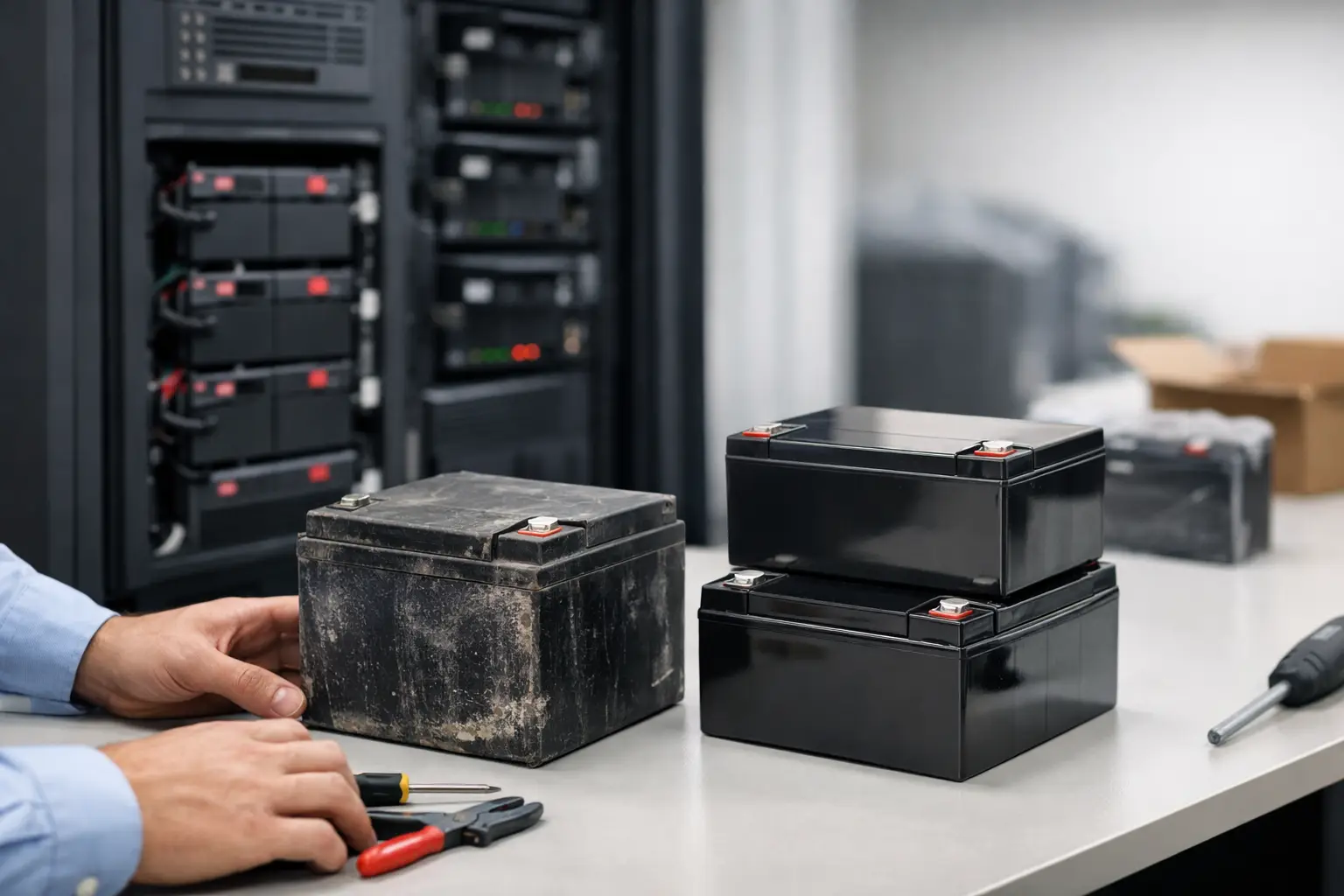
A UPS can look healthy right up until the moment a utility failure asks it to carry a real load. The UPS battery replacement lifecycle is therefore not a purchasing task or a calendar reminder assigned to whoever happens to manage the equipment room. It is a business continuity control. When ownership is unclear, a small, predictable maintenance issue becomes an outage affecting network closets, access control, building systems, servers, tenant operations, or all of them at once.
The risk is often hidden by normal utility power. A UPS may continue to condition power, report no immediate alarm, and show a plausible runtime estimate while its battery capacity has declined beyond what the connected load requires. That gap only becomes visible during a transfer event, a planned test, or a failed shutdown. By then, facilities, IT, security, and outside service providers may all have a role, but no one has accepted accountability for the outcome.
Why UPS Batteries Fail Before the UPS Does
The UPS chassis may remain in service for years, but batteries are consumable components. Their usable life changes with ambient temperature, charging behavior, load profile, installation quality, storage history, and the number and severity of discharge events. A manufacturer’s stated service-life range is useful for planning, not a guarantee that every installed battery will meet that date.
Heat is one of the most common accelerants. A telecom room that runs warm after hours, a poorly ventilated electrical closet, or a rack with restricted airflow can materially shorten battery life. So can a load added after the original UPS was sized. The unit may still support the load under normal conditions, while the remaining battery runtime is no longer sufficient for an orderly shutdown or generator transfer.
There is also a difference between a battery alarm and a battery strategy. An alarm identifies a condition after monitoring recognizes it. A strategy establishes what equipment is protected, the required runtime, the target replacement window, the test method, the escalation path, and the person authorized to act. One is a signal. The other is operational control.
UPS Battery Replacement Lifecycle Needs One Owner
The most reliable model assigns one accountable owner for the lifecycle, even when multiple teams perform work. Facilities may control room conditions and electrical access. IT may own the connected load and shutdown sequence. Security may depend on the same power path for cameras, panels, and door hardware. A service provider may conduct maintenance. Those responsibilities can be shared without fragmenting accountability.
The accountable owner should maintain the system record, approve the replacement plan, verify that testing is completed, and ensure exceptions are resolved. This does not require one person to be an electrical specialist, network administrator, and building engineer. It requires a defined decision-maker who can bring the right people together before a failure does it for them.
For commercial properties, this ownership question should be answered at both the asset and portfolio level. A building engineer may manage the individual unit, while an operations or technology leader governs standards across sites. Without a portfolio standard, each location develops its own replacement intervals, documentation quality, and tolerance for risk. That makes outages harder to predict and harder to explain.
Start With a Defensible Asset Record
A UPS inventory should do more than list a location and serial number. It should establish why the unit exists and what its failure would interrupt. At a minimum, the record should capture the UPS capacity, battery configuration, installation date, last replacement date, connected equipment, normal load, required runtime, environmental conditions, monitoring status, and responsible owner.
The record should also identify dependencies that are easy to miss. A network switch may support wireless access points, cameras, intercoms, tenant connectivity, and a building automation gateway. A UPS protecting a single rack may be more operationally significant than a larger unit in a less critical room. Criticality should drive the lifecycle plan, not just the nameplate rating.
Documentation must survive staff turnover, contractor changes, and property transitions. If the replacement history lives only in an email thread, a technician’s notes, or the memory of a former employee, it is not a managed record. Capture the data in the operating system used to govern facilities and technology assets, then make it available to the teams responsible for response.
Set Replacement Windows, Then Validate Them
A time-based replacement policy is the starting point. For many valve-regulated lead-acid battery systems, organizations plan replacement before the expected end of service life, especially where runtime is essential or access for emergency work is difficult. The exact window depends on the battery type, room temperature, criticality, maintenance history, and the consequence of an unplanned transfer failure.
Do not apply a single interval blindly across every environment. A lightly loaded UPS in a conditioned data room may justify a different plan than a unit in a hot loading-area closet that supports security and network equipment. The answer is not to wait for a failure alarm in either case. It is to define risk-based replacement windows and review them against observed conditions.
Validation matters because age alone does not reveal capacity. Review monitored battery data where available, inspect for corrosion, swelling, loose connections, or elevated temperature, and perform appropriate functional testing. A brief self-test can identify obvious failures, but it does not always prove that the system will support the required load for the required time.
For critical applications, load testing or a controlled runtime test may be warranted. These tests carry risk and should be planned around operational windows, dependencies, shutdown procedures, and recovery steps. The goal is not to create an avoidable outage in the name of maintenance. The goal is to replace uncertainty with evidence.
Plan the Replacement as a Controlled Change
Battery replacement affects more than the battery cabinet. Before work begins, confirm the protected load, current runtime, maintenance bypass availability, shutdown requirements, site access, electrical safety controls, and post-work validation method. If a UPS must be taken out of service, someone needs to approve the exposure and notify the people responsible for dependent systems.
A controlled change plan should answer four practical questions: What can lose power, how long is the exposure, who is on call if something does not recover, and what evidence confirms normal operation afterward? Those answers prevent a routine battery swap from turning into a network, security, or building-system incident.
After installation, update the battery replacement date, test results, alarm status, capacity assumptions, and any changes to load or runtime. Verify monitoring communications as well. A new battery set provides little assurance if the UPS can no longer report a fault to the team expected to respond.
Dispose of removed batteries through an approved process and retain the completion record. This is not clerical cleanup. It closes the chain of custody and gives future operators a reliable starting point for the next cycle.
Connect Battery Health to Building Resilience
UPS lifecycle decisions should be reviewed alongside generator testing, network refresh plans, security-system dependencies, cooling conditions, and major tenant changes. A newly added switch, access-control controller, or edge device can change the load profile enough to invalidate old runtime assumptions. The same is true when a space is repurposed or a telecom room becomes more densely populated.
This is where fragmented vendor management creates avoidable gaps. One party may install the UPS, another may manage the network, another may service building systems, and another may receive alarms. If no one reconciles those responsibilities, every party can complete its assigned task while the building remains exposed. One standard for inventory, testing, documentation, and acceptance creates a clearer operating posture.
The most useful question is not, "Are the batteries still under their expected life?" It is, "Can this UPS support the systems we rely on for the time we have committed to?" That question ties battery maintenance to real operational requirements.
Treat each replacement cycle as a chance to improve the record, verify dependencies, and confirm ownership. A battery will eventually age. An unmanaged failure does not have to be part of its lifecycle.