
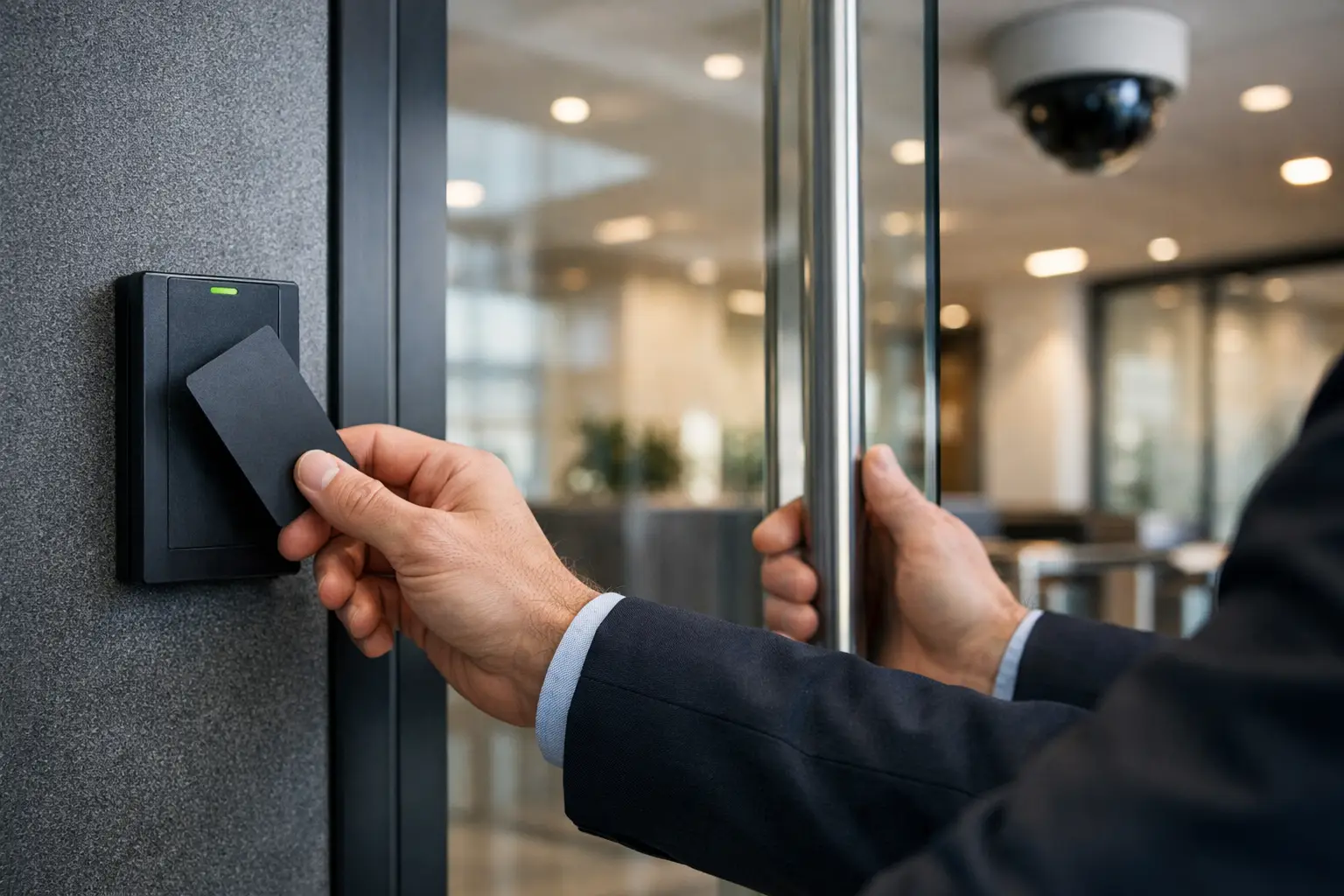
A locked door can still be an uncontrolled risk. If a former employee’s credential remains active, a loading-dock reader goes offline without an alert, or a contractor has a permanent code nobody owns, the building has an access control problem - even if every reader appears to work. This commercial access control guide focuses on the operational controls that make physical access reliable after installation, not just impressive on a floor plan.
Access control sits at the intersection of physical security, life safety, networking, identity management, tenant operations, and facilities maintenance. That makes it especially vulnerable to fragmented ownership. Security may own policy, facilities may own the doors, IT may own the network, and a contractor may retain the programming details. When an incident occurs, every party can point to a different boundary. The building still carries the risk.
A commercial access control guide starts with ownership
The first decision is not which credential readers to install. It is who is accountable for the complete operating outcome. A commercial access system includes openings, locks, door hardware, controller panels, power supplies, network connections, software, identities, event records, integrations, and the procedures that govern them. Splitting those elements among separate teams without a defined control model creates blind spots by design.
Assign one operational owner for the access control program. That person does not need to perform every task, but they must have authority to approve standards, resolve conflicts, require documentation, and verify that corrective work is completed. Supporting responsibilities should be explicit: facilities maintains door hardware and power conditions; IT governs network connectivity and cyber controls; security approves access policy; HR or another business function triggers employee onboarding and separation; property management governs tenant and vendor processes.
Shared responsibility is useful only when each handoff is documented. Shared ownership is usually another name for nobody owning the outcome.
Define risk by opening, not by product category
A main lobby, telecom room, executive suite, data environment, loading dock, roof hatch, and mechanical room do not carry the same risk. Treating every controlled opening identically either wastes effort or leaves critical areas underprotected.
Start with a door and area inventory that identifies the business purpose of each opening, who should enter, the acceptable hours of access, the credential method, emergency behavior, and the consequence of failure. For high-consequence spaces, document whether access events need investigation capability, whether two people should be required for entry, and how quickly a lost credential must be disabled.
This exercise often exposes a basic governance issue: access rights are frequently assigned by convenience rather than job function. A cleaner, contractor, tenant representative, and network administrator may all receive broad permissions because the approval path is informal. Role-based access reduces that sprawl. It also makes periodic reviews realistic because reviewers can validate a defined role rather than decipher hundreds of individual exceptions.
Decide what happens when systems fail
Every access decision has a failure mode. A door may need to remain secured during a network outage, while another must permit safe exit or support emergency response. Those choices depend on the opening, local code requirements, life-safety design, and the function of the space. They should never be left to default controller settings.
Document expected behavior for loss of network, controller failure, power loss, battery depletion, fire alarm activation, and a failed integration. Then test it. A building team should be able to answer a simple question for every critical opening: when this component fails, who can enter, who can exit, and who receives the alert?
Design access control as building infrastructure
Access control is not a stand-alone security purchase. It needs the same design discipline applied to structured cabling, power distribution, networked building systems, and critical equipment rooms.
Coordinate doors, hardware, and life safety early
The controller cannot compensate for poor door alignment, weak hinges, incorrect locking hardware, or an uncoordinated egress design. A reader may show a valid credential while the door fails to latch. A request-to-exit device may be installed without confirming its interaction with the lock and alarm conditions. These are operational defects, not minor construction punch-list items.
Bring security, facilities, electrical, network, and life-safety stakeholders into the design review before openings are finalized. Confirm cable pathways, enclosure locations, service clearances, lock power requirements, door schedules, and the approved sequence of operation. This reduces the common project failure where each contractor completes their scope while the overall opening does not function as intended.
Protect controller networks and power
An access controller is a connected device that influences physical entry. It belongs on a managed network segment with documented addressing, approved communications paths, monitored connectivity, and restricted administrative access. Default credentials, unmanaged remote access, and unknown controller firmware create both cyber and physical exposure.
Power deserves equal attention. Identify which panels, locks, network switches, and supporting components are backed by emergency power or battery systems. Confirm runtime expectations and maintenance responsibility. A neglected battery can turn a planned power event into a building-wide access problem.
Use consistent labels from the door to the panel, cable, network port, and management record. When a reader fails at 6 a.m., the response team should not have to trace an unlabeled cable through a crowded telecom room to determine what supports it.
Make identity lifecycle the control point
The strongest locking hardware cannot offset poor identity governance. Access should begin from an authorized business event, such as onboarding, tenant move-in, or approved contractor work. It should end automatically or through a documented offboarding process. Temporary access must have an expiration date rather than relying on someone to remember to remove it later.
Visitor and vendor access requires the same discipline. Define who sponsors the visit, what areas are allowed, what hours apply, whether escorting is required, and how the credential is collected or disabled. A contractor credential that remains active after a project ends is a predictable control failure, not an unavoidable administrative oversight.
Require evidence before accepting the system
A project is not complete because doors open and close during a demonstration. Final acceptance should confirm that the system can be operated, supported, audited, and recovered by the people responsible after turnover.
The acceptance package should include the following:
- Current door schedules, panel maps, cable records, network details, and device labels that match the installed environment.
- Approved sequences of operation for normal access, emergency conditions, outages, and alarm interactions.
- Administrator records, credential-management procedures, and documented removal of default or temporary installer access.
- Test results for critical openings, including power loss, network loss, emergency release, door-held conditions, and alarm reporting.
- A support runbook that names escalation paths, required response information, spare components, and maintenance responsibilities.
Do not accept documents that describe a generic design while the installed system differs in the field. The value of turnover documentation is not its appearance. Its value is whether a facilities manager, security lead, or technician can use it to diagnose a real issue without calling the original installer to explain what was built.
Test the operating scenarios that cause downtime
Functional testing should reflect the conditions that create real disruption. Test a terminated employee credential to confirm revocation reaches every relevant controller. Test a network interruption to verify expected offline behavior. Test an emergency power event to validate both door operation and controller monitoring. Test a door held open long enough to ensure the right team receives a useful alert, not just a noisy event buried in a log.
Also test the response process. An alert without an owner, escalation path, and response expectation is only evidence that the system detected a problem. For critical spaces, measure how long it takes to identify the issue, locate the affected equipment, restore operation, and document the corrective action.
Where tenants operate within a shared building, clarify which events are handled by building operations and which are escalated to tenant contacts. That boundary should be established before an incident, especially for after-hours access and spaces containing tenant-owned equipment.
Govern the system after turnover
Access control degrades when it is treated as a finished project. Doors shift, batteries age, staff changes, integrations change, controller firmware reaches end of support, and access groups accumulate exceptions. A formal operating cadence prevents small gaps from becoming an incident.
Review access rights on a schedule based on risk. High-security areas may need frequent manager attestation, while general office areas may follow a different cycle. Review administrative accounts, remote support access, firmware status, certificate expiration, battery maintenance records, and unresolved door alarms. Keep change records when door schedules, network settings, access rules, or emergency behavior are modified.
Most importantly, investigate recurring exceptions. A door that is repeatedly propped open may indicate a workflow problem, a hardware problem, or a policy that conflicts with daily operations. Repeated bypasses are useful evidence. They show where the building’s intended controls and its actual use are out of alignment.
A well-governed access control program gives leadership more than secured doors. It provides a clear answer when someone asks who can enter a critical space, who approved that access, how the system behaves under stress, and who is accountable for fixing it. Start with the openings that would create the greatest operational impact if they failed, then build one standard of ownership around them.