
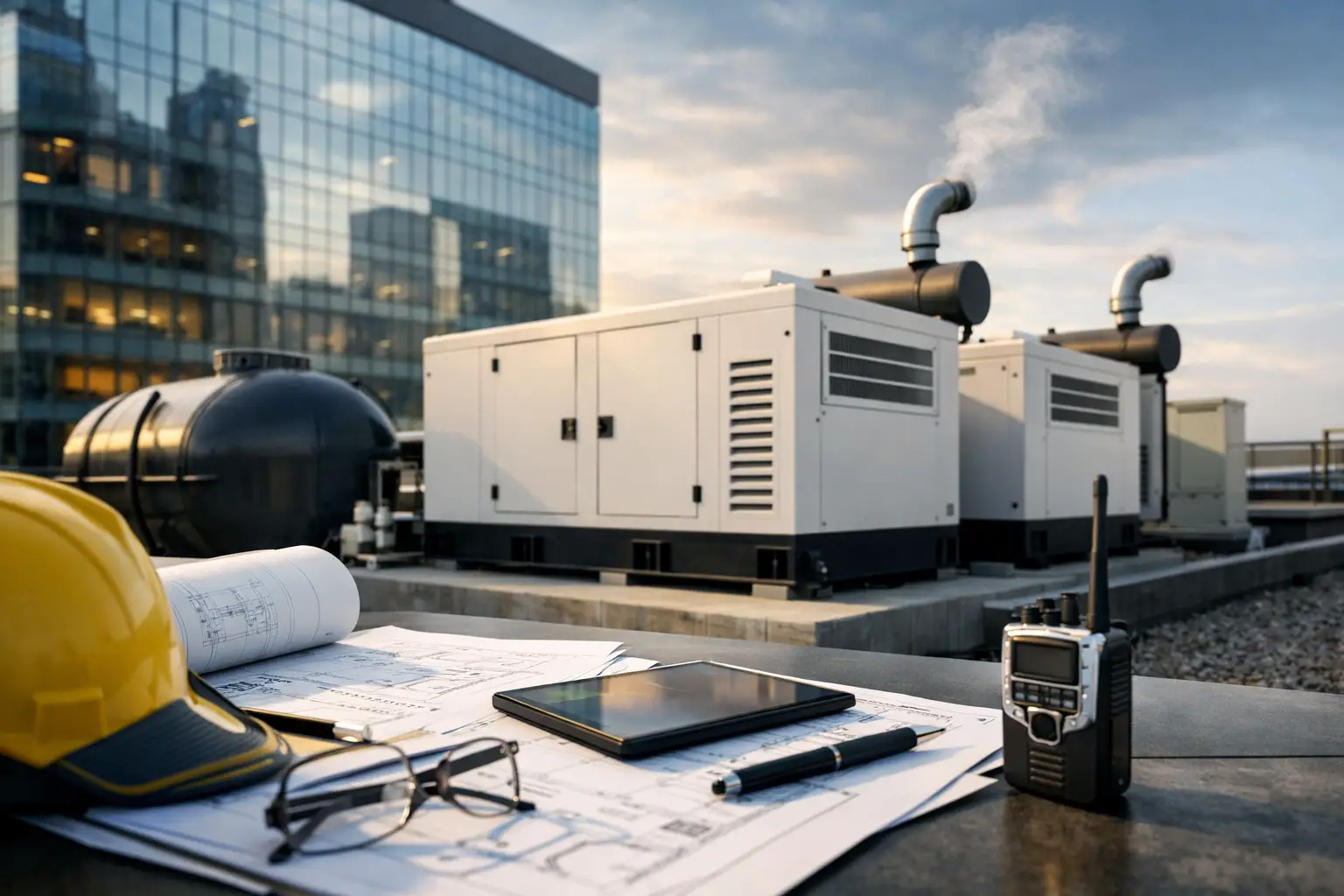
A generator that starts but cannot carry the loads that matter is not a continuity plan. It is an expensive false sense of security. Knowing how to plan backup generators means defining what must remain operational, proving the electrical design under real conditions, and assigning ownership long after construction is complete.
For commercial properties and enterprise environments, generator planning sits at the intersection of facilities, IT, life safety, physical security, tenant operations, and construction. That creates a predictable failure point: each group assumes another group has defined the requirements. A disciplined plan replaces assumptions with a documented operating standard.
Start With the Consequences of an Outage
Do not begin with generator size. Begin with the business and safety consequences of losing power. A facility may have legally required loads, mission-critical loads, and convenience loads, but those categories are not interchangeable.
Life-safety systems may need to operate under mandated conditions. Critical operations may include network rooms, access control, cameras, elevators, sump pumps, loading operations, process equipment, refrigeration, tenant systems, or a data environment. Other loads may be useful but can remain off during an outage. If every department labels its equipment critical, the project becomes oversized, costly to operate, and harder to test.
Create a written load-priority schedule with three clear levels: loads that must transfer immediately, loads that can return after stabilization, and loads that will remain disconnected during generator operation. The schedule should identify the equipment, location, electrical panel, expected power demand, acceptable outage duration, and accountable owner.
This is where facilities and IT need one standard. A network closet may appear small on an electrical drawing, but losing it can take down wireless access points, security controllers, building management connections, and tenant-facing systems across multiple floors. Conversely, not every receptacle in an office needs emergency power merely because critical systems are nearby.
Build a Load Model, Not a Nameplate Total
Generator capacity is often miscalculated by adding equipment nameplates. That approach ignores diversity, starting current, future load growth, power quality, and the sequence in which equipment starts. It can produce a generator that is too small during motor starts or too large to operate efficiently at its expected load.
A proper load study measures or estimates actual demand at each distribution point and accounts for operating conditions. Motors, pumps, compressors, elevators, and air-handling equipment can create high starting demand. Electronic loads such as servers, network equipment, and modern controls may have different power-factor and harmonic characteristics than older equipment. Variable-speed equipment changes the analysis again.
The design team should model the worst credible operating scenario, not simply a normal weekday condition. Ask what happens if the generator must start while a fire pump, sump pump, elevator, cooling system, or security system is calling for power. Determine whether loads will start simultaneously, in staged blocks, or through a managed load-shedding sequence.
Future capacity matters, but it should be intentional. Reserve capacity for planned tenant build-outs, additional network cabinets, building-system upgrades, or expanding security coverage. Do not leave growth as an undocumented assumption. A future equipment list, expected load range, and review date give leadership a basis for governing capacity instead of discovering the constraint during an emergency.
Account for the Transfer Path
The generator is only one component of the backup power system. The transfer switch, emergency distribution equipment, branch circuits, upstream service arrangement, and control logic all need to support the intended result.
A transfer switch may be correctly sized yet fail the operational requirement if it is assigned to the wrong panel, lacks bypass capability where maintenance demands it, or does not coordinate with other transfer switches. In facilities with multiple generators or multiple electrical services, the control strategy must establish which loads receive power first, what happens when one source is unavailable, and who can override automatic sequences.
For technology environments, separate utility disruption from ride-through requirements. A generator does not eliminate the brief interruption before it starts and transfers load. Systems that cannot tolerate that gap need appropriately designed battery-backed power. The battery-backed power system, generator, and transfer controls must be treated as one operating chain, not as separate purchases managed by separate vendors.
Choose Fuel Autonomy Based on Real Recovery Time
Fuel planning should answer a simple question: how long must the building operate before utility power, refueling access, or an alternate site is realistically available? The answer is rarely the same for every property.
A short-duration outage plan may support life safety, orderly shutdown, and security. A longer-duration continuity plan may need to maintain operations, tenant services, environmental controls, or critical technology for days. The required runtime drives fuel storage, delivery access, consumption calculations, maintenance procedures, and contractual responsibilities.
Fuel consumption is not fixed. It changes with generator loading, ambient conditions, testing frequency, and operating profile. A runtime calculation based on a lightly loaded test condition can be dangerously optimistic during a high-demand event. Plan for credible load, not ideal load.
Also evaluate fuel quality and logistics. Stored fuel degrades. Delivery vehicles need physical access during weather events and site disruptions. A generator may have sufficient tank capacity but still be unable to receive fuel because the loading area is blocked, access credentials are unavailable, or no one has authority to approve delivery after hours. Those are governance failures, not mechanical failures.
Plan Location, Environment, and Physical Protection
Generator location affects reliability before the unit ever starts. The equipment needs safe service access, appropriate ventilation, exhaust routing, drainage, clearances, electrical routing, fuel access, and protection from vehicles, flooding, tampering, and construction activity.
Avoid treating the exterior pad or equipment room as leftover space. Water intrusion, inadequate airflow, exhaust recirculation, snow accumulation, vibration transmission, and blocked maintenance access can all turn a compliant-looking installation into an unreliable one. For rooftop or elevated installations, structural loading, service access, noise, and fuel routing require early coordination.
Physical security belongs in the plan as well. Generator controls, transfer equipment, fuel components, and electrical rooms should not be casually accessible. Define who can enter, who can change settings, and how emergency access is logged. Remote monitoring can improve response time, but it also creates a cybersecurity and access-control responsibility. Remote visibility without controlled administration is another unmanaged doorway into the facility.
Validate the Design Before Final Acceptance
A generator project is not complete when the equipment is installed. It is complete when the system has demonstrated that it will perform the documented operating sequence under representative conditions.
Testing should go beyond a monthly no-load exercise. Commissioning needs to verify utility-loss detection, start timing, transfer timing, load sequencing, load shedding, alarms, remote notifications, battery-backed power coordination, and restoration to normal power. Where practical, test the actual critical loads or a suitable load-bank scenario that reflects expected demand.
Document failures during testing as operational findings, not inconveniences. A breaker that trips, an alarm that does not reach the right person, a cooling unit that fails to restart, or a security controller that requires manual intervention are exactly the issues the test is meant to expose.
Acceptance documentation should include one-line diagrams, panel schedules, generator and transfer-switch settings, load-study assumptions, sequence-of-operations documents, test records, warranty information, maintenance requirements, fuel procedures, and emergency contacts. Store it where facilities, IT, security, and leadership can access the current version during an event.
Assign One Owner for the Whole System
Backup power fails most often at organizational handoffs. The electrical contractor may own installation, facilities may own maintenance, IT may own the loads, security may own access systems, and a third party may receive alarms. Without a defined operating model, nobody owns the outcome.
Assign an accountable owner for backup-power readiness, supported by named technical owners for electrical equipment, fuel, critical-load inventory, monitoring, and emergency response. Review the critical-load schedule whenever tenants change, equipment is added, panels are modified, or operating priorities shift. A generator sized correctly five years ago may be wrong after a server-room expansion, security upgrade, or building-system modernization.
Run an annual scenario review with the people who will actually respond. Walk through a utility outage at night, a fuel delivery delay, a failed transfer switch, and a generator alarm that occurs while the facility is partially occupied. The goal is not paperwork. The goal is to expose decision gaps before a real outage forces them into public view.
A backup generator earns its place in the building only when its capacity, controls, fuel, documentation, and ownership all support the same promise: critical operations remain available when normal power does not.