
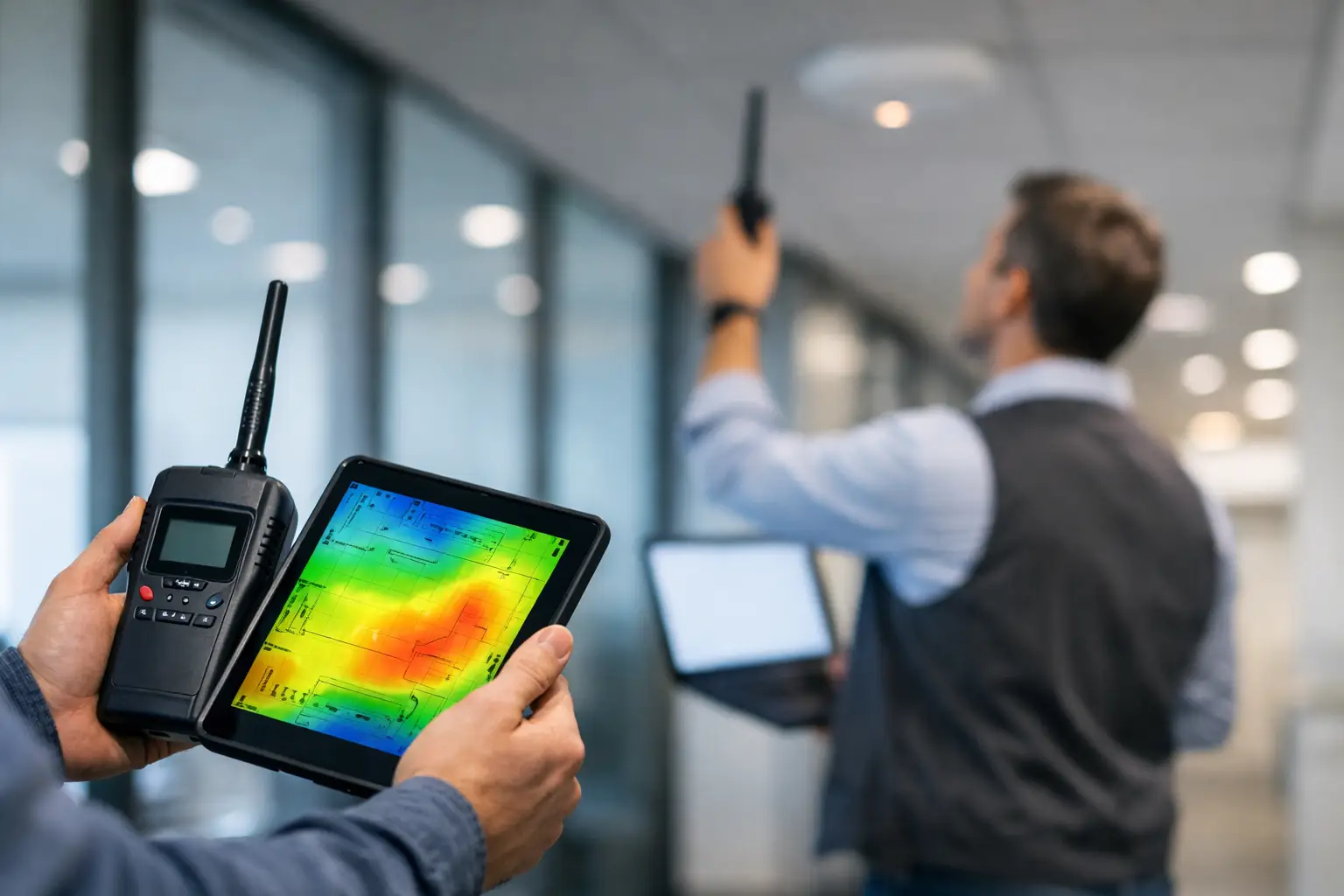
A conference room can show five bars on a phone and still fail the business. Add 30 laptops, wireless presentation devices, video calls, badge readers, and a crowded neighboring suite, and the apparent signal strength tells only a small part of the story. An enterprise wifi site survey is the field validation that determines whether a wireless design will support the people, systems, and operating conditions inside a real commercial building.
That distinction matters because wireless failures are rarely owned by one party. The cabling contractor may say the drops were installed. The network team may say the access points are online. The property team may point to concrete, glass, elevators, or tenant changes. Meanwhile, users experience dropped calls, slow applications, unreliable building systems, and a support process built around handoffs.
A proper survey creates a shared standard before those handoffs become excuses. It turns assumptions about floor plans and radio coverage into measurable acceptance criteria.
An Enterprise WiFi Site Survey Is Not a Walkthrough
A walkthrough has value. It identifies likely telecom room locations, construction constraints, pathways, ceiling access, electrical needs, and areas that may need special attention. It is not, by itself, a wireless survey.
A survey measures radio-frequency behavior in the actual environment. The work may occur before construction, after construction, or both. The right approach depends on the project stage, the risk of rework, and whether the facility already has active users and wireless systems.
Predictive surveys set a design direction
A predictive survey uses floor plans, building materials, ceiling heights, intended access-point locations, and estimated user demand to model coverage and capacity. It is useful early, when cable pathways, mounting locations, and telecom room decisions can still be corrected without opening finished walls.
But a model is only as reliable as its inputs. Plans may omit high-density shelving, metallic film on glass, concrete shear walls, mechanical equipment, specialty ceilings, or tenant improvements that change how radio signals travel. Predictive design is a disciplined starting point, not proof of performance.
Passive surveys reveal the existing radio environment
A passive survey listens to the wireless environment. It maps signal levels, noise, channel use, overlapping networks, and sources of interference. In an occupied building, this can reveal that the problem is not weak coverage at all. It may be congested channels, poor access-point placement, excessive transmit power, or interference from equipment that was never considered in the original design.
Passive findings are especially valuable during acquisitions, tenant turnovers, and remediation work. They expose inherited conditions before an organization commits to a design based on incomplete documentation.
Active surveys test the experience that matters
An active survey connects to the network and tests performance. It can measure throughput, packet loss, latency, roaming behavior, and application-relevant performance while a device moves through the facility.
This is the test that separates “the network is visible” from “the network works.” A coverage heat map cannot prove that a voice call maintains quality while moving between access points, or that a mobile workflow remains usable in a loading area. Where mobility is part of operations, active testing should be part of acceptance.
Start With Business Requirements, Not Access-Point Counts
The question is not how many access points a floor needs. The question is what the wireless network must reliably support, where, and under what load.
An executive office floor, a training center, a warehouse, a medical-adjacent workspace, and a mixed-use lobby have different performance requirements. A loading dock may need dependable mobile connectivity for operations. A conference center may need high client density for short periods. A mechanical area may have low user density but support connected controls that cannot tolerate intermittent communication.
Before survey work begins, establish requirements for coverage areas, user density, client types, critical applications, mobility, guest access, building systems, and security segmentation. Also identify spaces where service is not required. That prevents both overbuilding and vague expectations.
The requirements should answer practical questions: How many concurrent clients are expected during peak use? Will users roam during voice or video sessions? Are wireless devices supporting physical security, facilities operations, inventory, or tenant services? Is coverage needed in stairwells, garages, roof areas, exterior courtyards, or only occupied interior space?
This is where accountability begins. If no one owns the requirements, no one can credibly accept the outcome.
What the Survey Must Measure
Signal strength is one metric, not the standard. A credible survey evaluates multiple conditions together because a strong signal can still produce poor service.
Coverage measures whether the intended service level reaches required locations. Capacity examines whether the network can handle the expected number of active devices, not merely detect them. Channel planning checks whether neighboring access points compete with one another. Interference analysis looks for non-network signals and crowded radio conditions that reduce usable airtime.
Roaming requires separate attention. A client device decides when to leave one access point and join another, but network configuration and physical placement strongly influence whether that transition is stable. Poor roaming can surface as frozen calls, stalled scanning workflows, or devices that cling to a distant access point even when a closer one is available.
The survey should also account for both common wireless bands where applicable. Higher-frequency service can provide more capacity but generally covers less area and is more affected by walls and obstructions. Lower-frequency service may travel farther but can become crowded. There is no universal setting that resolves this trade-off. The design must match the building and workload.
The Building Is Part of the Network
Commercial real estate teams often inherit a false separation between “the building” and “the network.” In practice, the built environment determines wireless performance.
Concrete, masonry, steel framing, elevator shafts, low-emissivity glass, dense storage, refrigeration equipment, and water all affect propagation. Ceiling type affects mounting choices. Fire-rated assemblies affect pathway decisions. Telecom room location affects cable distance and maintenance access. Even a tenant’s future furniture plan can alter performance in a high-density area.
This is why a survey should be coordinated with facilities, construction, security, and operations, not handed off as an isolated IT task. The team needs current floor plans, reflected ceiling plans, construction material information, anticipated occupancy, and known changes that could alter the design.
A survey completed before major tenant improvements may need validation after the space is furnished and occupied. That is not wasted work. It is a recognition that the physical environment changed and the acceptance standard still applies.
Define Acceptance Before Installation
The most expensive wireless survey is the one performed after complaints begin. By then, ceiling access may require disruption, cable extensions may be costly, and every stakeholder has an incentive to describe the issue as someone else’s responsibility.
Define acceptance criteria in advance. They should identify required areas, minimum performance targets, expected client density, acceptable roaming behavior, and the test conditions used to validate the result. They should also state who receives the documentation, who reviews exceptions, and who has authority to approve remediation or final acceptance.
Final deliverables should include annotated floor plans, access-point locations, configuration assumptions, cabling identifiers, survey results, identified exceptions, and a record of corrective actions. A screenshot of a heat map is not enough. Operations teams need documentation they can use during a tenant change, incident investigation, renovation, or technology refresh.
The same discipline applies to changes after turnover. A new partition wall, a relocated access point, an added camera network, or a neighboring tenant’s wireless deployment can change conditions. Maintain an inventory and a change record so that the next problem can be investigated from facts rather than memory.
Common Failure Patterns to Catch Early
Several failure patterns appear repeatedly in commercial environments. Access points are installed where cabling was easiest, not where radio design required. Designs target general coverage but ignore peak client density. Equipment is mounted above obstructions or inside enclosures that reduce performance. Survey work is done against outdated plans. Final testing occurs in an empty building, then occupancy exposes a capacity problem.
Another frequent issue is treating wireless as isolated from the wired network. An access point can have excellent radio conditions and still underperform because of inadequate switching capacity, incorrect port configuration, power limitations, poor uplink design, segmentation errors, or weak identity controls. The survey cannot replace end-to-end network validation. It provides the radio evidence needed to complete it.
For facilities with operational technology or physical security devices, the stakes are higher. Wireless reliability may affect credential workflows, mobile maintenance tools, cameras, sensors, or building operations. Those dependencies should be documented and tested as business services, not treated as incidental devices on a shared network.
Make Survey Results an Operating Control
An enterprise wifi site survey should not disappear into a project folder after installation. It should become part of the building’s operating baseline.
Keep the survey record with current floor plans, telecom room documentation, cable records, network diagrams, and change approvals. Revisit it when occupancy changes materially, a tenant renovates, critical wireless workflows expand, or performance complaints show a recurring pattern. The interval is not fixed because buildings and usage patterns do not change on a fixed schedule.
The practical goal is simple: one documented standard, one accountable review process, and evidence that the wireless environment supports the work expected of it. When a building changes, validate the network against that standard before users are forced to discover the gap for you.