
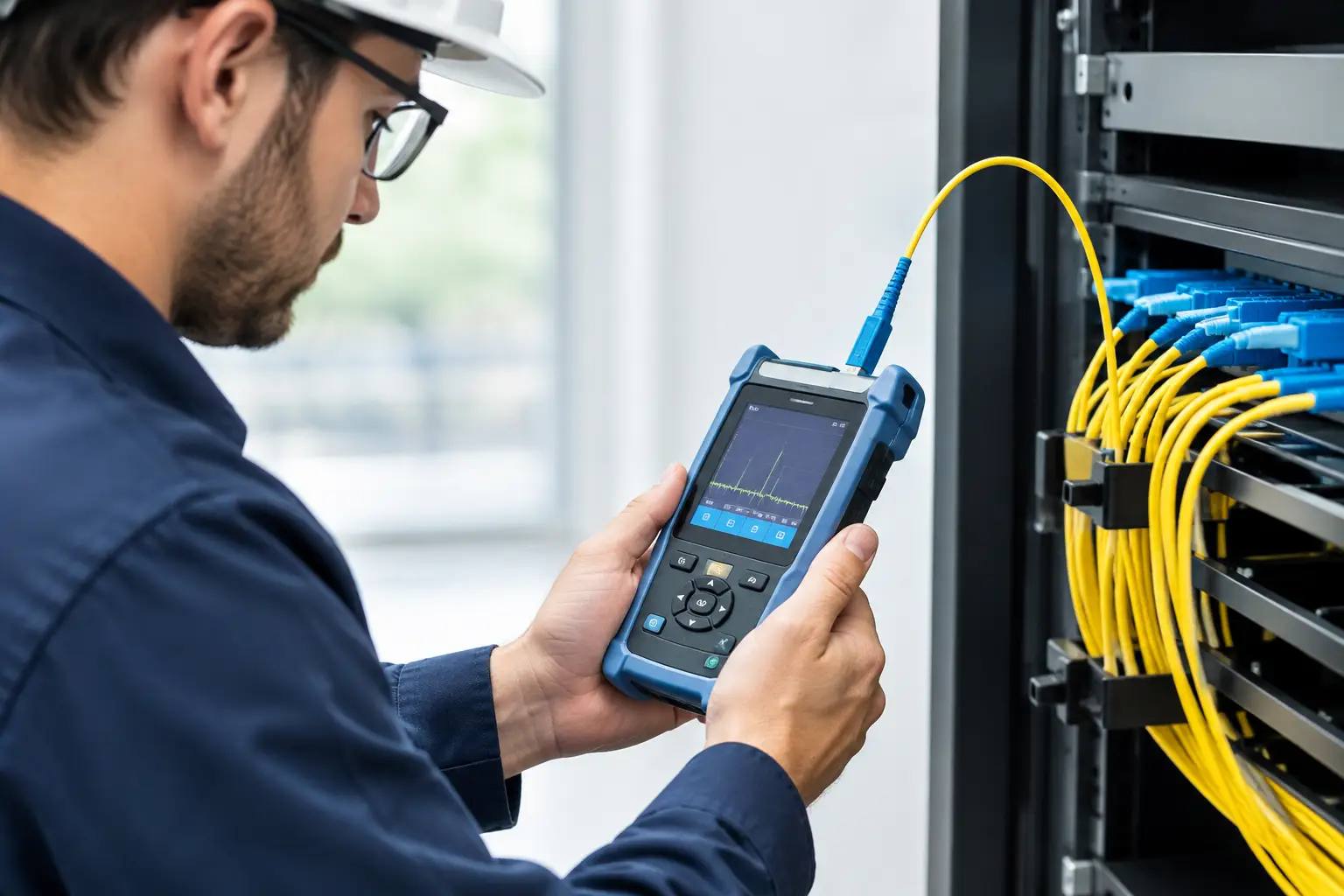
A fiber link can look finished long before it is ready for operations. The cable may be dressed neatly, labeled at both ends, and connected to active equipment, yet still contain contamination, excessive loss, a bad splice, a crushed section, or a connector that will fail after the ceiling is closed. Fiber testing services turn that uncertainty into evidence. They establish whether installed infrastructure meets its intended performance standard and whether someone has accepted responsibility for the result.
For commercial properties and enterprise environments, this is not a cabling closeout detail. Fiber supports network connectivity, Wi-Fi backhaul, access control, cameras, building systems, tenant services, and data center operations. When the test record is incomplete or misunderstood, the organization inherits a hidden defect along with the new installation.
Why Fiber Failures Become Ownership Failures
A fiber issue rarely arrives as a clean ticket saying that a specific connector has high loss. It appears as intermittent camera outages, a network switch dropping uplinks, unstable wireless service, slow application performance, or a building system that cannot communicate with its controller. Then the handoffs begin. The facilities team calls IT. IT calls the network provider. The provider points to the physical layer. The installer says the work was completed months ago.
That sequence is expensive in time and confidence because the acceptance process failed. The question is not merely whether the cable was pulled. The question is whether the link was tested against a defined requirement, documented in a usable form, reviewed by an accountable party, and tied to the correct locations and labels.
Fiber is especially vulnerable to this gap because problems can be invisible. A bend hidden above a ceiling may not fail immediately. A dirty connector may pass limited traffic during installation but introduce errors under normal operation. A link can also test differently after equipment is moved, patching is changed, or environmental conditions shift. Good testing does not eliminate every future incident. It makes the baseline clear, so teams can distinguish a new failure from an inherited one.
What Fiber Testing Services Should Actually Verify
Not every project requires the same test plan. A short multimode connection inside a telecom room has different risks than a long single-mode run between buildings. The required evidence depends on the fiber type, link length, connector design, application speed, construction scope, and the standard specified for the project.
At a minimum, the testing approach should answer two operational questions: Can this link support the intended service today? Can a future team identify and troubleshoot it without reconstructing the entire installation history?
Certification testing measures usable performance
Certification testing typically measures insertion loss across the complete channel or permanent link. It confirms whether total signal loss falls within the calculated allowance for that design. This is the acceptance test that provides a clear pass or fail against an agreed limit.
The detail matters. Results should identify the test method, reference method, wavelengths, fiber type, link identifiers, measured loss, applicable limit, and pass or fail status. A spreadsheet that simply says every cable passed is not enough. It cannot tell an operations team which test applies to which physical path, nor can it support a later investigation.
OTDR testing shows where loss is occurring
An optical time-domain reflectometer, commonly called an OTDR, traces events along the fiber. It can help locate breaks, splices, sharp bends, and high-loss connectors. This test is valuable for diagnosing a problem and documenting longer outside-plant or backbone pathways.
But an OTDR trace is not automatically a substitute for end-to-end loss certification. It sees events from one direction and interprets reflections and loss along the route. Bidirectional testing may be needed where splice loss must be characterized accurately. The right question is not, “Was an OTDR used?” It is, “Does the test method prove the requirement for this link?”
Inspection and cleaning are part of the test
Fiber end faces must be inspected and cleaned before connection and testing. This is basic discipline, yet it is frequently skipped when schedules are tight. Dust, oil, or damage at a connector can create loss, reflectance problems, and intermittent behavior that looks like an equipment failure.
A team that tests without inspecting can generate misleading results. A team that cleans without inspecting cannot confirm whether damage remains. The process should be inspect, clean if needed, inspect again, then connect. That control belongs in the field procedure, not only in a training manual.
Define the Acceptance Standard Before Installation
The worst time to decide what proof is required is after the installer has demobilized. Testing requirements should be defined during design and carried through procurement, construction, and closeout. Otherwise, each party applies its own definition of complete.
The acceptance standard should identify the links that require testing, the required test types, the performance limits, the labeling convention, and the format of final records. It should also state who reviews the results and who has authority to reject incomplete evidence. This is where one standard protects the project from fragmented ownership.
For example, a project may require loss certification on every installed strand, OTDR traces for backbone fiber, and visual inspection records for critical connections. Another project may need different controls because it is extending an existing system with known constraints. There is no benefit in ordering tests that do not match the operational risk. There is even less benefit in accepting a generic report that does not match the design.
The standard should also account for spare fibers. Spare strands are often treated as future capacity and left untested. That creates a problem later, when a planned expansion discovers that the supposed spare is unusable. If a strand is part of the asset being accepted, test it, label it, and include it in the record.
Treat Test Results as Operating Documentation
A test report should be usable by people who were not present during construction. That means it needs context. Each fiber identifier should map to a consistent naming scheme, physical endpoints, rooms or cabinets, panel positions, and strand numbers. Test results without accurate labels are evidence with no reliable chain of custody.
The closeout package should include updated drawings, rack and panel schedules, pathway information where relevant, fiber types, connector types, and the final test files in their native format as well as a readable report. Native files matter because they preserve the underlying test data and allow qualified teams to review settings or compare future readings.
This is also the point to verify that field labels match the documentation. A perfectly tested link with mislabeled endpoints still creates operational risk. Technicians patch the wrong port, emergency teams lose time tracing services, and moves or changes become guesswork. Physical infrastructure and documentation must agree.
Common Gaps That Create Future Downtime
The most damaging failures are usually not technical mysteries. They are controls that were omitted or waived without a clear owner. Watch for these recurring gaps:
- Test reports that show only summary pass results, with no strand-level identifiers or performance values.
- Testing completed before final termination, patching, or remediation work changed the link.
- Missing records for spare fibers, cross-connects, inter-building links, or tenant handoff points.
- Labels that do not match drawings, panel schedules, or the names used by network operations.
- Test files held by an installer, consultant, or subcontractor rather than delivered into the owner-controlled record.
None of these issues necessarily means the fiber is defective. They mean the organization cannot prove the condition of the asset it is accepting. That distinction matters when an incident occurs and multiple vendors are involved.
A Practical Review Before Final Acceptance
Before signing off, assign one accountable reviewer to compare the test package against the design and field conditions. That reviewer does not need to perform every test personally. They do need the authority and competence to ask whether the evidence is complete.
Start with coverage: are all required strands and pathways represented? Then confirm compliance: did every result meet the specified limit, and are failures clearly identified as corrected and retested? Finally, verify operability: do labels, drawings, and endpoint records allow an operations team to find the link without relying on an installer’s memory?
For occupied buildings, this review should include the services riding on the fiber. A backbone supporting security, tenant connectivity, and building controls may require coordinated validation after cutover, not just a cable test. The fiber can pass while the overall service still fails because of incorrect patching, port configuration, or undocumented dependencies. Physical acceptance and service validation are related controls, but they are not the same control.
Make the Baseline Work After Day One
Fiber testing services deliver their greatest value when results become part of lifecycle governance. Keep the records where facilities, IT, security, and operations teams can retrieve them. Use the baseline when evaluating a suspected fault, planning capacity changes, reviewing contractor work, or investigating recurring instability.
When work is performed later, require the same discipline: identify affected links, protect live services, retest changed paths, update documentation, and return the evidence to the owner-controlled record. A new patch panel, cabinet relocation, or tenant build-out can quietly break the integrity of earlier documentation.
The goal is not a larger closeout binder. It is a building technology environment with known conditions, clear accountability, and fewer opportunities for vendors to pass a physical-layer problem across the table. Test the fiber, retain the evidence, and make acceptance a decision someone is prepared to own.