
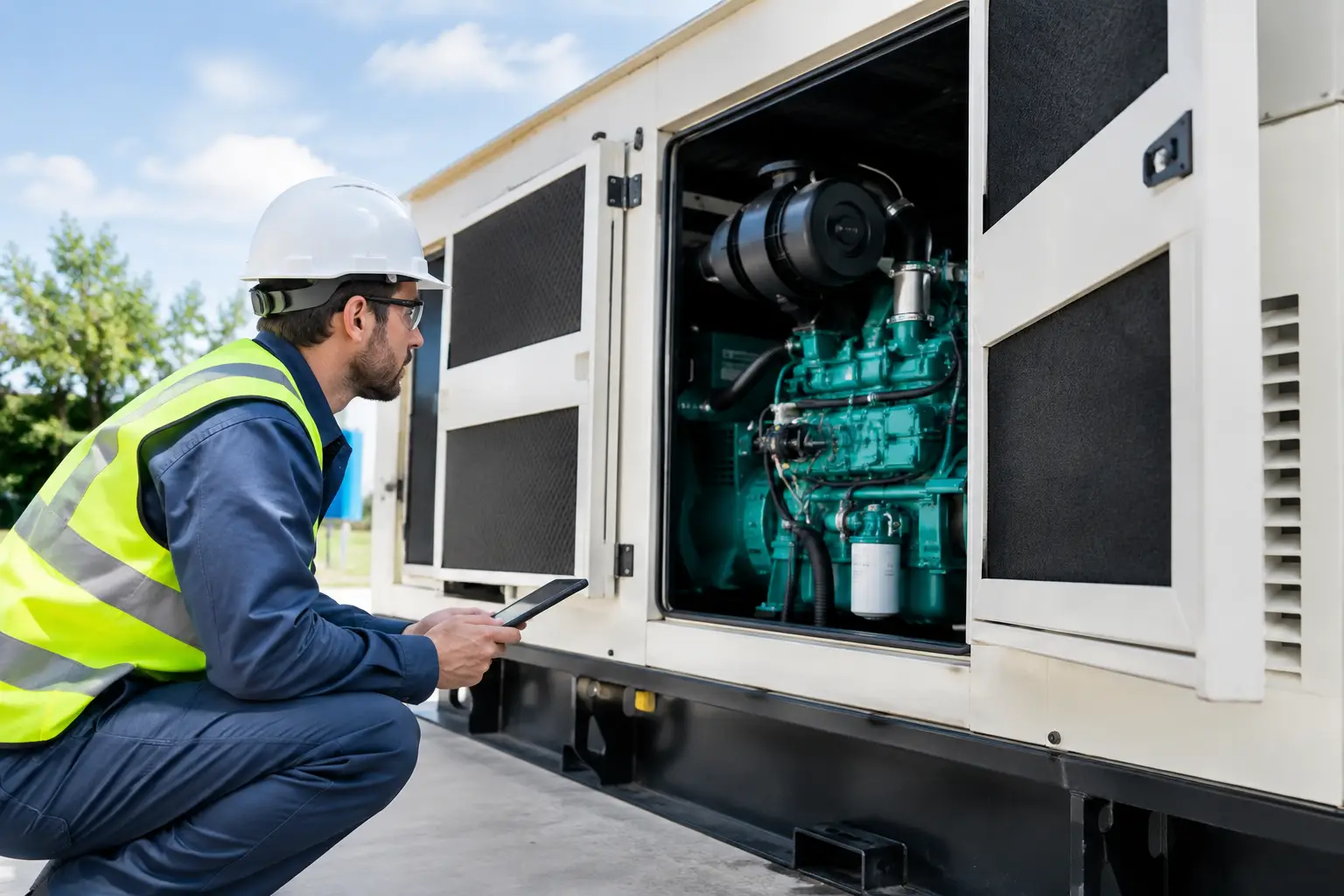
A generator that starts for ten minutes in an empty parking lot has not proved it can carry a building through an outage. It has proved only that the engine can start. When test backup generators is the question, the better answer is: test them often enough to expose failure before the utility does, and under conditions that resemble the loads your operation actually depends on.
For a commercial property, generator readiness is not just a facilities task. It affects life safety systems, access control, network closets, fire and security infrastructure, tenant operations, elevators where applicable, refrigeration, and the people expected to manage a disruption. A missed test can leave an ownership gap hidden until a storm, utility fault, or construction incident turns it into downtime.
When to Test Backup Generators
There is no single calendar interval that fits every building. A small standby unit supporting limited life safety loads has different exposure than a generator serving a data environment, a medical tenant, a connected mixed-use property, or a facility with 24/7 operations. The testing schedule should reflect criticality, run hours, fuel type, environmental conditions, manufacturer requirements, local code, and the consequences of failure.
As an operating baseline, facilities teams commonly perform a visual inspection and exercise the generator monthly. That routine should confirm the unit starts automatically, reaches normal operating condition, records no active alarms, and has no obvious fuel, coolant, oil, battery, exhaust, or enclosure issues. Monthly exercising matters because standby equipment fails quietly. Batteries lose capacity, fuel degrades, control settings change, heaters fail, rodents damage wiring, and small leaks become real problems.
But monthly no-load exercise is not enough for most commercial environments. The generator also needs periodic testing under meaningful load. A load test reveals issues that an unloaded engine may conceal: overheating, unstable voltage or frequency, transfer switch faults, fuel delivery restrictions, exhaust limitations, and poor performance under sustained demand.
The exact cadence should be documented in a site-specific maintenance plan. Do not rely on a technician's recurring visit as the plan. The plan should state what gets tested, at what load, for how long, who observes each connected system, what results are acceptable, and who owns corrections.
Exercise Is Not the Same as a Load Test
Teams often use these terms interchangeably. That creates false confidence.
An exercise test confirms the engine can start and run. Depending on the configuration, it may run without transferring building load to the generator. It is useful for identifying basic mechanical and control problems, but it does not validate the full emergency power path.
A building-load test transfers selected loads from utility power to generator power. This tests more of the chain: the generator, automatic transfer switch, distribution equipment, control logic, and the actual devices supported by emergency power. It also shows whether the building experiences the expected interruption and recovery behavior.
A supplemental load-bank test applies a controlled external load when the building cannot safely provide enough demand. It can help exercise the generator at a higher percentage of rated capacity and reduce problems associated with lightly loaded diesel operation. However, a load bank cannot fully prove that the transfer switch, emergency panels, branch circuits, and connected building systems will behave correctly during a real event.
The practical answer is often both. Use building-load tests to validate the end-to-end power path. Use a load bank when required by the maintenance strategy, operating profile, or equipment guidance. Treat neither test as a substitute for the other without documenting why.
Test the Entire Emergency Power Chain
A generator is one component in a larger system. Building leaders should ask a more useful question: what must remain operational, and has every dependency been tested?
For example, an access control server may be on emergency power while the network switch serving its doors is not. A telecom room may have a UPS, but the circuit feeding that UPS may not be on generator-backed power. A security operations workstation may remain on, while the internet connection, camera storage, or door controller loses power. These are not generator failures. They are design, inventory, and acceptance failures.
Before a planned transfer test, identify the loads expected to remain available. Confirm the electrical one-line, emergency panel schedules, transfer switch designations, and critical-load inventory agree. If they do not, the documentation is not a record of reality. Update it before the next outage makes the discrepancy operational.
The test should include observers from the groups that own affected systems. Facilities personnel should watch generator, fuel, and transfer equipment. IT should validate network availability, UPS behavior, servers, and communications rooms. Security should verify cameras, access control, intrusion detection, and monitoring. Operations should confirm the business processes that matter most. One test coordinator should own the schedule, communications, evidence, exceptions, and corrective-action log.
Plan Tests So They Do Not Create Their Own Outage
A well-run generator test is controlled disruption. It should not surprise tenants, security staff, IT teams, elevator service providers, or other affected parties.
Start with a written runbook. It should define the maintenance window, systems expected to transfer, systems that should not be interrupted, escalation contacts, stop conditions, restoration steps, and the procedure for returning to utility power. If a test affects life safety, consult the applicable authority requirements and ensure required notifications are made.
Review recent changes before testing. New tenant improvements, panel modifications, network upgrades, security expansions, and changes to fuel delivery arrangements can all alter the risk. A transfer switch may serve a different load profile than it did a year ago. A circuit labeled as noncritical may now feed a critical device because someone made a local change without updating the drawings.
During the event, measure rather than assume. Record start time, transfer time, voltage, frequency, load percentage, engine temperature, oil pressure, battery condition, alarms, fuel level, and return-to-utility behavior. For critical technology systems, record whether equipment restarted normally, whether UPS units remained within tolerance, and whether communications recovered as expected.
A clean result is not simply “generator ran.” A clean result means the expected loads transferred, stayed available for the required duration, returned to normal without error, and left no unresolved alarms or operational exceptions.
Common Failures That Testing Exposes
The most useful tests uncover uncomfortable facts while there is time to fix them. Weak starting batteries are common, particularly where battery charging or replacement is treated as a calendar task instead of a measured condition. Fuel issues are also frequent. Diesel fuel can accumulate water and contamination, while fuel supply arrangements can fail because of inaccessible fill points, inaccurate gauges, or unclear resupply responsibilities.
Transfer equipment deserves equal attention. A generator can perform perfectly while an automatic transfer switch fails to initiate, hesitates, transfers only part of the intended load, or does not return cleanly to utility power. Control wiring, sensing settings, breaker conditions, and interlocks all need verification.
Then there are human failures: no current single-line diagram, no list of emergency loads, no owner for corrective action, or no evidence that a prior deficiency was ever closed. These failures are especially dangerous because they persist across vendor visits and personnel changes. Fragmented service relationships make it easy for everyone to report a limited scope and nobody to own the outcome.
Build Accountability Into the Test Record
Testing has value only when results drive action. Maintain a test record that captures the date, scope, load condition, readings, alarms, participants, system observations, deficiencies, assigned owner, due date, and closure evidence. Attach updated drawings, photographs, and control screenshots when changes are made.
Classify deficiencies by operational impact. A cosmetic enclosure issue does not belong in the same category as a failed transfer switch, low battery capacity, fuel contamination, or an emergency panel that does not support the systems leadership believes it supports. Critical findings need a defined interim control if repair cannot happen immediately. That may include temporary monitoring, portable backup arrangements, adjusted staffing, or a planned outage until permanent correction is complete.
Review the record after every test, not just annually. Repeated low-load operation, recurring alarms, delayed transfers, fuel-quality concerns, or unexplained differences in load readings are trends. They deserve engineering attention before they become a no-start event.
Make Generator Testing Part of Continuity Governance
Backup power is often managed as isolated mechanical equipment. That approach misses the point. The generator exists to preserve operations, and operations depend on physical infrastructure, technology, security controls, vendors, people, and documented decisions working together.
Set the schedule based on risk, prove performance under real conditions, and give one accountable owner authority to close the gaps the test reveals. The best time to find out what emergency power does not support is during a planned test, with the right people in the room and a clear path to correction.